
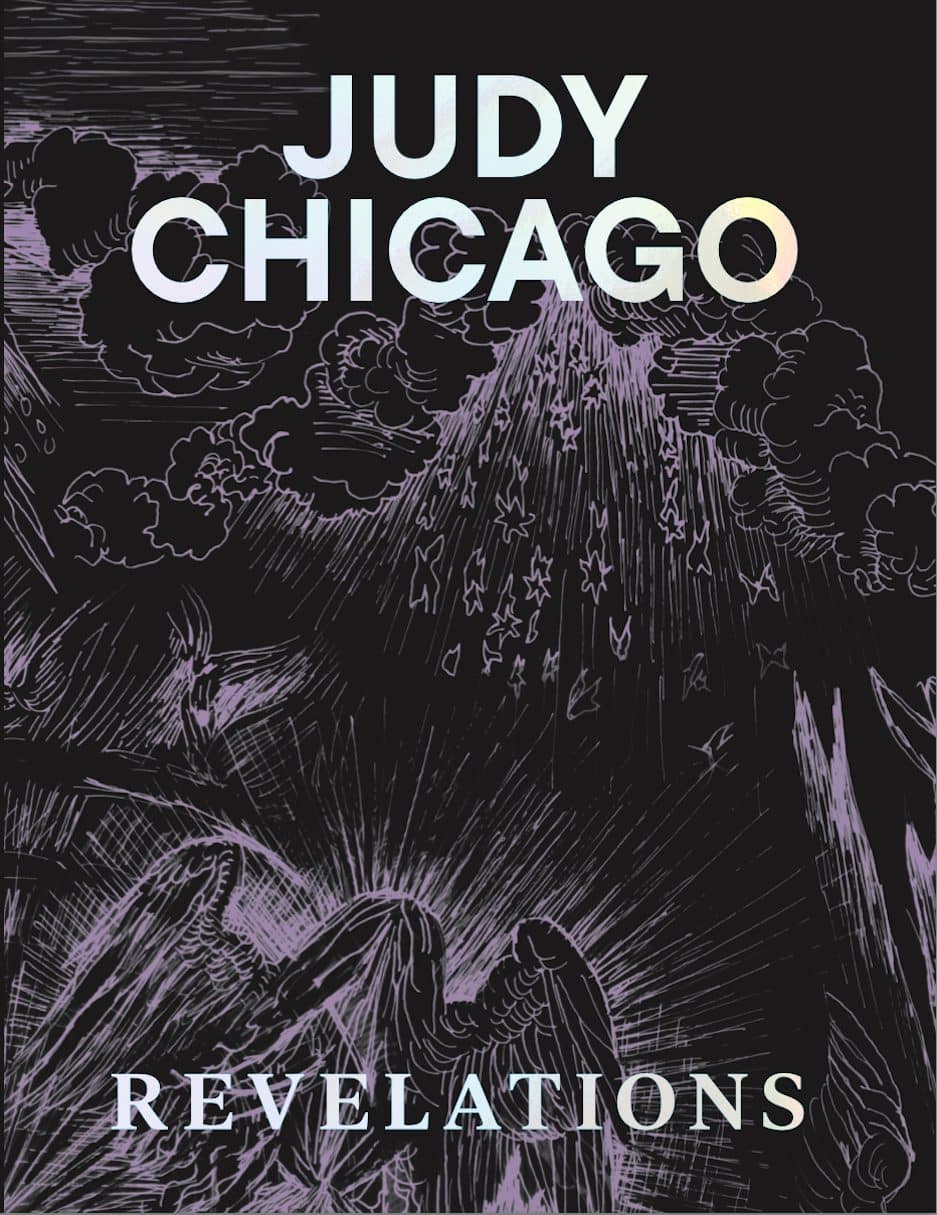
“Judy Chicago: Revelations” is published jointly by Serpentine and Thames & Hudson, to coincide with the artist’s first large-scale institutional show in London. The book serves as an extraordinary revelation of the breadth and longevity of the artist’s work over many decades on women and their place in our shared history.
Long concealed from public view, “Revelations” radically reimagines the course of our species’ history, giving women voice and visibility. It emerged around the same period as her landmark piece The Dinner Party (c.1974-79) and will be key to unlocking much of Chicago’s subsequent practice. Informed by her lifelong study of female deities and women’s history, the book delivers a strikingly beautiful and richly decorated account of 50 years of the artist’s output.
Commissioned by and created in collaboration with the artist, the book was designed by Jessica Fleischmann and Phil Kovacevich, with additional writing by Serpentine’s Associate Exhibitions Curator Chris Bayley and academic Martha Easton. An extensive conversation with the artist by Serpentine’s Artistic Director, Hans Ulrich Obrist, is also included. As a whole, the book mirrors and amplifies the content of the artist’s manuscript.
Since emerging onto the art scene in the final years of the 1960s, Judy Chicago (b.1939) has remained a formidable figure who refuses to accept the status quo of a patriarchal art world. Through her rigorous application of craft techniques and a willingness to push the boundaries of her medium, she has explored the subjects of birth, manhood, Judaism, strength, demise and environmentalism. Throughout her 60+ year career, Chicago has sought to centre the role of women in our history, fighting against their erasure from the West’s historical record.
This exhibition at the Serpentine Gallery serves as a powerful reminder of the artist’s impact on the field. Spanning the largest ever exhibition of the artist’s work to take place in a London venue, the display follows the structure of the Revelations book and features rare loans, works from her formative years in the 1960s and 70s (including abstract and minimalism), as well as a stunning video projection of her durational works utilizing colored smoke and pyrotechnics. Works executed as part of the development of her key installations, including The Dinner Party, Birth Project and PowerPlay, are presented, together with a wide range of drawings, notes and other materials documenting the artist’s processes and scholarship.
Through this beautifully produced volume, we learn far more about the artist’s tireless campaigning for social change through her artistic practice. Not only does “Revelations” provide an unrivalled resource to understand the origins and trajectory of the artist’s output, but it also pays tribute to one of the greatest living exponents of women’s inclusion in the arts. Any lover of modern and contemporary art should read this.