
Made In Ancient Egypt, running until 12 April, is the first-ever exhibition to focus on the identities, skills and working practices of the people who made the artefacts through which successive dynasties of Pharaohs expressed their royal magnificence.
The word Hemut, carved in hieroglyphs on a stone fragment from an Egyptian pyramid, has been deciphered as a collective signifier for craftspeople and artists.
Together with a small sketch of a mason at work, the 4,000-year-old stone serves as the portal into a groundbreaking exploration of the backstory of Pharaonic Egypt at the University of Cambridge’s Fitzwilliam Museum.
Complementing objects from The Fitzwilliam’s own world-class Egyptology collection, the show brings together loans from The Louvre, the Egyptian Museum in Berlin, the Rijksmuseum van Oudheden in Leiden, as well as several other British university collections.
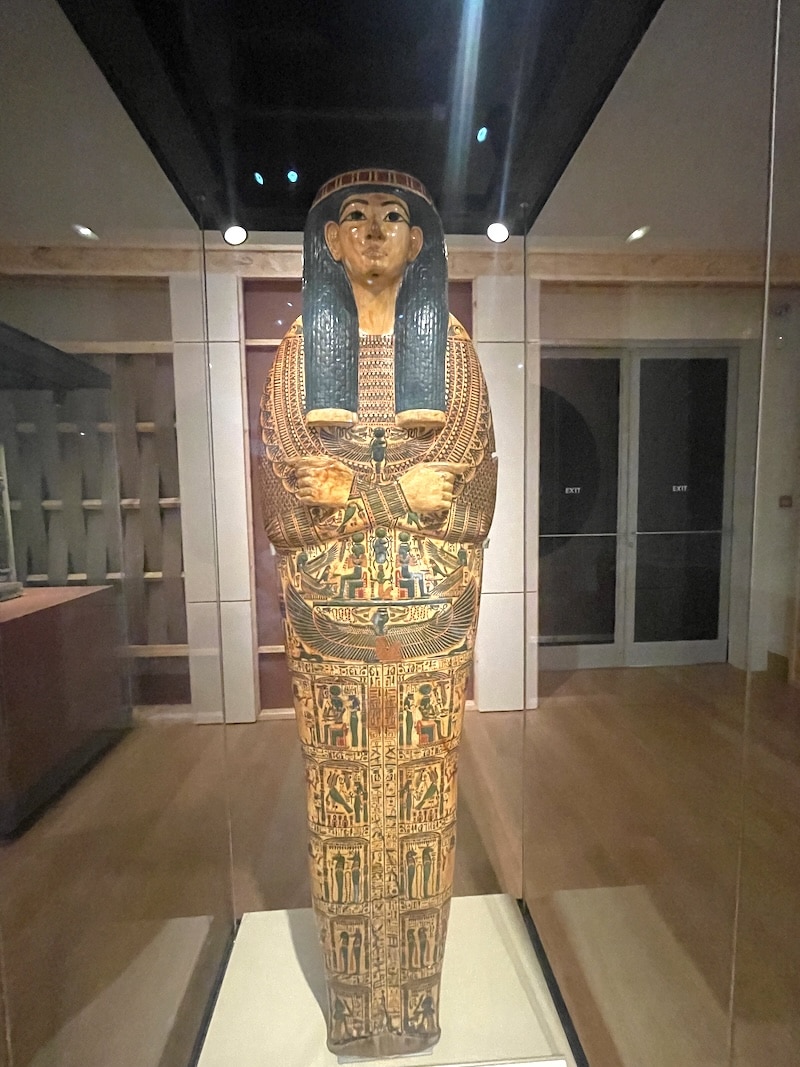
Painted mummy board from the coffin of Nespawershefyt, dating from about 1,000 BC Photo Claudia Barbari © Artlyst 2025
Star attractions from the Fitzwilliam collection include a richly painted mummy case of the Theban priest Nakhtefmut, dating from about 900 BC. From the Egyptian Museum in Berlin comes an unfinished statuette of King Akhenaten (c 1350 BC), husband of Nefertiti and father of Tutankhamun.
But more than the objects themselves, the show explores the lives, methods, and technologies of the sculptors, painters, woodworkers, glassmakers, weavers, jewellers, carvers, and potters who, across three millennia, created an iconic civilisation. Rather than competing with now familiar blockbusters like the Tutankhamun exhibition at the newly opened Grand Egyptian Museum in Cairo, it aims to tell previously untold stories.
Based on research carried out at the Fitzwilliam Museum and other institutions worldwide, the show is the product of “14 years looking at ancient Egyptian objects from the inside out rather than the outside in”, says Helen Strudwick, senior curator of the museum’s Egyptian antiquities collection.
Nakhtefmut’s mummy case is a case in point, a classic example of the body-shaped moulding known as cartonnage, embodying a complex combination of skills and techniques. Close scientific analysis, using state-of-the-art tools — X radiography, CT scanning, microscopy, organic residue analysis and advanced technical imaging — shows how its makers worked linens soaked in layers of plaster-like pastes, animal glue, an array of pigments, varnish and gold leaf to shape, carve, inlay and paint, in incredible detail, a coffin fit for eternity.

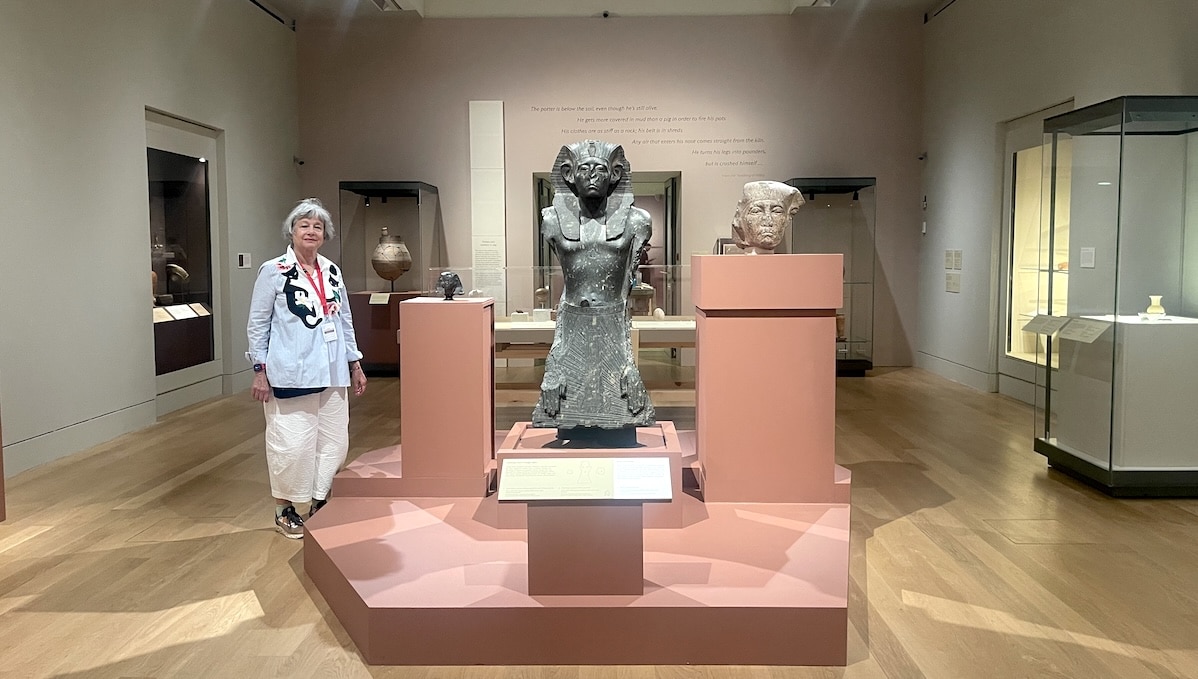
Statue of a 12th dynasty pharaoh Photo Claudia Barbari © Artlyst 2025
The unfinished stone statuette of Akhenaten shows the chisel marks of its sculptor and the inked lines of his intended carving. In a nearby room are displayed tools and preliminary plaster casts from the workshop of the royal sculptor Thutmose, excavated from his private studio and villa in the king’s purpose-built (and short-lived) capital city of Amarna.
The excavated objects bear witness to a social structure in which Thutmose, as a master sculptor, oversaw a studio of assistants, “just like Raphael, or Peter Paul Rubens…an artistic entrepreneur” running a small business and collecting commissions from royalty and other elite clients, say art historians Alessio Delli Castelli and Dimitry Laboury in the show’s catalogue.
The sculptors’ room is the first in a series of themed spaces illustrating the multiplicity of crafts that evolved in the parched desert and lush Nile valley of ancient Egypt: There’s a space for furnace workers – ceramicists, glassmakers, metal smiths; other spaces for jewellers, woodworkers, paint and papyrus makers, coffin makers, spinners and weavers.
Rich, earthy background colours are a reminder of the baked desert landscape. Sonic effects add to an immersive experience: the sizzle of fire for the kiln workers; Egyptian birdsong for the cloth workers.
Textile crafts were, uniquely, the preserve of women (though even here, notes Strudwick wrily, “men were the bosses”). A crinkled and fringed linen dress, four and a half thousand years old but still in mint condition thanks to that parched desert air, shows off its fabric skills and fashion creds.
Among the hundreds of objects, some stand out. Fragments from the Book of the Dead of Ramose, a royal scribe, are among the finest surviving examples of painting on papyrus. A mummy board from the coffin of Nespawershefyt, a temple workshop manager, is richly painted recto-verso, with scenes of the sun god’s journey through the underworld on the back and a detailed record of his job titles on the front, his CV for the next life.
A ceramic stela or commemorative slab is glazed in a shimmering blue, the colour of lapis lazuli. More than 3,000 years old, it depicts the faience maker Rekhamun presenting an offering to Osiris, ruler of the afterlife. The coloured glaze, known as Egyptian Blue, was the world’s first synthetic pigment, made by heating quartz sand with compounds of copper and calcium to nearly 1,000 degrees centigrade – an extraordinary feat of furnace technology.
For the skilled artisans of Ancient Egypt, death and its rituals were a focal point of work and life, as witnessed by a workshop ledger from the royal tombs of the Valley of Kings. Inscribed on a limestone shard almost 4,000 years ago, it records the entire workforce taking two days off for a colleague’s funeral. “These makers are getting their moment in the sun, says Strudwick.
Made in Ancient Egypt, The Fitzwilliam Museum, Cambridge, until 12 April 2026
Visit Here