
Brigitte Bardot, a defining Midcentury Modern actress, has died at the age of 91. Born Brigitte Anne-Marie Bardot in Paris in 1934, she became, almost against her will, the most recognisable woman in the world by the age of 22. The term “sex symbol” followed her everywhere, though it never quite fit. Bardot was not formulated like the Hollywood bombshells she was compared to; she moved awkwardly, spoke plainly, and often looked bored. Desire clung to her natural beauty anyway, or perhaps because of it.
Her arrival onto global consciousness came with And God Created Woman (1956), a film that scandalised and electrified in equal measure. Bardot did not personify seduction — she embodied something more dangerous: indifference to the rules governing it. She danced barefoot, laughed at the wrong moments, refused to signal shame. The film detonated across Europe and America, turning her body into a battleground for morality, fantasy, and projection.
By the early 1960s, Bardot was ingrained in the public’s imagination. She kept working, but never with the passivity expected of her. Bardot could feel the mechanism closing in and pushed back where she could — giving interviews that went nowhere, refusing the rhythms of promotion, derailing productions by simply leaving. Directors complained. Journalists sulked.
Those performances carry a friction, a sense of someone acting against the role even as they inhabit it. Not laziness. Defiance, visible on screen. She worked constantly but reluctantly. Stardom arrived too quickly, hardened too fast. Bardot distrusted the machinery that fed on her image, and she made that distrust visible. She sabotaged interviews, clashed with directors, and walked off sets. Her performances, often dismissed at the time, now read as something else entirely: resistance leaking through character.
Her private life was lived just as publicly, and just as volatile. Four marriages, each conducted under full media glare. None more emblematic of the era than her union with Gunter Sachs, the German industrialist, heir and jet-set provocateur who pursued her with theatrical excess. They married in Las Vegas in 1966, weeks after meeting. Sachs famously had a helicopter scatter hundreds of red roses over her home in the south of France — a gesture that captured the moment perfectly: lavish, romantic, faintly absurd.
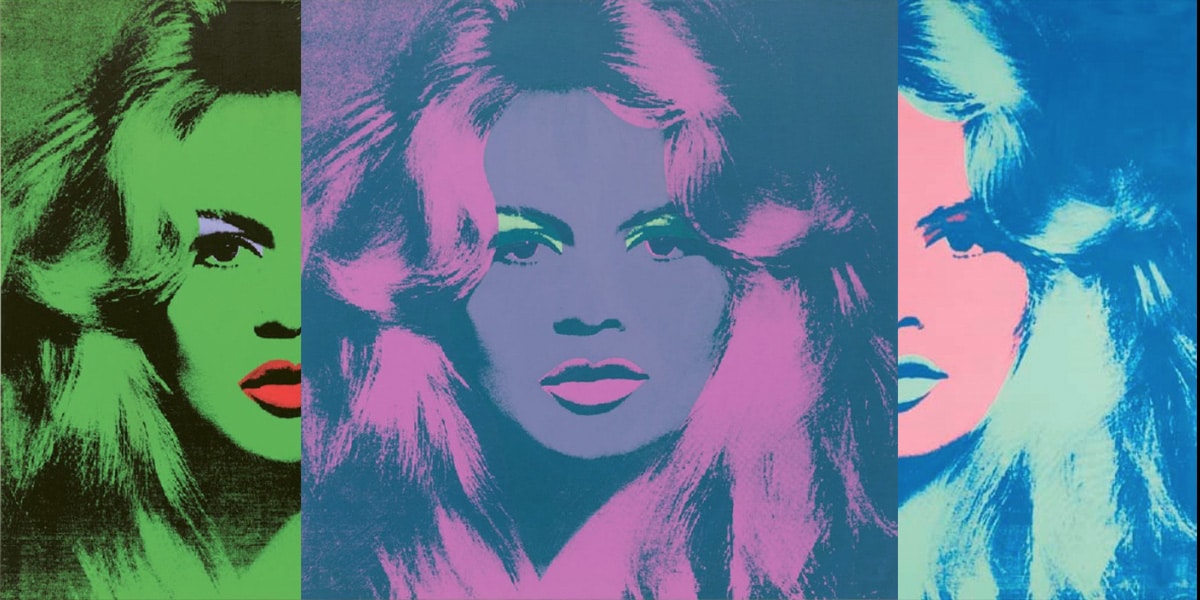
Their marriage lasted three years. It ended without bitterness, but not without symbolism. Sachs would remain a presence in Bardot’s story — a relic of a period when wealth, art, celebrity, and spectacle collapsed into a blur. Long after the marriage had ended, Sachs commissioned Andy Warhol to create a portrait of Bardot. The image froze her in time. Warhol’s rendition, derived from a photograph by Richard Avedon, seduces the viewer. It flattens and distorts her face through colour, drained of warmth, fixed at a moment when retreat had already begun. Warhol understood Bardot better than most. His portrait neither flatters nor explains. It embalms her, drains indiviual from the surface until only an outline remains. Unlike Marilyn Monroe — whose image helped define Warhol — Bardot holds her ground.
In 1973, at the height of her fame, Bardot walked away from cinema entirely. No farewell film. No final statement. She stopped. The decision baffled the industry and infuriated the press. For Bardot, it was survival. She did not want immortality if it meant permanent exposure. What followed was not retreat but transformation. Bardot redirected her attention, and her fury, toward animal rights activism. She founded what would become one of France’s most influential animal welfare organisations, throwing herself into the work with the same intensity that once defined her screen presence. It was not a soft reinvention. She was uncompromising, abrasive, and frequently controversial.
Her later years were marked by public statements that alienated many former admirers and led to legal consequences. Bardot did not soften with age. She did not apologise. The press that once worshipped her learned how quickly adoration can turn to condemnation when a woman refuses to behave appropriately.
Gunter Sachs would die decades later, by suicide, his art collection dispersed at auction, including Warhol portraits of himself and Bardot. The sums were vast. The symbolism is unavoidable. What remained was the image — and the distance between image and person.