

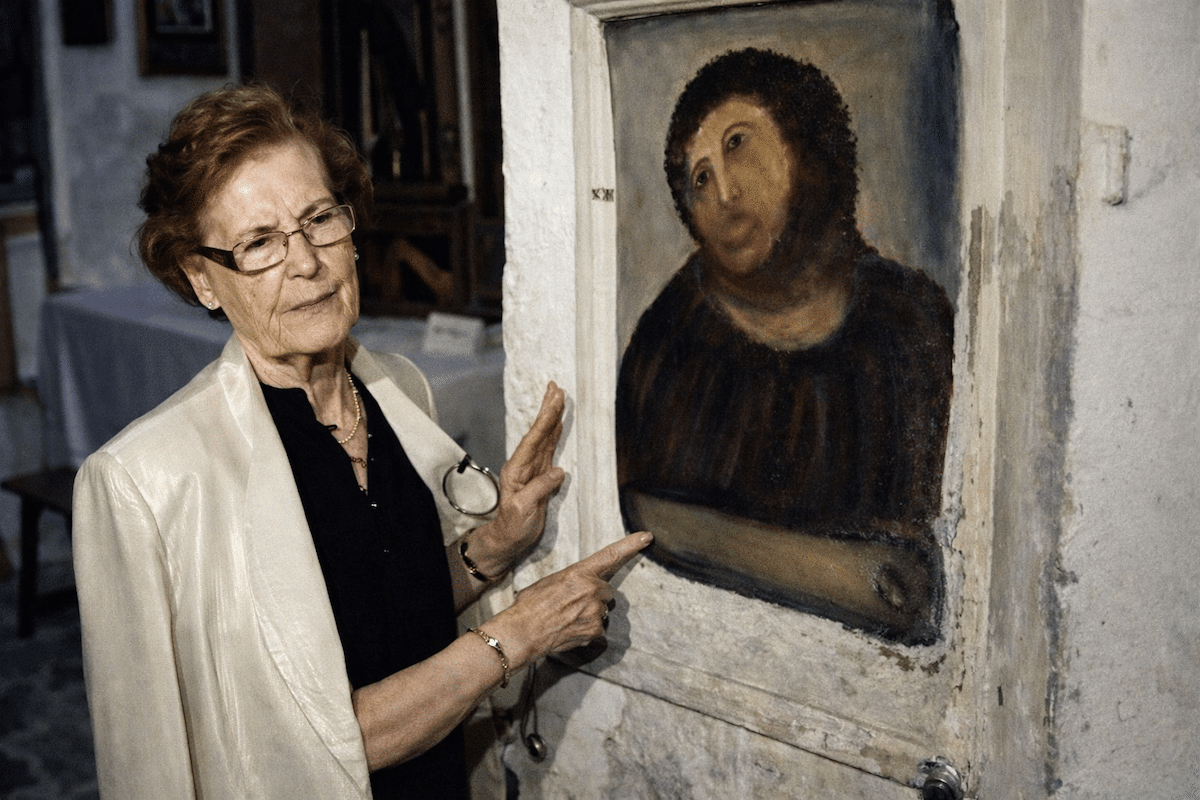
Cecilia Giménez Zueco lived a quiet life in Borja, a small town in Aragón, Spain. She never intentionally set out to become an art celebrity. She painted for pleasure, attended church, and remained largely invisible to the broader world. That anonymity ended abruptly in 2012, when an act of devotion turned her into an accidental global social media phenomenon.
Her attempt to badly touch up a fading fresco of Christ was caught by Facebook followers, who turned it into a viral meme shared on news platforms worldwide. Giménez died peacefully this week at 94, leaving behind a body of work (mostly flower paintings) and an international reputation.
The fresco in question, Ecce Homo, was painted in 1930 by Elías García Martínez on the wall of the Sanctuary of Mercy. By the early 21st century, it had deteriorated badly. Giménez, who had no formal training in conservation, took it upon herself to intervene. What emerged was not restoration in any conventional sense but something closer to a reinvention. Christ’s face dissolved into soft, rounded forms. The eyes slid. The features blurred. Within days, photographs ricocheted across the internet. The comparisons were rifel. “Ecce Mono,” “The Beast Jesus,“ or Behold The Monkey, were some of the jokes.
What followed was ridicule on a scale rarely seen. Giménez, elderly and unprepared, became the unwilling centre of a scandal. But something else happened. People came to Borja. Then more people. Then thousands. The church that had been largely ignored for decades became a site of pilgrimage for selfies, driven in part by curiosity, in part by a sincere engagement with a work that had slipped free of its original intent.
Giménez didn’t hide. Nor did she attempt to correct the record. She stayed. She spoke gently. She accepted interviews with a mix of embarrassment and resolve. Eventually, she exhibited her own paintings—small, earnest works that revealed none of the irony imposed upon her by strangers. The town introduced an entrance fee to see the fresco. The proceeds funded local projects. Borja, once peripheral, found itself pinned to the map.
Giménez did not destroy the fresco. She altered its fate. Ecce Homo ceased to function as a standard devotional image and became something else entirely: a collective object, shaped as much by online circulation as by pigment on plaster. Giménez, once framed as the villain of a conservation fail, became an accidental collaborator in a sprawling, participatory artwork authored by the public.
Eduardo Arilla, Borja’s mayor, described her as “one of the town’s most beloved residents,“ praising her generosity and resilience.“ Those qualities were visible to anyone who knew her. She never claimed credit. Nor did she express bitterness.
Cecilia Giménez Zueco was an outsider artist and will be remembered not for mastery but for achieving something that, for whatever reason, grabbed the public’s imagination.
She reminds the art world that meaning is not always authored, that reverence can misfire, and that even the smallest acts can tilt the cultural axis. In Borja, Ecce Homo remains on the wall, unchanged. It no longer asks to be restored. It simply insists on being seen.
Photo Via X