America is (to repurpose the famous quote from The Go-Between, that most quintessential of English novels by L.P Hartley) ‘a foreign country: they do things differently there.’ If in doubt, two influential exhibitions at Gagosian emphasise the point that we are two nations divided (as Oscar Wilde suggested) by a common language. The historic and cultural trajectories of each country are so different, a fact emphasised today by the behaviour of the MAGA regime and ICE’S activities.
Richard Avedon was a socially conscious photographer who produced fashion photography as well as powerful portraits and images of the Civil Rights movement. Facing West is a series of potent black-and-white photographs made when Avedon spent five years (1979-1984) travelling to 21 US states and conducting more than 1,000 sittings, producing 126 editioned portraits, 21 of which are on view here in London. Using only an 8 x 10 Deardorff camera, natural light, and very few props, he photographed his subjects against a luminous white backdrop, so that they achieved something of the status of secular American icons.
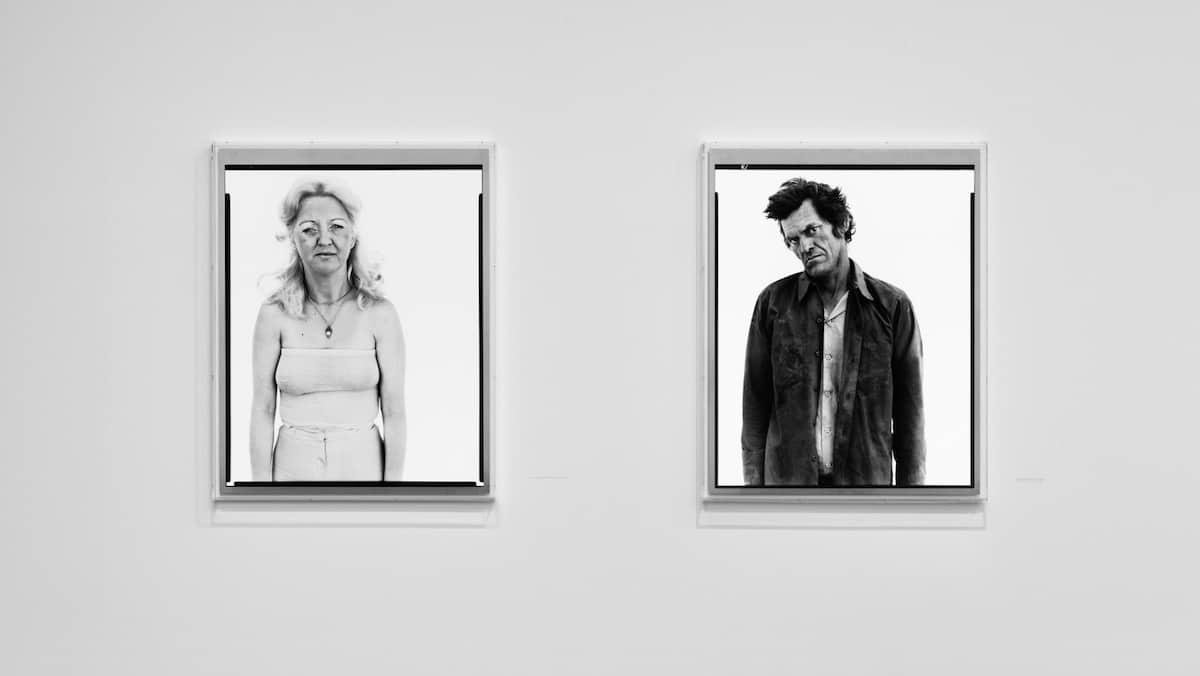
Photo: Richard Avedon Installation Shot Courtesy Gagosian Gallery
The famous phrase ‘Go West, young man’, credited to the US newspaper editor, Horace Greeley, emphasises the heroic myth of westward American expansion, the belief that anyone might make it in the new world. The fertile, resource-rich land was seen as an idealised space ripe for exploitation; expansion a divinely ordained right, part of the inevitable mission to spread American ‘civilisation’ from ‘sea to shining sea.’
Avedon presents us with portraits of those engaged in a range of professions and rural pastimes necessary to America’s economic success, often overlooked subjects, from immigrant coal miners to one-armed drifters. These are the very same people that Steinbeck wrote about in The Grapes of Wrath. The American underclass, the disposed, who today would probably figure among Trump’s ‘rust-belt’ supporters. Avedon highlighted their suffering, turning them into modern martyrs crucified on the cross of individualism, opportunism, greed, and the need for survival at the very heart of the American Dream. We are presented with indigenous men working as coalminers, bare-chested and dripping with sweat, and those with roughhewn faces that tell of privation, mental illness, and quiet despair. They stare out at the viewer, defiant but not quite defeated, the harsh realities of their everyday lives etched on their bodies and faces. A podgy white teen stands cradling a rifle, a kohl-eyed Indigenous woman hugs an armful of dollar bills and an older man in jeans and braces, the right sleeve of his creased and dirty denim shirt tucked into his waistband, indicating the loss of an arm in some work accident, stands before us broken but not bowed. Young couples hold hands, their appearances still (just about) youthful, though beginning to show the hallmarks of poverty and disenfranchisement.
This is a remarkable body of work: raw, honest and humanely dignifying. Without a touch of sentimentality, it documents the harsh realities of those without money, connections, or education who were sold the American dream.
Nan Goldin Robin and Kenny at Boston/Boston, Boston (1978) from The Ballad of Sexual Dependency, 1973–86 126 archival pigment prints © Nan Goldin
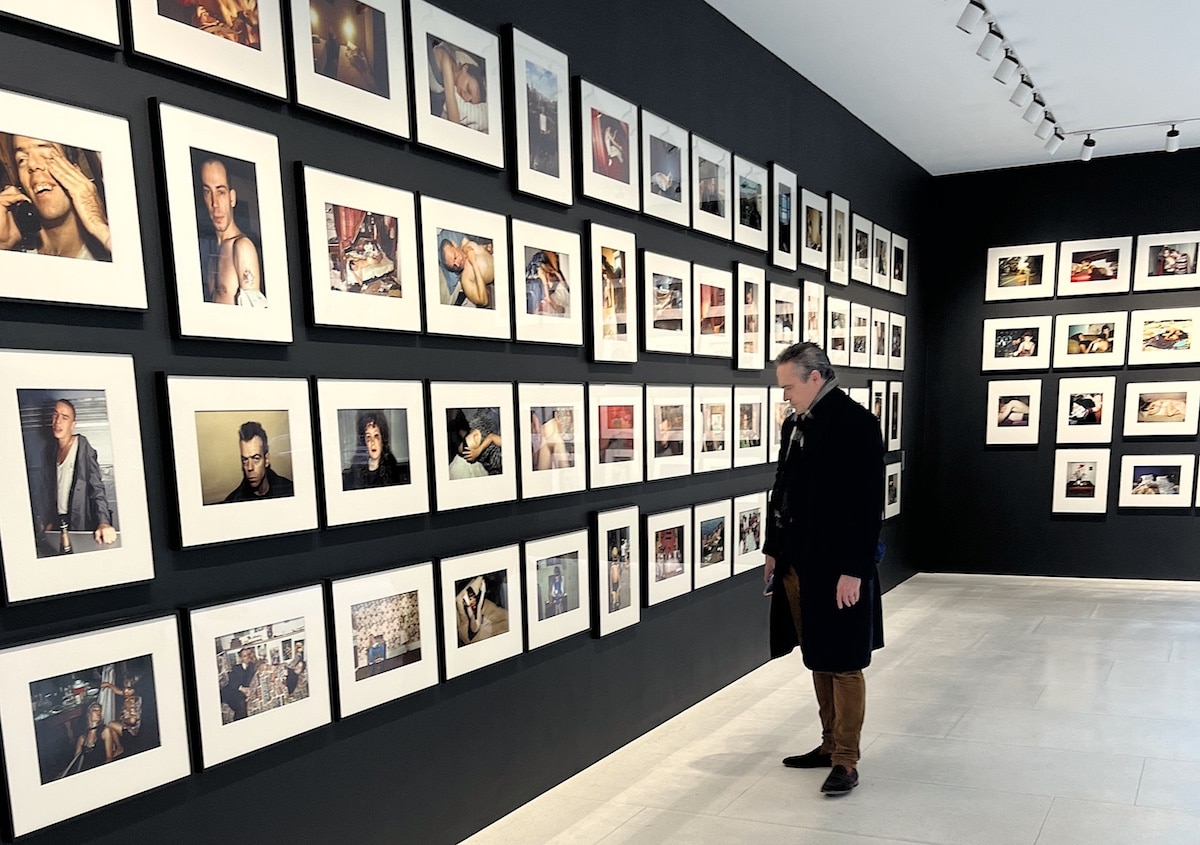
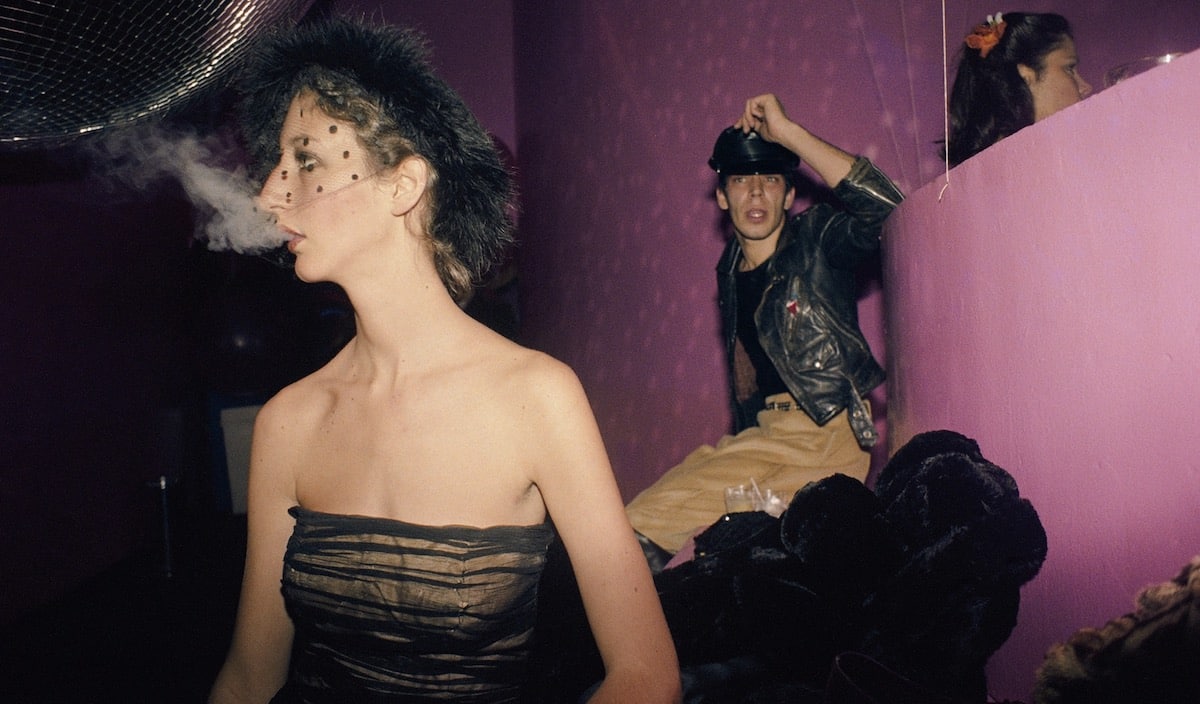
In their smaller Davies Street space, Gagosian is showing The Ballad of Sexual Dependency, a closely hung exhibition of 126 coloured photographic prints by Nan Goldin that contrasts with Avedon. Initially conceived as a slide show to be presented in nightclubs and barns, they depict the world of downtown New York between 1973 and 1986. This era not only defined the city but also influenced decades of visual culture. A testimony to a generation, they redefine sexuality, gender and the lives of those living on the edge. Goldin has said that she never selected people to photograph. Her pictures grew out of relationships, not observation. ‘I photograph them directly from life.’ The photographs are, she suggests, ‘an invitation’ to her world, ‘the diary I let people read.’
Unlike Avedon’s intrinsically heroic studies that, despite their deprivation, emphasise the dignity of his subjects, Goldin gives us anti-heroes trapped in a web of ennui and postmodernist angst. Two semi-clad young women lie in a dreary room on a cheap floral counterpane of an old walnut bed. They loll side by side, one on the phone, the other flipping through a newspaper. The dark tuft of black pubic hair visible through one of the girl’s pink nylon knickers suggests a post-coital moment. Elsewhere, couples of various sexes and genders copulate in cheap, smoke-filled rooms. The photos are voyeuristic, yet intimate. Unlike Avedon’s work, there is no implied Romanticism. We see Bobby masturbating for the camera and empty Hopperesque hotel rooms decorated with turd-brown wallpaper, rooms that numerous truckers and their molls must have used. Elsewhere, we are presented with a tattooist at work and an old Mexican couple standing in their doorway, she grey-haired, in a crisp cotton dress, he in a baseball cap and a grubby white vest. They suggest normality and fidelity. But who knows what their life stories have really been?
Goldin’s family background has been well documented. The daughter of educated, middle-class Jewish parents, she had an early life marked by tense family relationships. Her parents argued over her sister’s apparent promiscuity, leading to her suicide in front of a train when Nan was only 11. From the age of 13, Nan smoked marijuana, dated older men and lived life on the edge, existing in a world of drag queens and the LGBTQ community. It was in the Bowry neighbourhood, she insists, that she found ‘her tribe’. The photos were often of friends, though some were of children, like the bare-chested kid in a Spider-Man mask and tights standing on a crowded sidewalk. And there is violence. A self-portrait: Nan One Month After Being Battered 1984 – that shows her with all black eyes and a puffy face – the result of an incident towards the end of an intense and dysfunctional relationship with Brian.
Strangely, though, this body of work is a love letter—a love letter to her chosen family at a time when she felt distanced from her biological one. Despite the often blighted lives and early deaths from drugs, drinks and AIDS of many of her subjects, these photographs were a way of documenting her chosen people. a way to always keep them close around her.
Sue Hubbard is an award-winning poet, novelist and freelance art critic. She has published five collections of poetry, a book of short stories, and four novels, which have been translated into French, Italian, and Mandarin.
Top Photo: Sue Hubbard. Other Photos Courtesy Gagosian © Richard Avedon Foundation
https://pushkinpress.com/book/flatlands/ A Sunday Times historical fiction book of the year