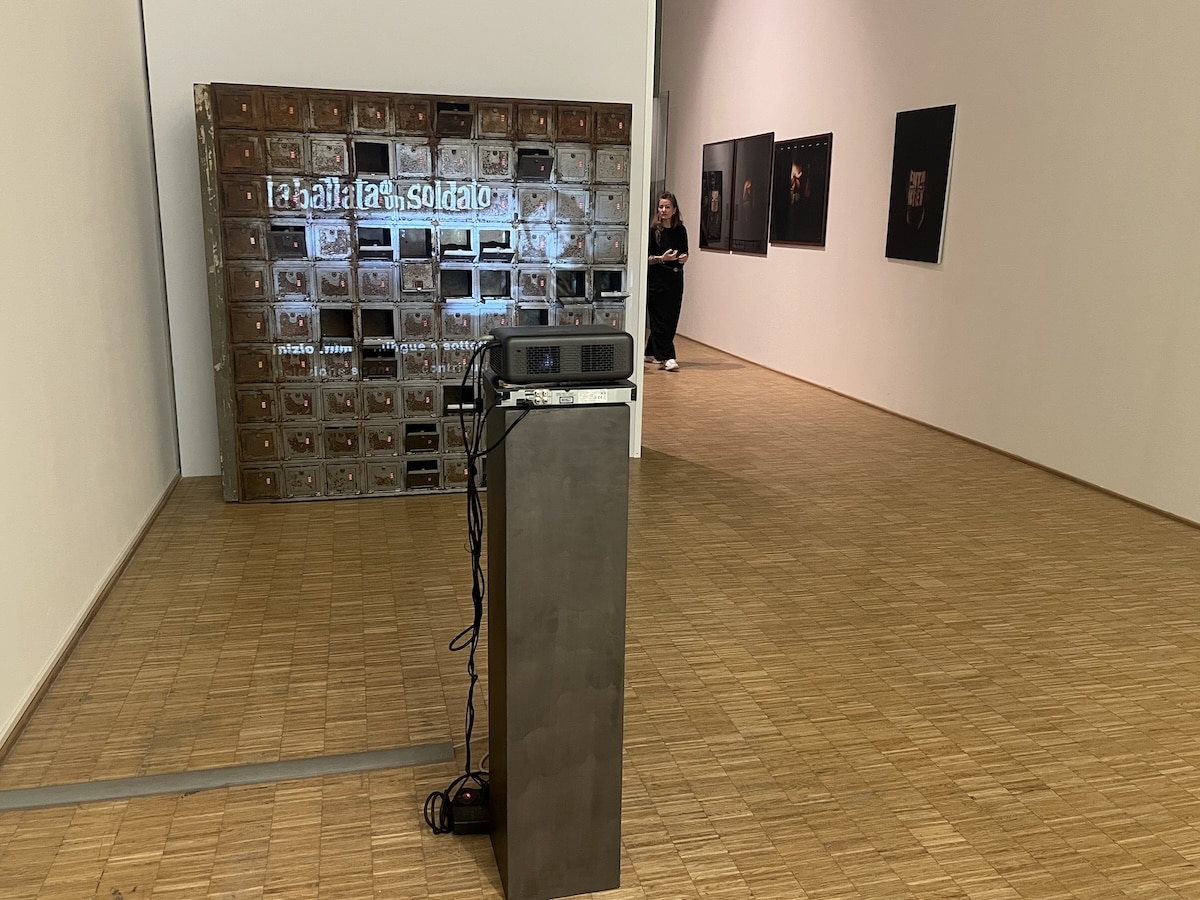
I must admit I hadn’t heard of Fabio Mauri. So who was he and why has curator Carolyn Christov-Bakargiev edited a catalogue raisonné of his work, and what’s his relevance today? To find out more about who he was and why he matters, I travelled to the Milan Triennale to view the exhibition Fabio Mauri: De Oppressione, and then to Turin to meet with Christov-Bakargiev. The online release of the catalogue raisonné – one of the first in art history to be published entirely digitally – provides free, public access to Mauri, his work and ideas to new generations at a point in time that could not be more relevant with the continuing rise of the right and authoritarian regimes globally. He devoted his life to warning future generations about fascism.
Fabio Mauri (1926-2009) was a significant figure in the post-World War II Italian avant-garde. His work ranged from drawing, painting, and sculpture to performance, installation and writing, and explored how the concepts of culture and identity have become reasons for oppression. His prophetic insights into the power of the screen and his use of it as a filter and a device for projection and manipulation were ahead of their time, and he believed the screen was the most powerful and potentially dangerous image in modern society. His obsession with it took the form of his ongoing series ‘Schermi’ (Screens), which began with the advent of television in Italy. Also important was his idea of the body as a place of memory and critical reflection on oppression, ideologies, and the possibility of transmitting collective traumatic experiences, as shown in his use of the human body as a screen, as in his performances with his friend Pier Paolo Pasolini. Mauri saw radio and television as a tool to project fascist messages to mesmerise audiences and capture mass attention in even more powerful and insidious ways through the use of images.
I learned so much from Christov-Bakargiev’s introductory essay – she knew Mauri well and had included his work in solo and group exhibitions as well as Documenta (13) in 2012. 2026 marks the centenary of Mauri’s birth – the exhibition and catalogue raisonné are the first of a number of events to celebrate this.
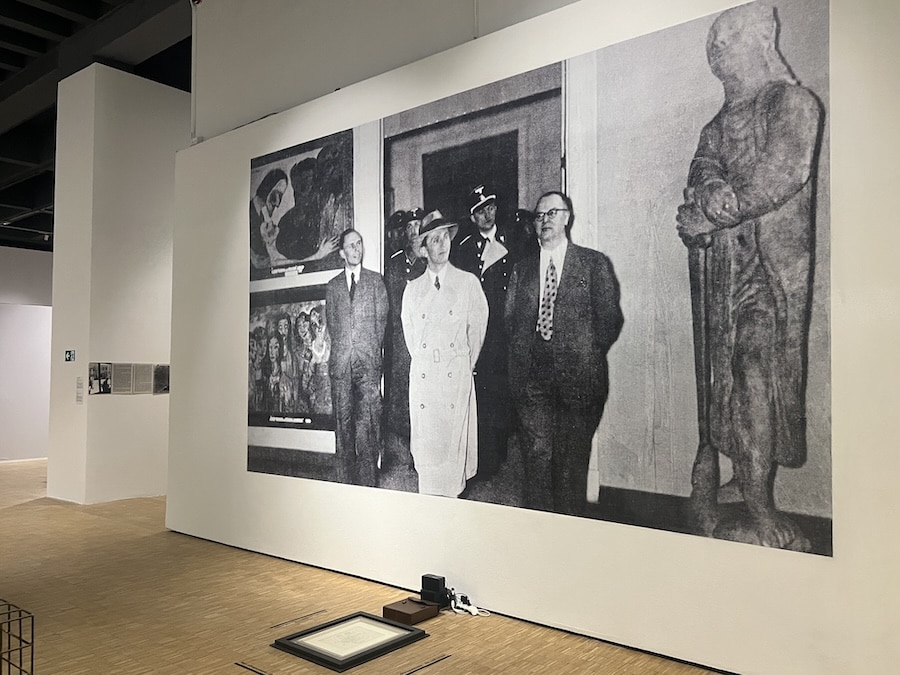
Fabio Mauri exhibition at Milan Triennale installation shot photo by Miranda Carroll
Miranda Carroll: What compelled you to compile this catalogue raisonné on Fabio Mauri?
Carolyn Christov-Bakargiev: Well, first of all, I promised him. He was the first artist I invited to Documenta (13) in Kassel in 2012. I remember sending the letter of invitation in March, and he was already terminally ill. I thought he would live a little bit longer, but I’d been speaking about it to him for several months. He told me he was going to rent an apartment in Kassel and take German lessons. He was so happy to be in Documenta. It was like a dream of a lifetime, and then he didn’t make it to the opening.
I used to go visit him in his apartment, overlooking the Bernini fountain in Piazza Navona. The windows of the living room looked out to the Piazza, so in the summer, you could hear the water and the tourists that almost sounded the same. I must have spent thousands of hours with him since about 1985, 1986. And in those final months, I said, I’ll do your catalogue raisonné. In a way, the catalogue for his Galleria Nazionale show in Rome that I curated in 1994 was already the beginning of a catalogue raisonné. So I had the best files on his work. And anyway, I promised him.
So why Mauri, in particular, I think because he’s an extraordinarily monumental, important artist of the 20th century, literally the first, in my knowledge, in Western art history who seriously understands the relationship between the technologies of communication: radio and television, film, mass communication, and the rise of authoritarian regimes. This is common practice nowadays. Almost all artists, I mean, just look at Hito Steyerl. One point is the rise of radio and film before World War II, then television after it. In Italy, it arrived in 1954, but only in bars and cafes, not in people’s houses, until the 1960s. So, it has to do with Fabio as his Schermi (screens) that have the proportion of an old television set, square with rounded edges. His first Schermo, in late 1957, was a black outline marked on flat paper, more of a cinema screen format. Then in 1958, the bulging canvas shaped more like a TV set, literally only a few years after you see the first televisions in bars. So, all this to say that… I believe that he’s an extraordinarily important artist, who is not well known for a number of reasons, therefore a catalogue raisonné which is scholarly and objective and isn’t a question of opinion or criticism is important. It’s a question of materials, techniques, intention, and date of exhibition, and there is no saying no to the facts. It’s just facts.
I do believe in art history, of course, I believe that there are different kinds of art history and different points of view, and it always needs to be rewritten. But there’s one point of view that if you look at that question, the rise of art that is somehow grounded in a research into how these mechanisms of communication on a broader social level function, there’s no way around it. It’s Fabio. Way before the late 1960s and ’70s, conceptual practices focused on this same topic. So, I promised him, and I think that I’m getting into catalogue raisonnés also for a personal reason – I think it has something to do with putting one’s papers in order, and you do it in a displaced way by putting somebody else’s in order. Who’s maybe more worthy in your opinion. But it is that putting things in order. I think there is that element which makes it a very old art historical tool.
MC: At the end of your essay, you start talking about what Mauri might think nowadays of AI and Generative learning.
CCB: I don’t know. We can only imagine, but… there’s a banal generalised anti-AI movement by so-called enlightened and educated people. I think he would have seen various sides to that, and he would have also been suspicious, because he was always suspicious of what the common-sense educated people thought.
I don’t think his reply would have been as standard as he’s going to hate AI. He would have actually started to work with it, to see where he would go with it and would have tried to figure out a certain number of things, I don’t know what. So we can also not conjecture.
MC: Do you feel you’ve shifted the narrative in your catalogue accordingly?
CCB: Yes. The tool right now, and why the online is also very important to me, it’s not only for the market and authenticity, but it’s for all people’s understandings of art in a way that is not ideological, because in this multiplicity of art histories and points of view, we’re reading it in a very subjective way, even though it’s through a shared subjectivity. For example, women. Griselda Pollock really changed the point of view and brought in the history of women artists and a shared rereading of art history, which is changing the canon by admitting women. And therefore changing what we think, what things like uncertainty, complexity, fragmentation – well, bad characteristics. When you have the feminist approach, it suddenly becomes, well, the world is not exactly linear and perspectival. So, if we bring in all the women who are telling us that you can make a work that is complex, uncertain, contradictory, fragmented, and pluri-central, multi, multi-perspectival, like Joan Jonas, or the many, many other women, you basically change art history. So I believe in that task at that time.
But right now, we are in the time of AI, and it works on the basis of large language models, and therefore, what we normally call, or used to call, before speaking of LLMs, datasets, and what is in the dataset, everything that’s on the internet. So if the internet is full of mistakes and unfounded opinions, then you’re going to get bad results.
A catalogue raisonné is a human task (no robot can do it, it’s impossible) because it’s not a question of just scanning all the archival material, throwing it into a computer and saying, reorganise this in this way. There’s this huge human work that needs to be done. And now, having done that, of course, ChatGPT can answer questions perfectly on Fabio Mauri, because we put this online.
So, to me, it seems logical not complain about AI and then be reticent. These are catalogues raisonnés – it’s not personal data. When somebody publishes their own private information on social media, it’s their responsibility, it’s going to be out there so if they don’t like that, they shouldn’t do it. There are contradictions all over. But in this case, I’m speaking about why I was interested in doing Fabio Mauri’s catalogue raisonné. There’s a tautological response, which is that I want to feed the datasets so that we can redress a kind of margin, or bias, which there is, not just women, and the underprivileged, and the indigenous peoples of the world. I mean, there are thousands of wonderful artists who are of the male gender and happen to be heterosexual, and they are not known outside their countries, because there is a dominance of what is seen in London, Paris, and New York and LA. I mean, that is still totally, absolutely, the truth.
MC: Also, a catalogue raisonné is a permanent thing, whereas an exhibition is so temporary.
CCB:Well, nothing is permanent in the world. I mean, there are many backups to this online catalogue which is hosted on the website of the Studio of Fabio Mauri.
Some people ask me why the book is going to be so heavy? It’s almost eight kilos. It’s because Fabio was always saying that ideology is physical, it’s not an immaterial thing. And it can kill you, like a brick can be thrown at you. He would use this metaphor of a brick, that ideology is like a brick. And so, he wanted to give you the feeling of the physical embodied materiality of ideologies, and he saw ideology as a product of European culture. For him, the great beast to deal with is ideology.
MC: So, this brick of a book….?
CCB: The brick of the book is…because we need to save books. You know what happens when there’s a big, historic cataclysm and we need books. If there were World War III or something, and somebody messes with it they can wipe out things in data servers so there is a risk of destroying them. So there will be a book for medieval times, let’s say. And it’s different from the website, and as close as I can get to permanence.
One of the main differences between online and paper is that online has a lot of video documentation, and a lot of Mauri’s work is on film. Of course, today we have everything on our cell phones. It’s just the weight of a phone. So if anybody wants to carry it around with them, they have it online, always.
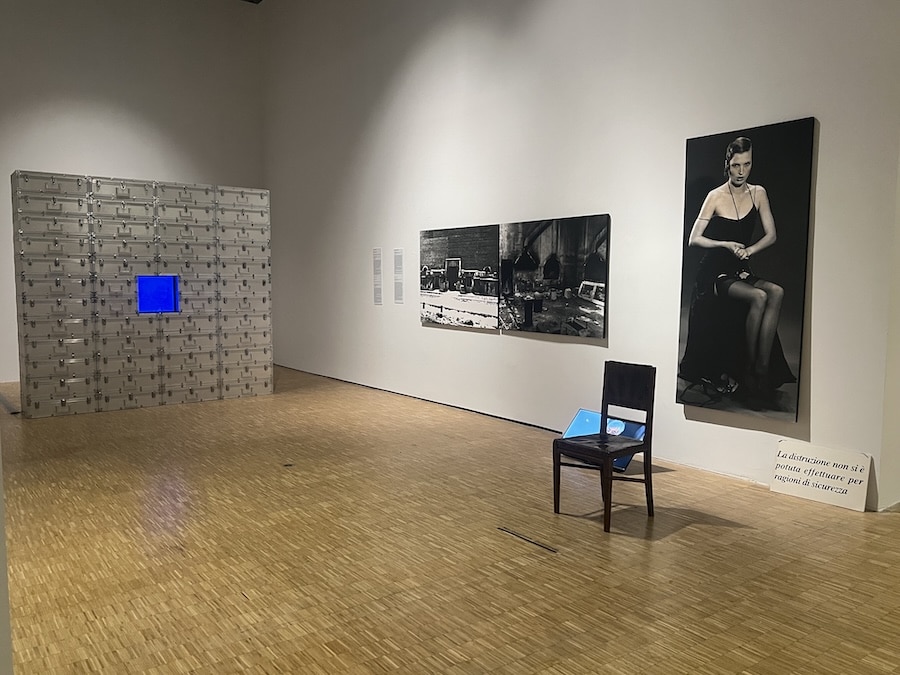
Fabio Mauri exhibition at Milan Triennale installation shot
MC: Tell me what else is happening to celebrate Mauri’s centenary.
CCB: This is the beginning of it. He was born in 1926. Ilaria Bernardi, a young curator in Italy has curated the exhibition currently showing at the Milan Triennale that has launched it.
I wanted the catalogue raisonné to come out by the centenary, and as you know, the online version is up. The paper version, the brick, is being published by Hatje Cantz for the English edition, and with Allemandi Editore, a Turin-based publisher, for the Italian. We will present it in May, at the Venice Biennale.
Then, in L’Aquila, Italy’s Capital of Culture for 2026, where Fabio taught from the late 1970s for many years, there will be a small exhibition curated by Maurizio Cattelan. Those years were very important to Mauri because he was able to redo certain performances with the students that would have been too costly, otherwise, with actors that he would hire. They asked Cattalan to propose something, and he thought, why not Fabio Mauri?
MC: Do you know what he’s going to do?
CCB: Show works made during Mauri’s years of teaching. Many were about how young people were manipulated into enrolling in the army in the War, or how nationalist enthusiasms and playing on the ego of the young can often push these people to get killed. He would have something to say, I suppose, about Ukraine and Russia right now. But what brings this manipulation of youth? Youth culture was very important – in Italy, the ‘piccole Balilla’ would be wearing brown, like Boy and Girl Scouts, and then in Nazi Germany, youth is… What’s the word?
MC: Malleable?
CCB: That’s the word, malleable. With this generation of works, that’s a really good thing you said, because it’s really precise. One of the materials he uses in that period is lead, the most malleable material, also used to make bullets. So the students are very malleable, and it is the lead of malleable youth.
There’s a major survey exhibition I’m curating at MAMbo, the Museo d’Arte Moderna di Bologna, opening in February 2027, then travelling to MUDAM in Luxembourg. But it originates in Italy. It was important for me to do that. Why Bologna? Because it’s a very important city in his biography – where he grew up as a child, went to elementary school with Pasolini. In 1942, during the fascist period, they created a magazine together called Il Setacchio, the sieve, because it filters certain things through it, with Pasolini’s poems, and Fabio’s drawings. Two drawings from this magazine will be the earliest works in the exhibition.
Interview by Miranda Carroll with Caroyln Christov-Bakargiev ©Artlyst 2026
Fabio Mauri Catalogue Raisonné, edited by Carolyn Christov-Bakargiev
Released online on October 13, 2025, this is one of the first catalogues raisonnés in art history to be entirely published online
Print publication in Spring 2026 by Hatje Cantz / Allemandi Editore,
Visit Here
Fabio Mauri: De Oppressione at the Triennale Milano, 3 December 2025 – 15 February 2026
The Exhibition is organised by Associazione Genesi, chaired by Letizia Moratti and curated by Ilaria Bernardi in collaboration with Studio Fabio Mauri
Visit Here