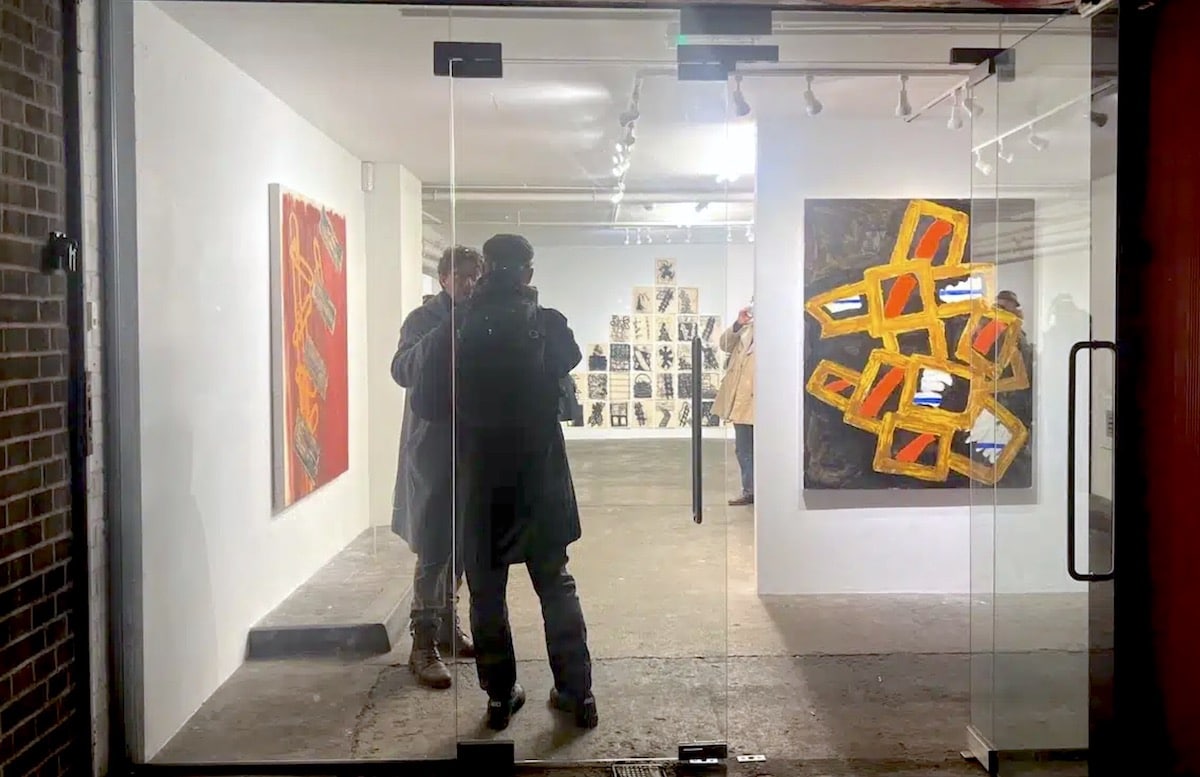
This solo exhibition at Turps Gallery celebrates 91-year-old British artist Basil Beattie through recent drawings and paintings hung in dialogue with three large works from his Janus series (2007-09).
Beattie was a student at the Royal Academy Schools when he saw The New American Painting show at the Tate in 1959 – the works of Mark Rothko and Barnett Newman particularly led him towards abstraction. But he developed his own unique style and subject matter and in the late 1980s at Curwen Gallery he showed works that included arches, ladders and towers – motifs he would return to throughout his career.
Beattie taught at Goldsmith’s for many years, and artist Marcus Harvey who established Turps Magazine and painting school was a student of his, so it’s appropriate that Beattie’s works are being shown here at Turps Gallery. Split between two spaces at Turps – the ground floor, and upstairs on the first floor a much taller gallery accommodates the three large Janus series paintings and is accessed by a circuitous route up ramps and walkways.
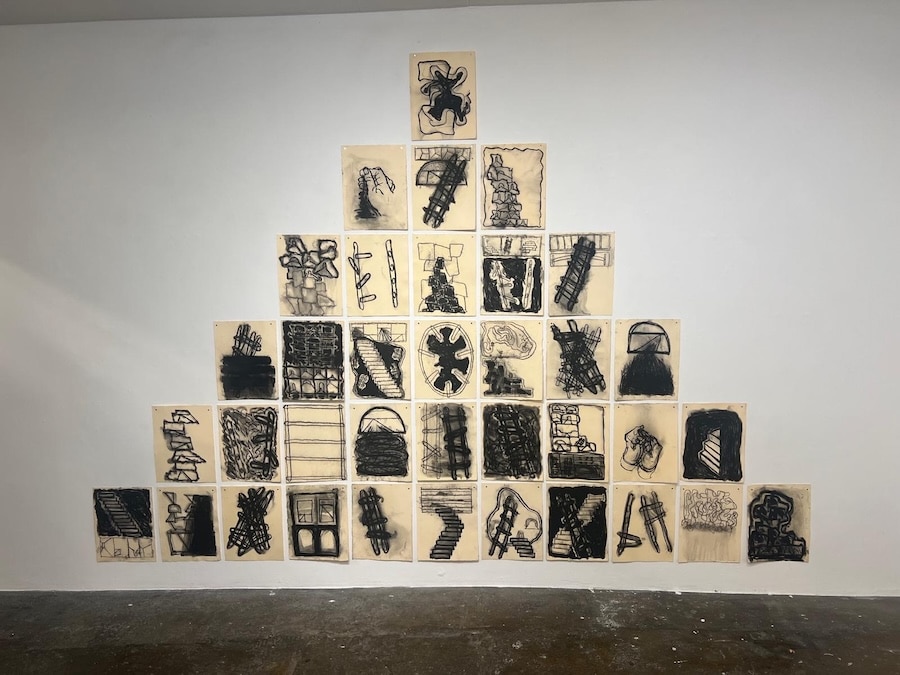
Basil Beattie, Drawing on the Interior 2026
Beattie’s connection with the Eagle Gallery stretches back to 1991 and an installation bringing together paintings and 376 drawings, also called Drawing on the Interior. In 2002 Sadler’s Wells commissioned a work by him called Above and Below, and in 2005 Marking a Year was shown at Childers Street, both also in association with the Eagle Gallery.
The drawings in the 1991 Eagle Gallery show were stacked floor to ceiling on three walls – here they are mounted in the towering form of a step pyramid. Drawing on the Interior 2026 is an installation of 36 drawings from 2020-2023, made with charcoal and chalk on paper. Some of these drawings show elements not necessarily found in the paintings. Yes, there are the tesselations, tumbling honeycombs and amorphous shapes echoed in the paintings on the adjacent walls, but also hands, and what looked to me like the half-cut interior of some exotic fruit, that are less abstract and more tangible forms.
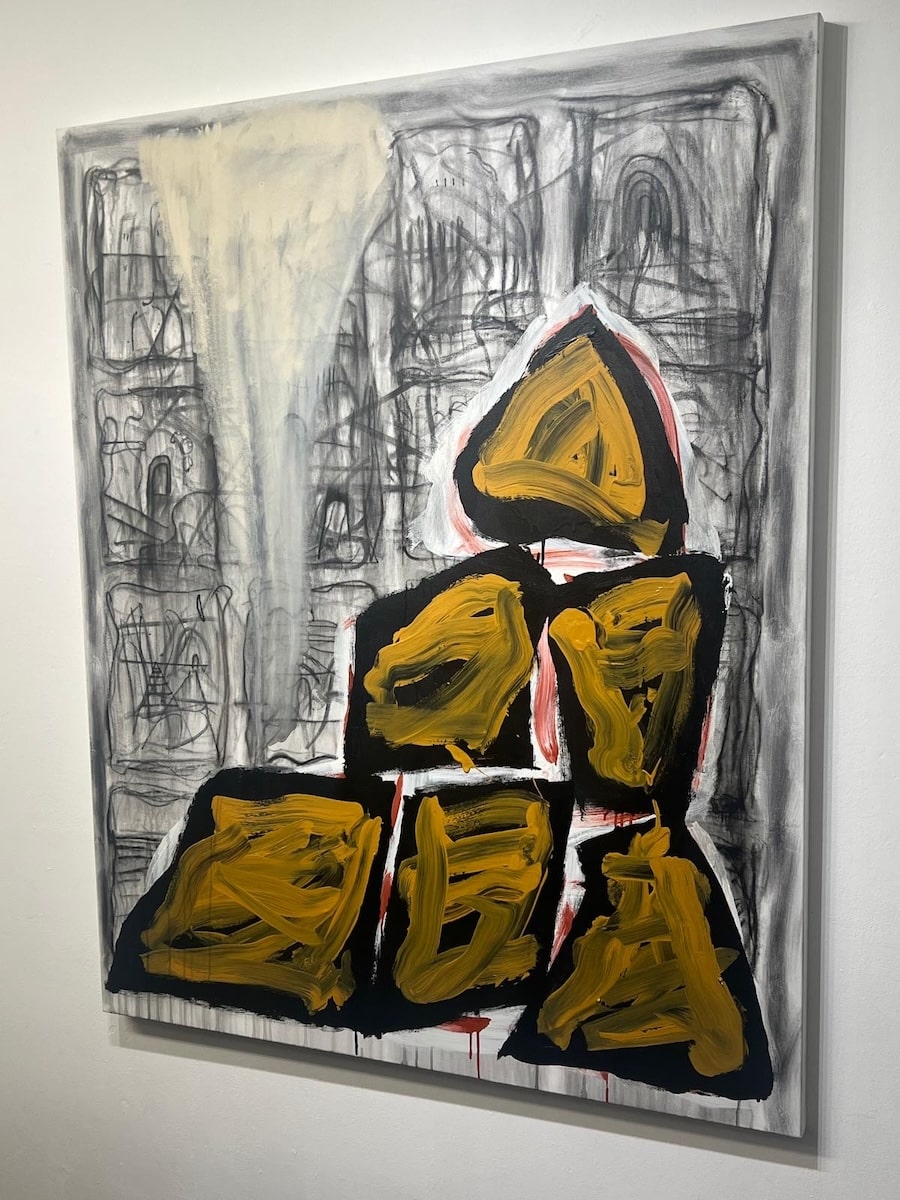
Basil Beattie, Now to Then, 2023 photo: Miranda Carroll
Now to Then, 2023 hanging nearby shows similar drawings displayed in a grid featuring archways and tunnels and drawn onto the canvas in charcoal behind a pyramid of acrylic painted rhombuses.
The painting Untitled, 2022 appears in the group of 36 drawings nearby but here in large scale, the split horizons and single tracks look like stick men, hieroglyphics stacked in a cartouche – marks, signs and characters arranged in a cellular format in black, white and grey on an orange background.
The Janus series was also first shown by the Eagle Gallery in 2009. Here at Turps are three works from the series, all oil and wax on canvas. These large paintings contain either three or four elongated stacked shapes, which, to me, resemble mastabas, mud-brick Egyptian burial structures containing underground chambers.
When Night Sidles In (2007) contains four of these shapes, three of which contain steps, lines or what appear to be railway tracks leading to a tower, an almost Piranesi-like perspective drawing the eye through the painting. The second from bottom shape bears only a horizontal line. Sketchily outlined in red, almost scratched lines, each shape is broken into two planes above and below a horizon using a simple palette of grey, white and black.
Night Embrace (2008) has three similar shapes outlined in a darker brown this time. Once again the top and bottom shape include what look like railway tracks yet the middle one simply shows the above and below of a horizon, created with a much more muted palette of mostly thick textured black paint.
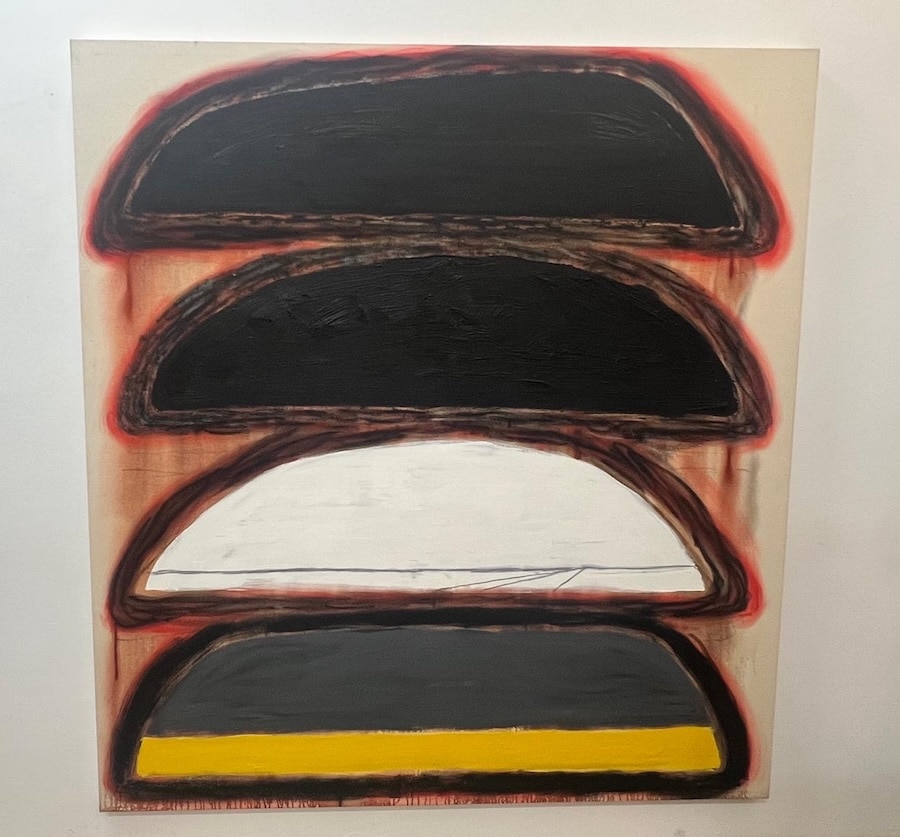
Basil Beattie, Night Shade 2009 photo by MIranda Carroll
Night Shade (2009) again contains four shapes, and seems darker, the outlines of each almost black with a dripping, melting blood-like red underneath. The two top shapes are filled thickly in solid black paint, the second from bottom is solid white with a few lines and the bottom one is split in two by a horizon – above is grey and below is mustard yellow. You can tell Beattie enjoys the sensuousness of using these materials through the application of the thick layered and textured paint.
Why is this series titled Janus? Perhaps it is for the two-faced Roman god who looks forwards as well as back, at the future and the past, yet this seems ambiguous. Or it’s how we read things in relation to our own experiences through memory, emotion, perception and consciousness. A somewhat ephemeral, intangible and private experience of evoked sensations, the imagination running riot, dredging the memory and evoking the past, enticing the viewer to interject. The motifs of steps or stairs, ladders or train tracks, stacked blocks and towers, to me recall fleeting moments seen through the rear view mirror driving through flat fenland of endless horizon and Talking Heads’ Road to Nowhere on my mind.
Seen together in this space these monumental canvases left me strangely restless yet wanting to view the entire series as a whole.
Basil Beattie Drawing on the Interior II, Curated by Eagle Gallery at Turps Gallery, 24 January – 20 February 2026
Visit Here
A concurrent exhibition, Basil Beattie Another Place: Paintings from the 90s opens at Hales Gallery, London 29 January – 28 February 2026.
Visit Here
Words and photos by Miranda Carroll ©Artlyst 2026