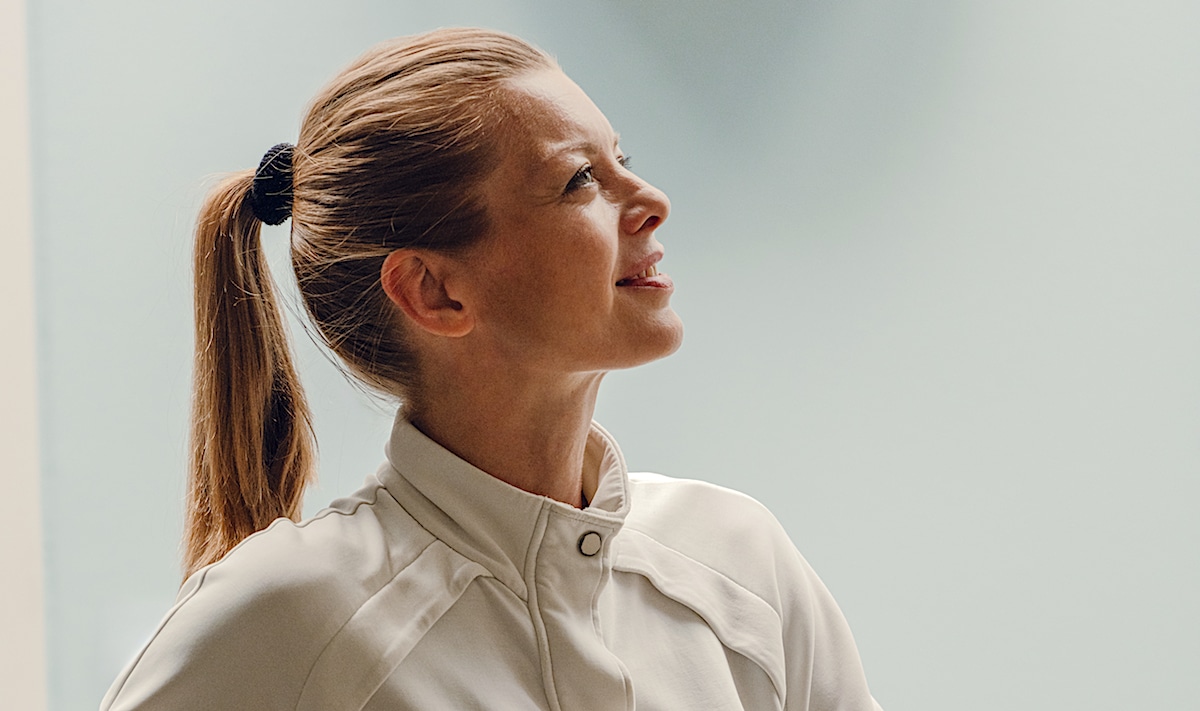
Berlin-based Jorinde Voigt develops systems to depict how an individual’s inner world – such as their personal experience, emotions, and memories – intersect with external conditions. She summarises her methodology as ‘trying to be what I observe’. Voigt became well-known for complex drawings with many references and annotations (see, for example, her account of the ‘Horizon’ series from 2011), but has moved towards more sculptural territory, while still working with paper. She is showing work from two recent series at Dirimart London, alongside Seçkin Pirim in the duo exhibition ‘Fractures & Rhythm’. I’m tempted to link them to my first encounter with Voigt’s work in 2009, when she turned her exploration of Berlin’s Botanical Garden into elegantly coloured metal rods.
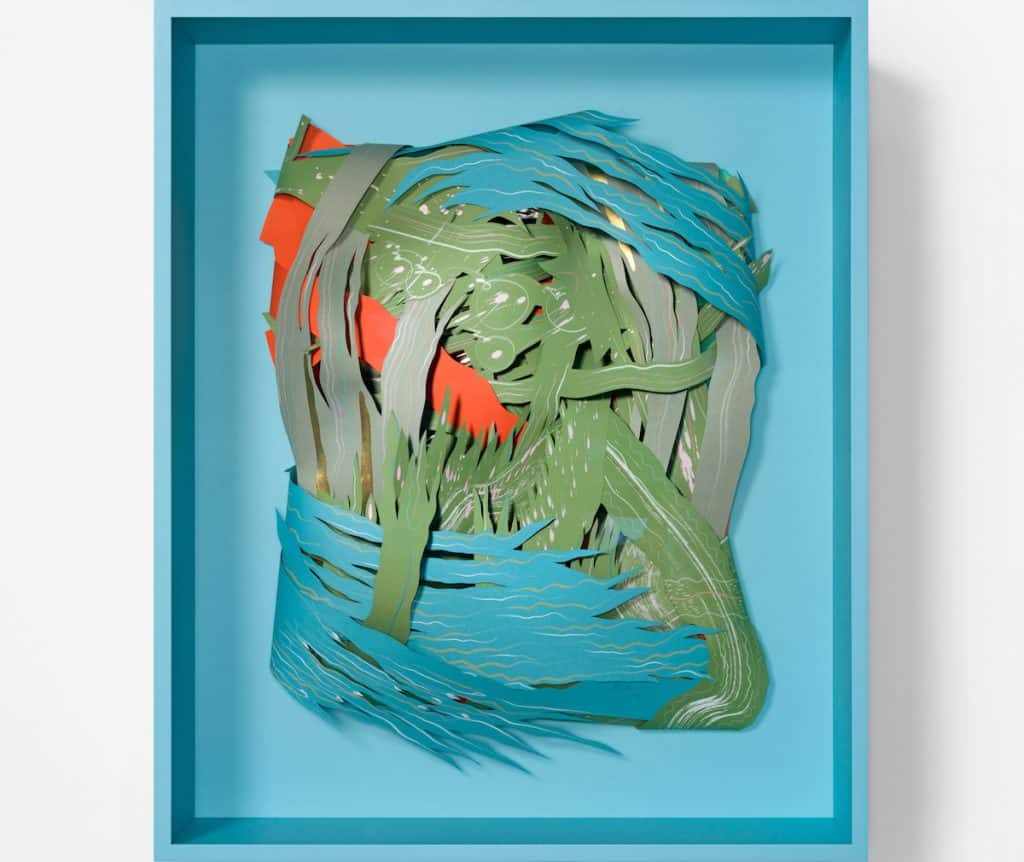 Jorinde Voigt: ‘Rhythm (Charged)’, 2025 – Gold leaf, ink, oil chalks, pencil and paper on wood, 67 x 67 x 22.5 cm
You are showing several works from the ‘Rhythms’ series. How did that come about?
The context was the garden outside my studio during lockdown. Each day, I searched for seeds and plants, then prepared the ground and planted them. And there were also plants that were already there, replacing themselves. I’ve always worked a lot on paper, and I’ve started using a multi-layer structure, always comparing it to what I experience in reality. I wanted to get closer to reality, so a flat surface wasn’t possible for me anymore. I start by making lots of drawings on huge rolls of coloured paper, following actions such as ‘how far can I reach with my body’, ‘how many pens can I use at the same time?’ or throwing ink to give a directional energy, giving up some control. Those actions turned out to follow a river, perhaps, or the wind… I was trying to be what I observe – trying to be like the sparkling water or the movement of the waves, translating them into my movements. Then I cut the paper in the same sort of operation – spontaneously, making a different kind of line as it divides the surface in two.
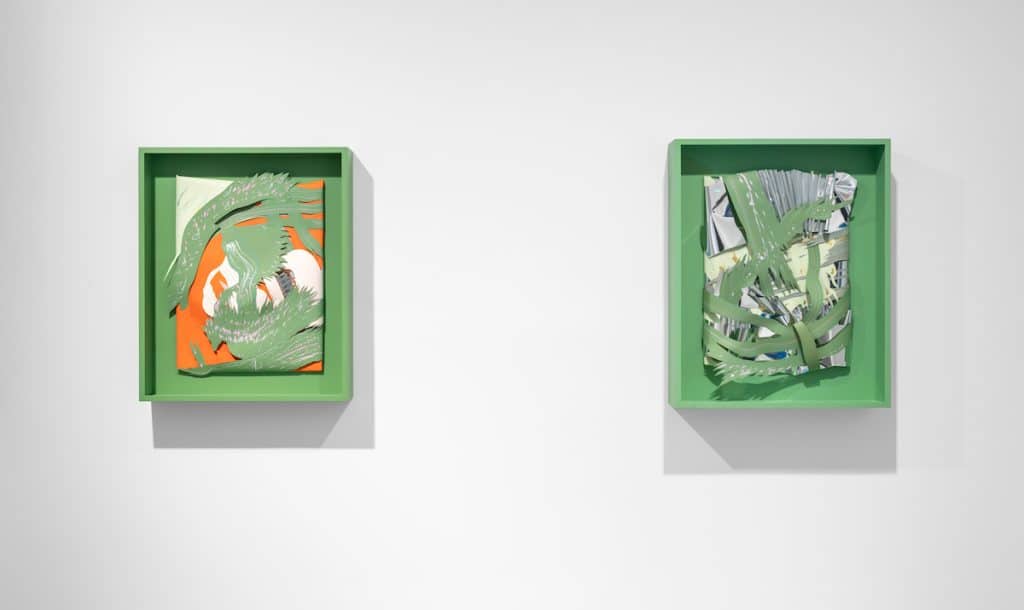 Jorinde Voigt: installation view at Dirimart with ‘Rhythm (The Garden at Night)’, 2025 and ‘Rhythm (The Garden)’, 2025
There are also mirrors?
Yes, under each one, there is a foil that mirrors the drawings. Also gold, which is hermetic as you can’t see what is underneath, and – like the mirror – it reacts to light. Then the last step is to integrate the components into a system, so they hold together visually and remain stable on the board. As in music, when different instruments create a sound together. And there is always the aspect of something behind, as there is also drawing underneath – you can tell it is there, but you hardly see it. It keeps a fragility. Then all of that is set in a sculptural frame that takes its colour from the paper.
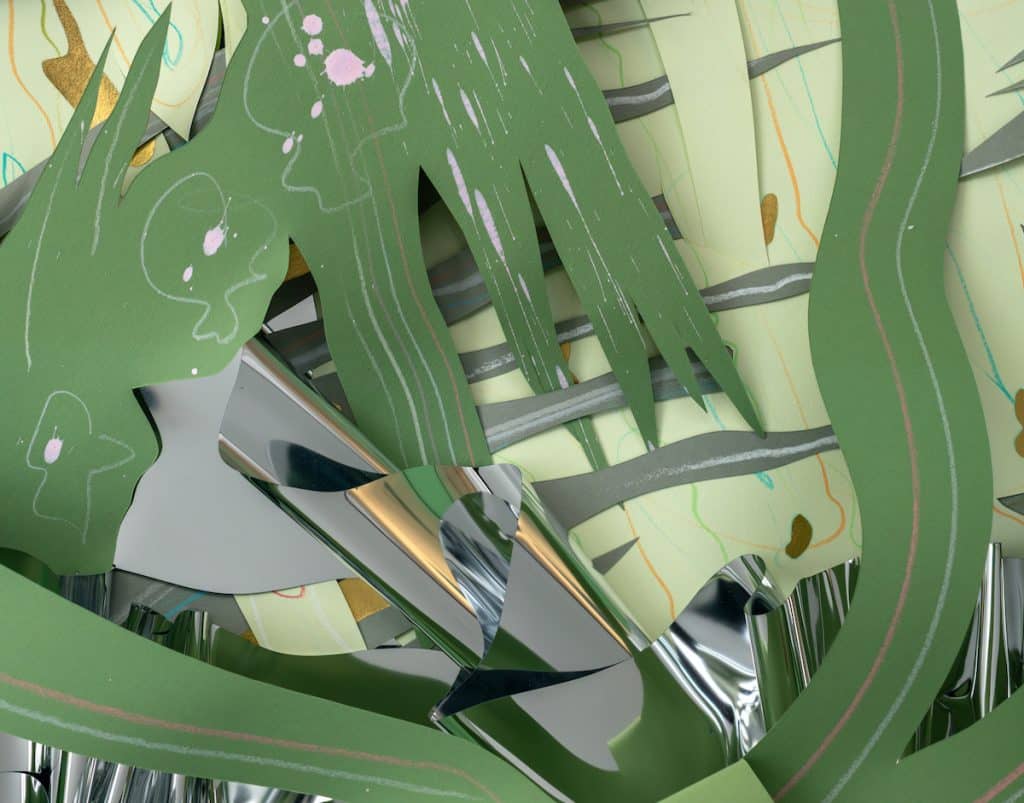 Jorinde Voigt: ‘Rhythm (The Garden at Night)’ (detail), 2025. Gold leaf, ink, oil chalks, pencil and paper on wood, artist’s frame 100.5 x 81 x 19.5 cm.
What appeals to you about combining elements like that?
That way of composing is inspired by exploring the garden, watching plants grow, and how I decide which plants are allowed and which are not, and where they are positioned. I am questioning the decision-making process in general. What right do I have to disturb the natural position, to remove one plant and import another? And if you transfer those questions to society and culture… they are big questions.
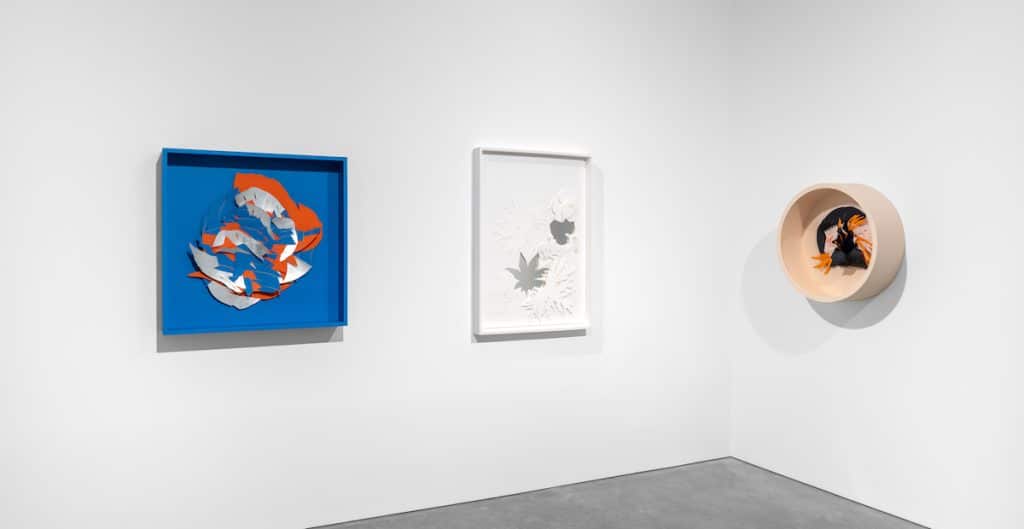 Installation shot at Dirimart with Rhythm (10), 2022, ‘The Sum of All Best Practices V’, 2021 and Rhythm (4), 2022
You could read them as landscapes, still lifes, or abstractions?
Or as topography, as well as being drawings that question flatness. I’m putting them on top of each other, but each of the works could be ten drawings – spread them all out and you’d use up the whole floor. I’m also thinking of how different plants appear after each other in time – the drawings are from different weeks, so I’m bringing time together, which was previously separated, into a different chronological order and simultaneity.
What ‘rhythm’ are you seeking?
The question for rhythm is ‘how do things hold together when separated’, and for me, it connected to the Coronavirus experience. I struggled with the feeling that the world was falling apart and there were huge gaps – so how could I connect things again?
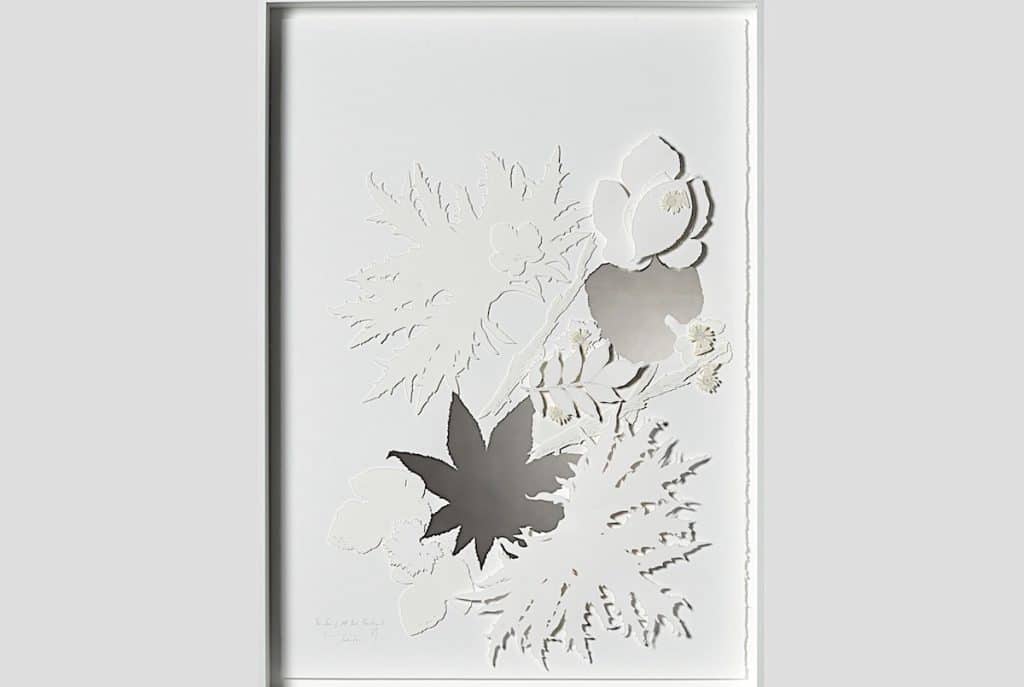 Jorinde Voigt: ‘The Sum of All Best Practices V’, 2021- Collage mounted on mirror glass stand and graphite on paper, 106 x 77 x 9 cm
You are also showing one work from another series: ‘The sum of all best practices’. What is that about?
I heard a podcast in which the word ‘histrionic’ was used. I didn’t know it, but I realised it described the character of my mother – she was hugely dramatic, so much so that when I was close to her, I felt I was disappearing. The podcast said that a person’s character results from the strategies they have used to survive a critical situation. If a strategy is successful, you keep using it, so that, looking at it philosophically, the character we have results from the sum of all the decisions we make to survive. That helps you to understand why people are as they are.
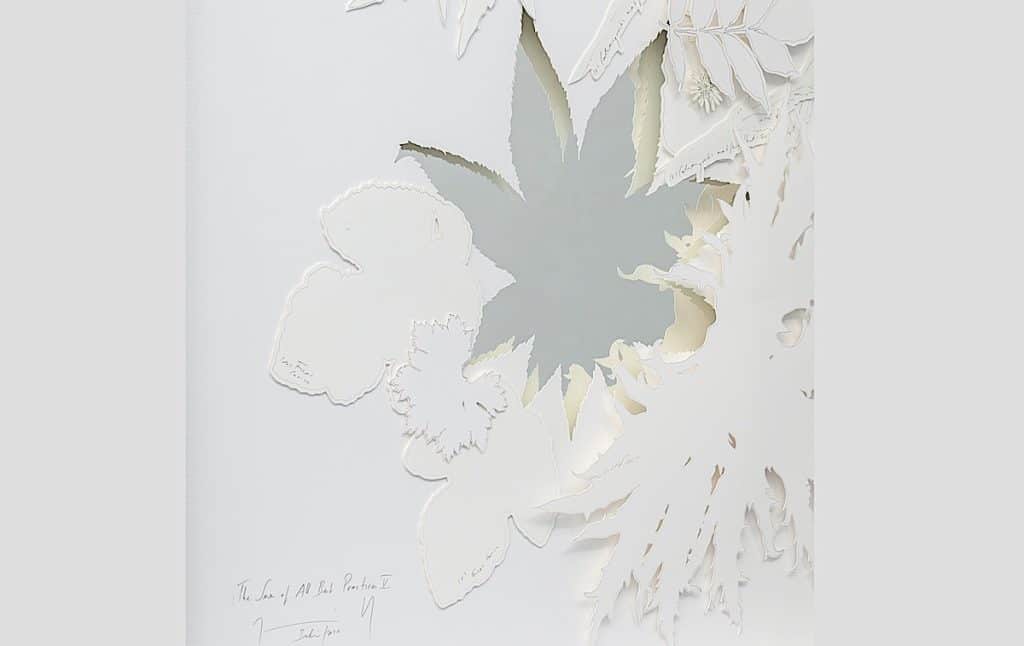
Jorinde Voigt: ‘The Sum of All Best Practices V’, 2021(detail) – Collage mounted on mirror glass stand and graphite on paper, 106 x 77 x 9 cm
But what we see are leaves?
As with plants, the shape of leaves comes from functional strategies shaped by what has worked in the past. So I was collecting real leaves around my studio and copying them 1:1 by tracing around the leaf to focus on the shape. It’s about shape, not colour, so I left them white. On the abstract level of shape, a narrative is created as your eye moves around – and again a mirror brings in the actual space, the viewer, and the back of the drawings. The annotations list the plant names. I’m celebrating the uniqueness of shapes in nature – and also the uniqueness of people.
And, if you look closely enough, every leaf – like every person – is different?
Yes… The characteristics of a person, plant or any other living being invariably tell us about their past biography or evolution. Their specific attributes are a testament to a successful strategy or solution that allowed them to survive or prevail in critical situations. Every part, every leaf of every plant speaks of the sum of all these solutions – and every leaf, therefore, is the best shape it can be. But it is also different from every other leaf, even those on the same tree. It might be similar to the next, but no two leaves are ever the same. And rather than expressing their past contexts, they reaffirm the obvious success of their survival technique, which would otherwise never have made it to the present.
Much of your older work is inspired by literature, philosophy, or music. How does this newer work relate to that?
To me, there isn’t a big difference between reading a book and looking at the garden – I’m examining how I experience it, considering the possibilities, representing the way perception operates. Everything translates into my movement, whether it’s a musical score or my garden, and that movement has always informed my works.
What next?
At least every two years, I feel the need to learn something completely new. At the moment, it is an oil painting. I previously tackled metal sculpture in the same spirit, but it doesn’t have to be an art form: I have also explored mathematics, learned to play tennis and make clothes, and earned a licence to pilot a boat. Next up is the engineering of fountains. They are all things about which I had no clue, and so had to go through all the points of frustration…
Images courtesy of the artist and Dirimart. Photos by Mel Castro Duar, Top Photo: Portrait by Pion Studio.
‘Fractures & Rhythm’ is at Dirimart London, 23 Princes St, Mayfair W1B 2LY, to 21 February. It puts the cut paper works of Jorinde Voigt into dialogue with those of Seçkin Pirim as ‘two distinct yet interconnected approaches to navigating chaos, harmony, and the search for coherence’.