The Royal Academy of Arts is mounting the most expansive exhibition yet devoted to Rose Wylie, bringing together more than 90 works that trace her practice in painting and drawing over several decades. Part survey, part recalibration, the show gathers key works alongside new and rarely seen paintings and drawings, offering a view of an artist who has consistently sidestepped neat categories in favour of instinct, scale and visual memory.
Wylie’s work is rooted in lived experience. Her paintings fold together fragments of personal history, popular culture and art history with little concern for hierarchy. Early memories of family life and wartime London sit alongside scenes drawn from films, newspapers, television and everyday encounters. The exhibition opens with works that revisit childhood recollections of the Blitz, then moves through paintings shaped by her early training in anatomical drawing in 1950s Kent, and by her return to painting in the mid-1980s after raising a family. That return produced Room Project (2002–03), the body of work that marked her wider critical recognition and announced her appetite for large, immersive canvases populated by swimmers, cats, paper figures and versions of the artist herself.
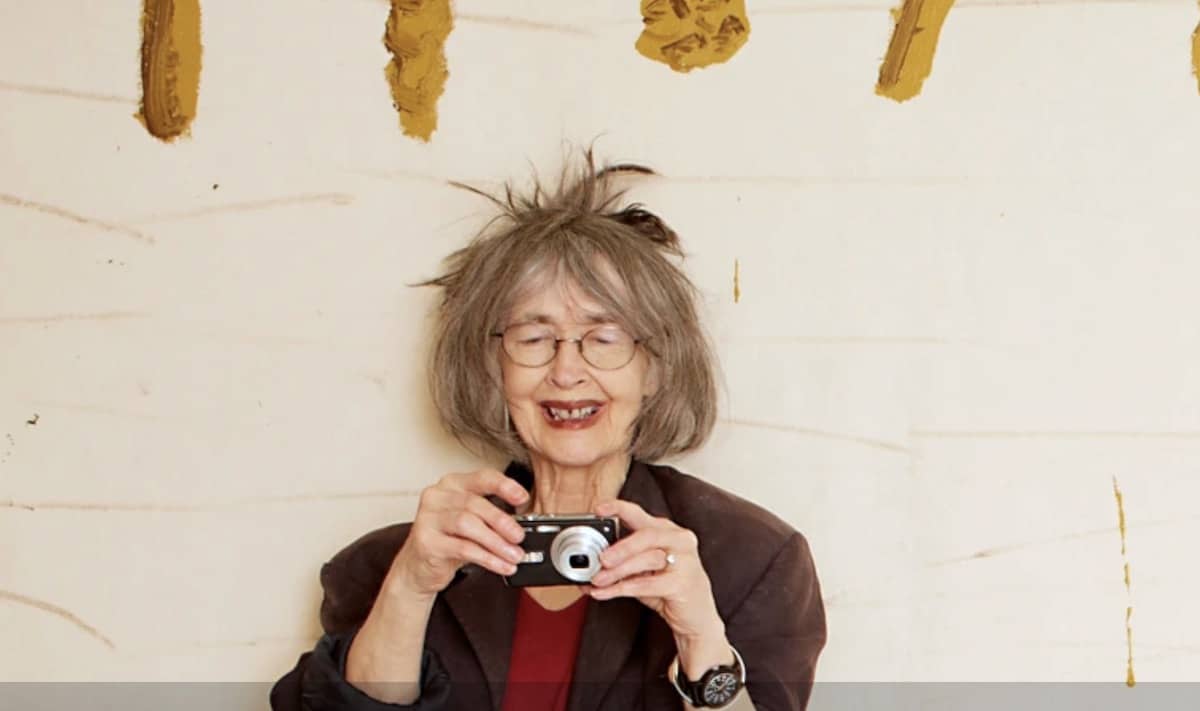
Rose Wylie RA (b. 1934)
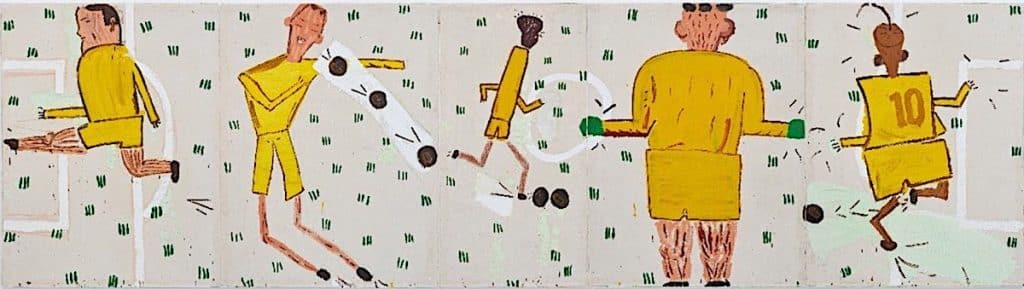
Drawing runs as a constant thread. Wylie draws daily, accumulating images that may lie dormant for years before resurfacing in paint. Works on paper appear throughout the exhibition, reinforcing drawing as a central medium of her practice. Her Film Notes series, also brought together here, reveals how cinema affects her pictorial thinking: close-ups collide with long shots, incidental details mix with dramatic moments, all reassembled through memory rather than narrative logic. Elsewhere, the visual noise of contemporary media presses in.
Newspaper photographs and online images—detached from their original contexts—are absorbed solely for their graphic force. Red-carpet appearances, ancient artefacts and fleeting news images become raw material, flattened and reworked into paintings that reflect how images circulate and lodge in the mind today. Wylie’s immediate surroundings remain a steady source: her home, her garden, her cat, meals shared with friends. The everyday blends into a visual diary.
The exhibition closes with a group of large, monochrome animal paintings, made by applying paint directly by hand. Thick, physical surfaces give these works a blunt intensity, foregrounding process over polish. The forms are legible, but that is almost beside the point. For Wylie, the image arrives through the act of painting itself. Meaning follows later—if at all.
Rose Wylie is a painter. She studied at the Folkestone and Dover School of Art and the Royal College of Art. Her work is centred on painting and drawing. Wylie represented Great Britain in Women To Watch at the National Museum of Women in the Arts, Washington, D.C., 2010. Her first retrospective exhibition was held at the Jerwood Gallery, Hastings, 2012, and was followed by her BP Spotlight exhibition at Tate Britain, 2013, which led to museum shows in Philadelphia; Tonsberg, Norway; Wolfsberg, Germany; Tal R’s Project Space, Copenhagen; and the Douglas Hyde Gallery, Dublin.
In 2011, she was given the Paul Hamlyn Award, and in 2014, she won the John Moores Painting Prize. In 2018, she was awarded an OBE in The Queen’s Birthday Honours.
She has been invited to meet and talk with students in the significant artists series ‘Artists Promenades’ at the Royal College of Art and given talks on her work at The Slade, Goldsmiths, Wimbledon College of Art, The Royal Academy Schools, The Royal Drawing School, John Moores Liverpool, the ICA and Tate Britain. Wylie has work in private and public collections, including Tate Britain, the Arts Council Collection, the Jerwood Foundation, the Hammer Collection, and York City Art Gallery.
Rose Wylie: The Picture Comes First Royal Academy 28 February – 19 April 2026