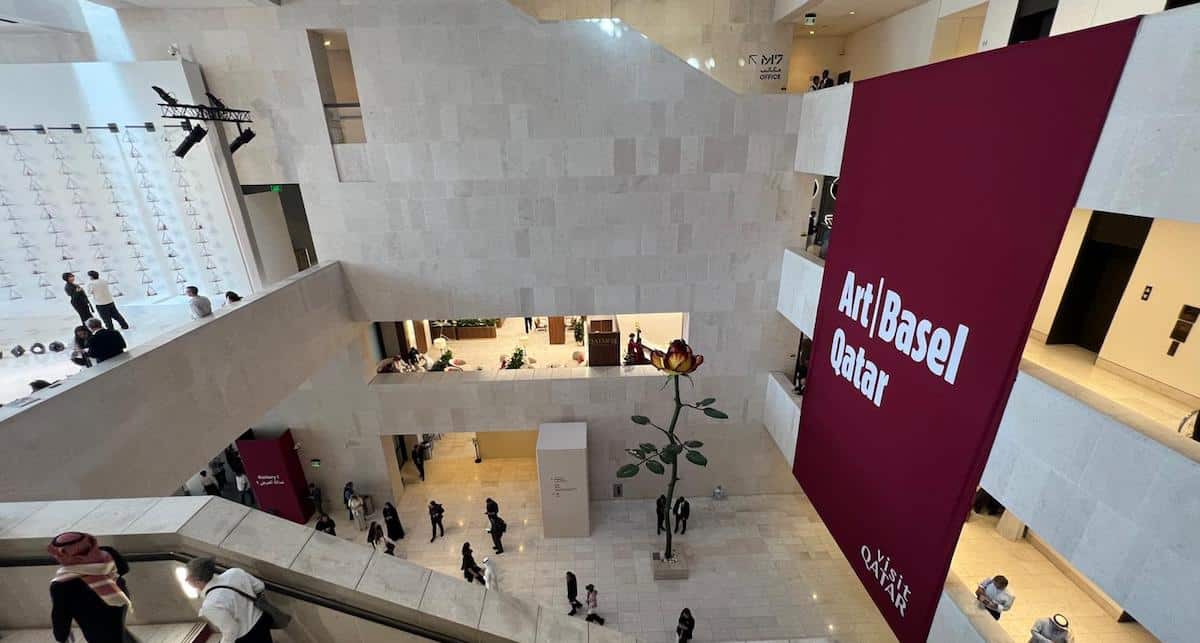
Art Basel Qatar ended its first edition this week with a level of optimism and assurance. Over the seven-day period, including VIP previews and the public opening, more than 17,000 people visited M7 and the Doha Design District, and many thousands more participated in events in Msheireb. For a first attempt, the visitor figures are essential, but what people felt was even more so. This was not a slow burner for the region; it was a fair, intended to remain, strongly supported by regional and international partners.
From the outset, the focus was on quality. Almost half of the private collectors and supporters who came were from the MENASA region, and they were joined by large numbers from Asia, Africa, Europe and the Americas – which, for the galleries, meant more than simply the number of visitors. The talks were serious, well-structured, and, most importantly, led to transactions. Sales were made across all price points, with strong demand from buyers and organisations in Qatar, Saudi Arabia, the UAE, and Europe.
With more than 85 museums and foundations in attendance, Art Basel Qatar is recognised as a key platform for discovering new art. Attendees travelled from across the Middle East and beyond – Europe, Asia, Africa, and North America. Notable institutions such as the Museum of Islamic Art, Mathaf, and Art Mill Museum, along with regional entities including Guggenheim Abu Dhabi, Louvre Abu Dhabi, Sharjah Art Foundation, and MISK Art Institute, underscored the event’s international stature. Major global institutions such as Tate, Whitney, Fondation Beyeler, Dia, and MoMA PS1 further confirmed its ability to attract important institutions.
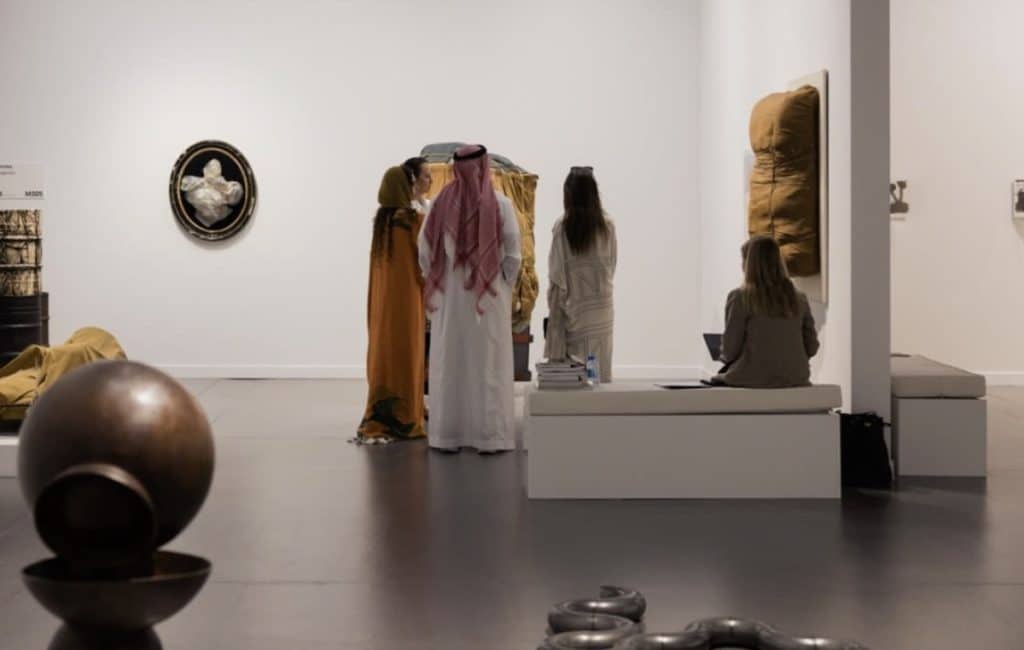
That degree of attention was also seen at the highest levels of government and culture. His Highness The Amir Sheikh Tamim bin Hamad Al-Thani went to the fair, as did Her Highness Sheikha Moza bint Nasser, His Excellency Sheikh Mohammed bin Abdulrahman Al-Thani, and Her Excellency Sheikha Al Mayassa bint Hamad bin Khalifa Al-Thani. Their presence wasn’t just ceremonial; it signalled strong government and cultural leadership, affirming that this fair is part of Qatar’s long-term cultural vision, not just a one-off event.
In terms of what people wanted to buy, the most interest was in artists from the Middle East, North Africa, South Asia, and the wider Global South. Galleries said that visitors were especially drawn to exhibitions of individual artists’ work and museum-quality pieces, with buyers showing interest in both established and emerging talents. This focus on diverse backgrounds and challenging work highlights a commitment to fostering inclusive and meaningful collections.
That idea was shown in how the fair was organised. Bringing together 87 galleries from 31 countries and regions, including 16 galleries making their Art Basel debut, the programme was intentionally compact. Stories from the area weren’t kept separate; they were placed in active conversation with contemporary work. Throughout the rooms, modern and contemporary one-artist shows were paired with new pieces made specifically for the fair and with significant works responding to the space, creating a flow that encouraged careful viewing.
“Art Basel Qatar has presented a new way forward for the art market. By building on and complementing the strong cultural and artistic infrastructure already in place here, the fair enhances the ecosystem and offers artists real opportunities to grow their practices. Seeing the artist-led presentation format resonate so clearly this week has been incredibly rewarding, and it reinforces my belief that this approach can meaningfully shape future editions of Art Basel Qatar and, more broadly, how the art market evolves. It’s been an immense privilege to work closely with all the galleries and artists, as well as the teams at Art Basel and our partners in Qatar on this incredible first edition of Art Basel Qatar.” – Wael Shawky, Artistic Director, Art Basel Qatar 2026
In addition to the fair itself, Art Basel Qatar’s Special Projects brought the event to Doha. Ten installations and performances took place in the city, in public spaces and cultural venues, demonstrating that the fair was intended to function as an area-wide event, not a closed-off commercial one. Works by Abraham Cruzvillegas, Nour Jaouda, Hassan Khan, Nalini Malani, Bruce Nauman, Khalil Rabah, Sweat Variant, and Rayyane Tabet explored themes of memory, language, identity, and change. Jenny Holzer’s SONG, shown on the Museum of Islamic Art every night, was a major event: it was subtle, aimed at everyone, and powerfully present.
The series of talks, called Conversations, was another indication of the fair’s scale. Qatar Creates Talks began with a panel featuring Sheikha Al Mayassa, Maja Hoffmann, and Hans Ulrich Obrist. Nearly 2,500 individuals came to M7 over three days, making a record for the most people at any session in Art Basel’s history. People such as Glenn Lowry, Ruba Katrib, Lina Lazaar, Rachel Whiteread, and Mohammed Hafiz spoke about the changing cultural facilities in the area, and how it connected to the world – talks that seemed current, not just hopeful.
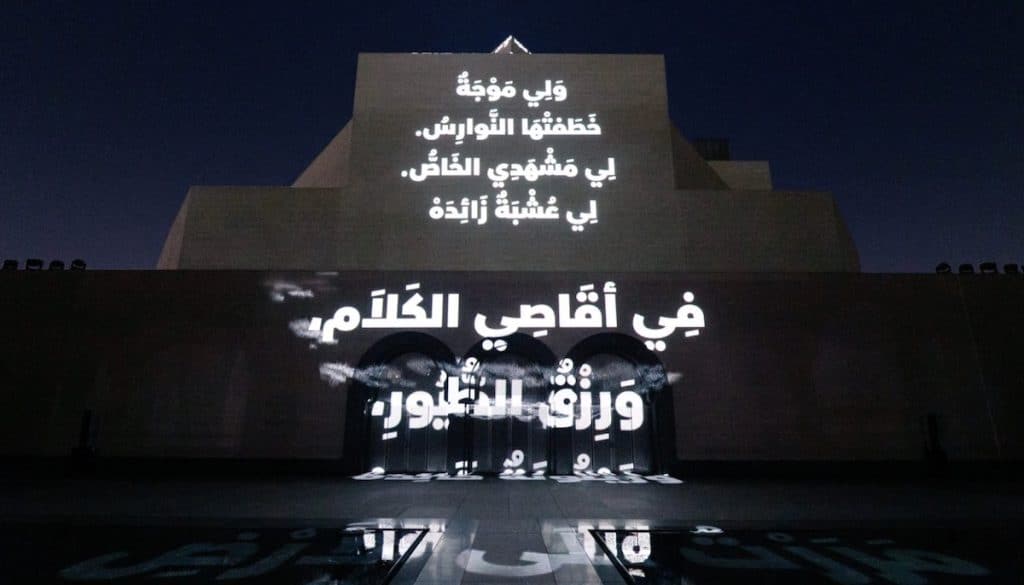
Jenny Holzer Installation Art Basel Qatar 2026
The week proved to Art Basel’s managers that an old fair model wasn’t needed for MENASA, but a new one tailored to the area’s specific needs was. Noah Horowitz, Chief Executive Officer, said this showing was creating a foundation for artists, galleries, and a lasting market structure. Vincenzo de Bellis, Chief Artistic Officer, noted the decision to work with the site rather than copy a pattern and credited Wael Shawky, Artistic Director, for creating a vision that puts artists and stories from the area first.
This thinking was also apparent outside the fair itself. Art Basel Qatar coincided with a full slate of exhibitions at the Museum of Islamic Art, Mathaf, the National Museum of Qatar, ALRIWAQ, and the Fire Station, showcasing Doha as a vibrant centre for making, learning, and international connections. The fair did not go against these places; it made them bigger.
If there was one major success of this first showing, it was self-control. Art Basel Qatar did not succumb to the temptation to stage a show of arrival. Instead, it made itself a platform – one which valued working with others over big displays, and going on over newness. With Visit Qatar as the main partner, and held February 5–7, 2026, with VIP days before, the fair ended not with statements, but with energy.
Sales
The first edition of the fair adopted an unusual open-format layout, with galleries restricted to presenting work by a single artist. Combined with a series of private transactions and a reported first option extended to members of the Qatari royal family, it resulted in one of the least transparent editions I have encountered in a decade of covering international art fairs. Some high-profile, high-priced works, such as a $42 million Picasso, were sold privately to a collector. Many of the sales were by local artists to regional museums.
Notable Sales
Hauser and Wirth offered some of the fair’s priciest works (three paintings by Philip Guston priced from $9.5 million to $14 million) we hear at least one sold.
Ahmed Mater, ATHR Gallery, 9 photos (a complete photographic study) $45,000 – $220,000 apiece
Ali Cherri Almine Rech statues and watercolours $35,000 – $153,000
Kutlug Ataman Niru Ratnam Mesopotamian Dramaturgies / The Stream $250,000 (sold to a museum)
Nari Ward Lehmann Maupin 2 works (including PRAISEWORTHY) $80,000 – $100,000 apiece
Imran Qureshi Nature Morte woven work (a version) $50,000 (an Asian museum bought it)
Aiza Ahmed Sargent’s Daughters, a big painting and smaller pieces, $3,500 – $25,000
Solange Pessoa Mendes Wood DM 2 paintings Price not given (US and Dubai museums bought them)
Museum Sales
Buying: Qatar Museums (QM) was very active, using “white slips” to indicate they intended to purchase works for the Art Mill Museum, which is set to open.
Area’s Strength: More than half of the galleries came from the MENASA area – the Middle East, North Africa and South Asia. Sales of artists from these places were robust, including Ahmed Mater of Saudi Arabia and Ali Cherri of Lebanon.
Private Viewings: Valuable pieces shown privately included a pumpkin sculpture by Yayoi Kusama at Victoria Miro and a rare Henri Rousseau at Acquavella; however, we don’t know how much these sold for.
What The Dealers and Organisers Had To Say:
White Cube founder Jay Jopling called it a “measured refinement” and a “more engaged viewing experience.”
A representative from Thaddaeus Ropac stated, “The solo format helped create a ‘deeper understanding’ of the work.
Yasmine Berrada Souni, co-founder of Casablanca- and Marrakech–based Loft Art Gallery, said that the organisers were deeply involved in the creative process. “We frequently exchanged with the fair organisers to fine-tune the curation of the booth.” “The vision is a fair that bridges commercialism and education. “Art Basel Qatar should be seen as a platform of intellectual as well as commercial exchange; yes, of course, it is ultimately about our galleries selling art, and in turn supporting their artists.”
Advisor Nicolas Nahab of NG Partners told Artsy the presence of “European clients…looking to expand their collection beyond the Western canon.”Success in Doha, however, required a higher commitment to the artists on view. Abela, the art advisor, noted that the fair’s smaller, solo-presentation format was a deliberate move to align with the “long-term vision” of buyers who prefer depth over rapid transactions. This curatorial restraint paid off: Nahab noted that the format offered a “more coherent understanding” of the work, making it easier for collectors to make “decisions on the spot.”
Noah Horowitz, Chief Executive Officer, Art Basel, said: “Art Basel Qatar represents a pivotal moment for our platform and for the global art market. Conceived specifically for this place and developed in close partnership with our Qatari collaborators, the fair reflects the region’s extraordinary cultural ambition and our commitment to building platforms that resonate both locally and globally. By connecting the broader MENASA region more deeply with Art Basel’s international ecosystem, we are creating new opportunities for artists, galleries, and audiences – while advancing a model of growth that is entrepreneurial, inclusive, and built for the long term.”
Top Photo: Clayton Calvert © Artlyst 2026