
Miranda Carroll visited the Metamorphoses exhibition at the Rijksmuseum in Amsterdam.
Transformation of words into paint or sculpture, of poetry alchemically made flesh, of shifting from one state or form to another, a constant transmutative flux. How have visual artists succeeded in telling a complex story of transfiguration within a static image? Ovid’s Metamorphoses comprises over 250 stories and has been and continues to be an inspiration for artists, composers, writers, poets, filmmakers – the list goes on.
The greatest of these recurring themes is love in all its forms – from arousal, desire, lust, passion, to self-love, consensual and non-consensual, violent forms of love, deception and manipulation: love and death and that delicate balance between the two states, the agony and ecstasy.
But like those in the stories, we have to be careful with what we look at and how we see. That’s quite key to many of the tales. There are warnings about the dangers of looking, introvertedness, voyeurism, introspection, and not looking back. Also, the sin of hubris – Icarus, for instance. Or Narcissus, Prometheus, Orpheus. A stark warning, perhaps, that the same fate may befall us. Many of these tales feature contests, arrogance in challengers thinking they are better and going head to head in a weave-off, a musical or storytelling competition – as befalls the fate of Arachne, Marsyas and others.
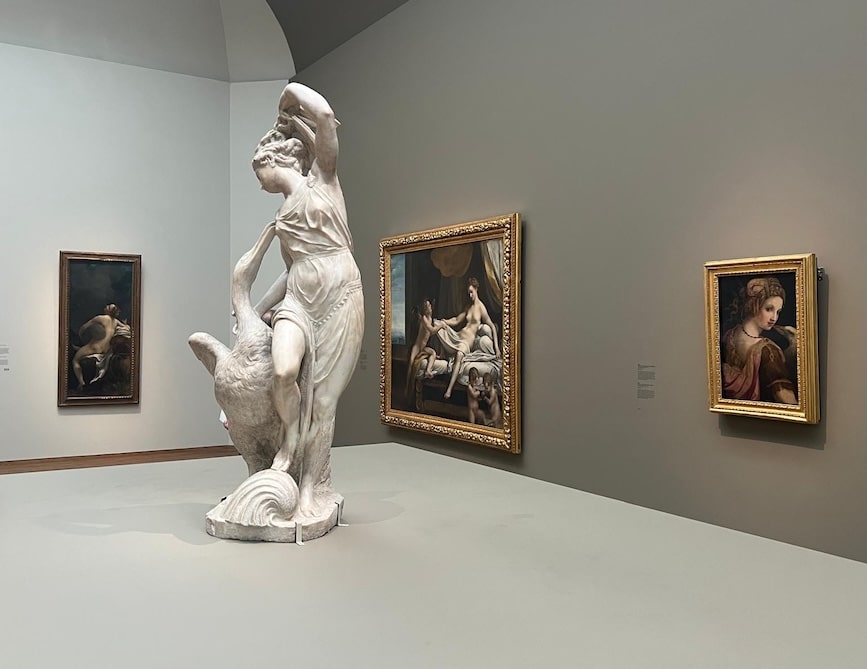
Metamorphoses at the Rijksmuseum, installation view photo by Miranda Carroll
Countless tales, endless representations – how would you choose what to include in an exhibition titled Metamorphoses?
I was hoping Bernini’s Apollo and Daphne would be here – seeing it for the first time as a student at the Galleria Borghese in Rome, I recall it as the only object in the room, drawn to its movement. Daphne crying out – from Apollo’s touch, from the feeling that something incredible is happening to her body, or what? Rapture? Her transformation is akin to a climax, perhaps. I could almost hear the sound of cracking tree bark, translucent leaves unfurling from her fingertips, roots probing the earth and fastening her feet to the ground, and recalling my awe at how Bernini had rendered solid marble into tactile flesh, that hand on her, fingers pressing into the softness. Transforming story into stone, flesh to bark, soft to hard. I wanted to be taken back to that first encounter. Would it appear differently in the austere Northern light of a cold, dull February day compared to the early summer of Rome? Alas, I was thwarted and will have to wait in sweet anticipation for the next iteration of this exhibition when it moves to the Galleria Borghese in June.
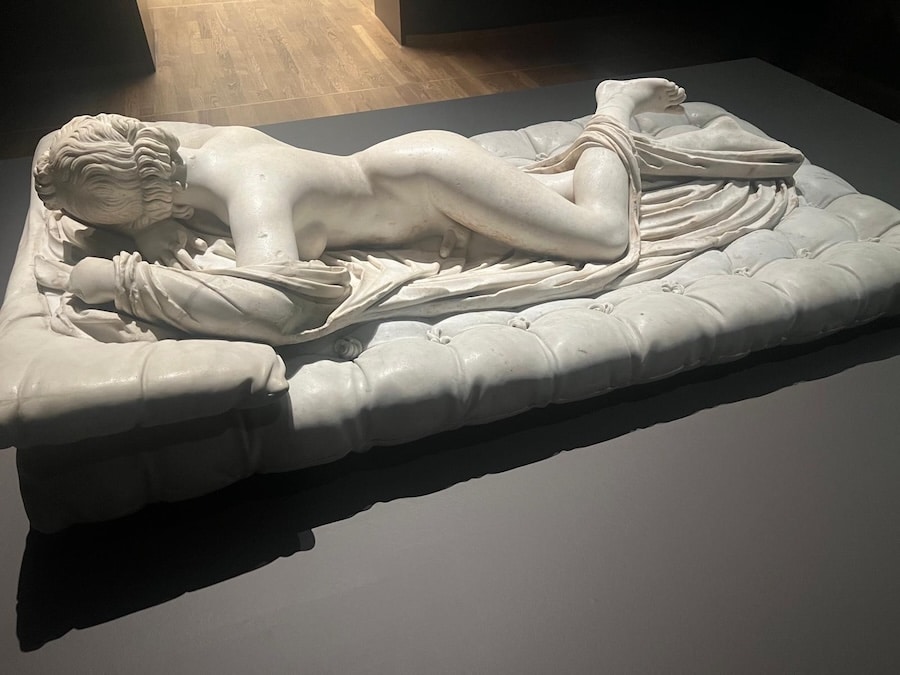
Bernini, Sleeping Hermaphroditus, Louvre Collection photo by Miranda Carroll
The Bernini that is included in this exhibition, Sleeping Hermaphroditus, from the Louvre, involves another kind of transformation – repurposing an excavated Roman sculpture and placing it on a mattress that looks so contemporary, like an IKEA futon, that the binding together of the old and new, combined with the subject matter, is disconcerting. We take part in the metamorphosis by circling the prone figure – approaching from behind, their back to you, and walking around the mattress until all is revealed.
In Rodin’s work from the Met in New York, Pygmalion, the sculptor, breathes life into the belly of Galatea after falling in love with the statue he has created and asking the gods to make her human. Both artists’ touch transforms the hard marble into something soft and tangible, crafting raw material into meaningful shape, evoking Michelangelo’s unfinished forms emerging from rough-hewn marble.
Brâncuși’s Prometheus from the Philadelphia Museum of Art reduces the head to a hint of a nose, brow and an ear from an egg-shaped oval of marble, just as the god is said to have shaped the first humans from clay. It’s beautiful in its simplicity.
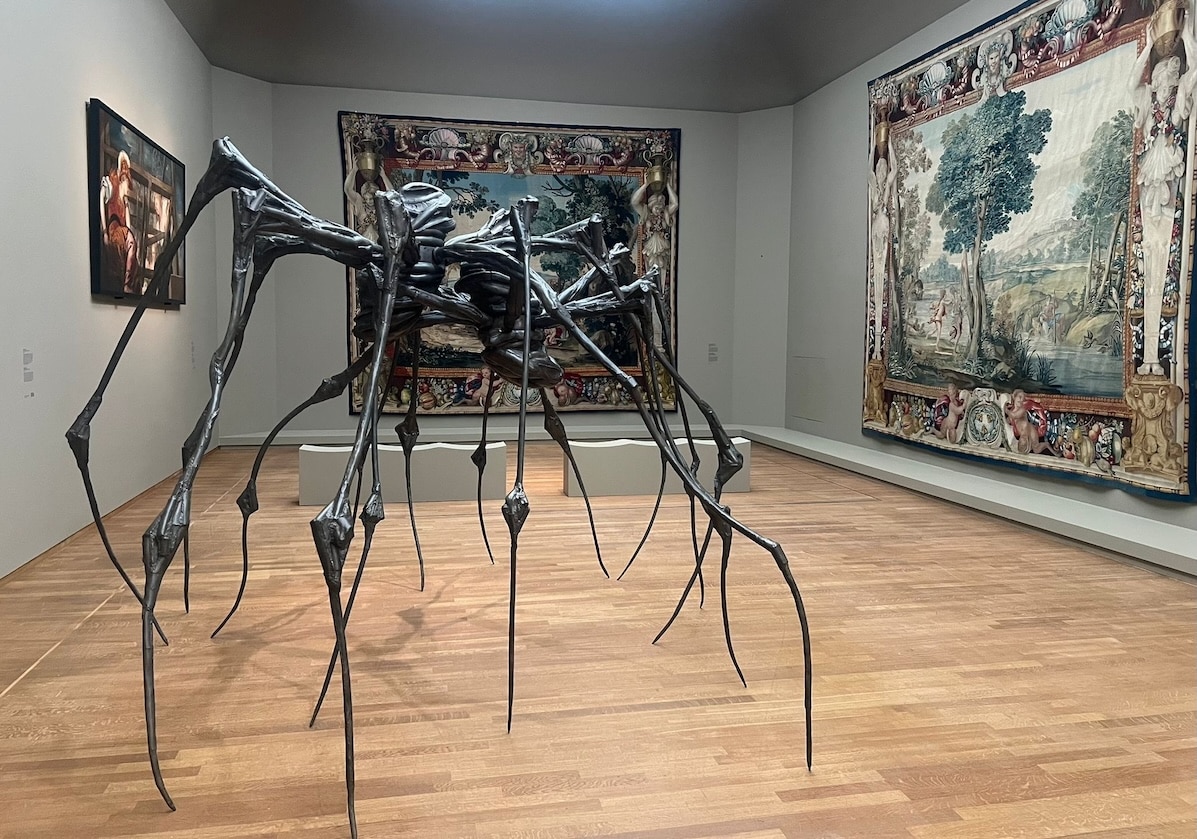
Including Louise Bourgeois’ Spider Couple from the Kunstmuseum in The Hague in the section on Minerva and Arachne is predictable (her mother wove and repaired tapestries). However, the contrast with the paintings by Giordano and Tintoretto and the large tapestries on the same subject weaves the story together nicely. Arachne’s arrogance was her downfall, leading Minerva to transform her into a spider who would spin webs for eternity.
In Correggio’s sensual and seductive painting from Vienna’s Kunsthistorisches Museum, sneaky Jupiter transforms himself into a mist that engulfs Io, priestess to his wife Juno, in order to take her. Contradicting the assault described by Ovid, here Io is seen in ecstasy, the bear-like claws of cloud around her waist as she presses the hazy vapour deep inside her. Feeling somewhat voyeuristic, as if stumbling upon this intensely intimate moment from behind her, I couldn’t look away from the rapturous expression on Io’s face – her head thrown back, her parted lips, and the emergence of the spectral visage of Jupiter leaning in to kiss that face. A representation of this work hangs on the wall in scene 4 of Hogarth’s Marriage à la Mode, alluding to infidelity – not the only Ovidian reference in that series. The other Correggio in this exhibition from Rome’s Galleria Borghese, where Jupiter comes in a shower of golden rain penetrating Danaë, is less erotic, as too is Titian’s version nearby from Apsley House in London, perhaps because in both Danaë faces us, and we are drawn into the scene. Almost equally sensual is a Leda and the Swan, after Michelangelo, from London’s National Gallery, where the overtly eroticised touch of lips to beak and Leda’s splayed stance taking in the swan’s form could be the reason for the disappearance of the original version of this work.
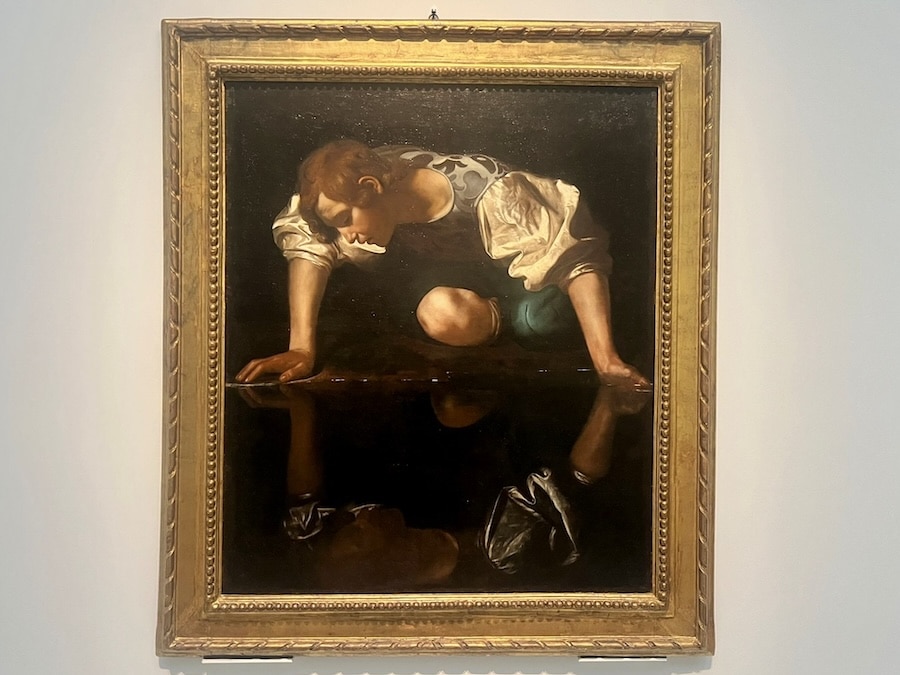
Caravaggio, Narcissus c1597-1599 photo by Miranda Carroll
The highlight of the exhibition for me is Caravaggio’s Narcissus from the Palazzo Barberini in Rome, in which the viewer has an unusual vantage onto the scene, on a level with him, gazing at his own reflection as if we might see our own. He can’t tear himself away from something he can never have, touch it, and it’ll dissolve. Looking is all he has to keep the illusion alive. And you’re compelled not to look away too, as you’re sharing the confined and claustrophobic space with him, hemmed in by the frame.
Do the more contemporary works complete this exhibition? They certainly complement it in some cases, but seem gratuitous in others. The 3-screen film Spawn by Juul Kraijer fills the dark space it’s screened in, where writhing snakes surround and eventually smother and obliterate the tranquil human face, becoming one. It’s mesmerising and terrifying, and succeeds also because it is the only work in the exhibition that’s not static.
There’s an abrupt colophon in the last room hosting just two works – Giordano’s Apollo and Marsyas from El Escorial in Madrid, where the horrific cutting away of the tortured satyr’s flesh is a metaphor for the renewal of the soul, and opposite this Magritte’s The Red Model III from Rotterdam’s Museum Boijmans Van Beuningen, in which a pair of boots morph into bare feet. Yet of course, all these stories will continue to be interpreted and reinterpreted, again and again.
Omnia mutantur, nihil interit (Everything changes, nothing perishes). Ovid, Metamorphoses, 15:165
Metamorphoses
6 Feb – 25 May 2026 Rijksmuseum, Amsterdam
Visit Here
22 June – 20 September 2026 Galleria Borghese, Rome
Visit Here
Words and photos by Miranda Carroll ©Artlyst 2026