
Bonhams, the auction house, has opened its new U.S. headquarters at 111 West 57th Street, unveiling a flagship that is as much about visibility and long-term positioning as it is about square footage. The move places Bonhams at the heart of Manhattan’s most symbolic cultural corridor, anchoring itself within the landmarked Steinway Hall and beneath the needle-thin residential tower designed by SHoP Architects that now rises above it.
For decades, this building has been synonymous with music, stunning craftsmanship, and timeless prestige. In making it their new home, Bonhams gains something most auction houses lack: a space with serious architectural weight that still feels welcoming to the public. The new headquarters, over 42,000 square feet in all, unites the historic Steinway Rotunda with a sweeping, 80-foot glass atrium. This light-filled hall acts as both an entrance and a gallery in its own right. More than just a place for auctions, it’s a space designed to make you pause, step inside, and simply be there for a moment.
Across four floors, the headquarters has been purpose-built to accommodate Bonhams’ unusually broad range of collecting categories, from fine art and jewellery to cars, memorabilia, and design. Auction rooms sit alongside exhibition galleries, storage facilities, cataloguing studios, and client spaces, all consolidated under one roof.
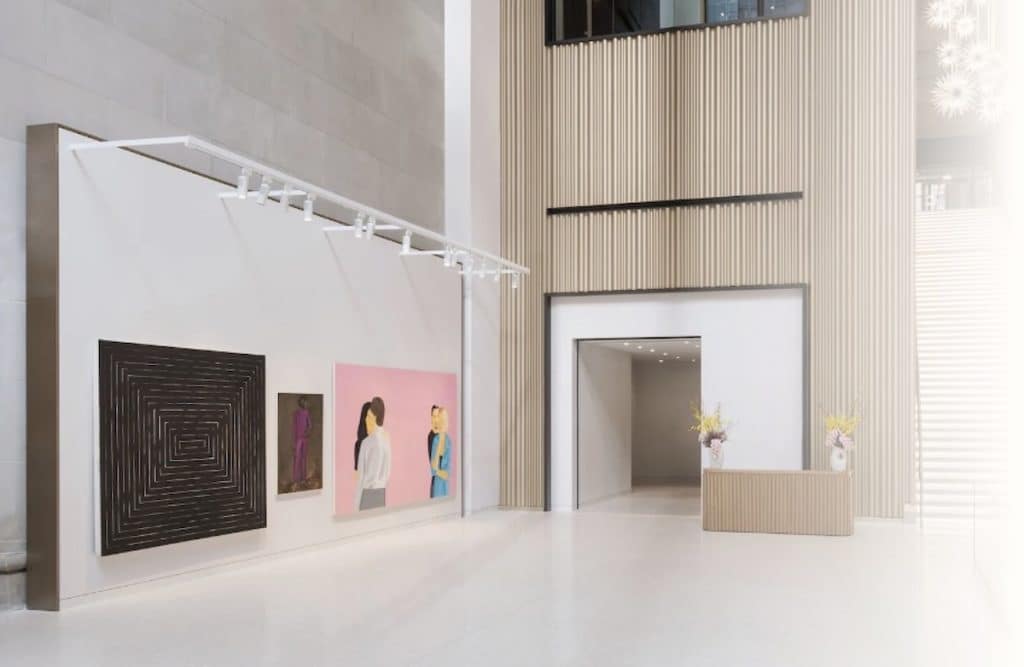
Bonhams Brand New NY Headquarters
Bonhams has marked the opening with a month-long programme of exhibitions and previews that lean deliberately into the building’s musical lineage while asserting the house’s cross-category ambitions. Rather than a single blockbuster sale, the launch unfolds as a series of overlapping cultural moments, part exhibition, part market rehearsal, aimed at positioning the space as a destination rather than a transactional stop.
At the centre of the programme is Striking a Chord, an exhibition staged in the atrium and running from 9 February to 6 March.
Among the highlights is La Muse endormie II by Constantin Brancusi, an exceptionally rare sculpture to appear on the market and a quiet anchor for the exhibition’s ambitions. The work is joined by pieces from John Chamberlain, Francis Bacon, Lee Krasner and others, creating a dialogue across modernism and post-war abstraction that feels calibrated rather than overcrowded. The effect is less spectacle than assurance: Bonhams signalling that it can operate comfortably at this level.
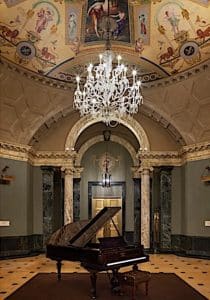
Bonhams NY Headquarters
Music, unsurprisingly, plays a more literal role elsewhere in the building. In the restored Steinway Rotunda, Bonhams is presenting a 1910 Steinway & Sons Model B grand piano with an unusually layered provenance. Played by Elton John during the recording of Caribou in 1974—including “Don’t Let the Sun Go Down on Me” the instrument later spent time at the Caribou Ranch studio and a decade on display at the Musicians Hall of Fame in Nashville. Now returned to Steinway Hall, it carries with it a century of musical and cultural history.
Estimated at $250,000 to $350,000, the piano will be offered in Bonhams’ forthcoming Masters of Pop sale later this spring. Before that, it will serve as a live presence in the building, anchoring a series of performances that reinforce the headquarters’ status as an active cultural space rather than a static showroom.
Elsewhere, Bonhams has turned to historical recalibration. Modern Cuban Painters from Havana to New York, presented in collaboration with the Fundación Mariano Rodríguez, revisits MoMA’s landmark 1944 exhibition Modern Cuban Painters, reassembling works that helped introduce Cuban modernism to the United States. Shown at the 111 Gallery, the exhibition reunites paintings that have not been publicly displayed together in more than eight decades, alongside archival material that maps the networks and ambitions of the period.
Artists including Wifredo Lam, Mario Carreño, Cundo Bermúdez, Mariano Rodríguez, and Amelia Peláez are represented, positioning the exhibition between historical correction and timely rediscovery. In a market increasingly attentive to overlooked modernisms, the show feels pointed without being opportunistic.
A shorter preview, New York Modern: The Evan Lobel Collection, offers a different lens. Drawn from the collection of the New York gallerist, the presentation focuses on post-war design shaped by French and Asian traditions but reworked through a distinctly New York sensibility. Works by Philip and Kelvin LaVerne, Karl Springer and Stephen Rolfe Powell are shown alongside a rare Andy Warhol painting with diamond dust depicting Sid Bass. The preview precedes a March auction but also serves as a reminder of New York’s role as both an incubator and an amplifier of design innovation.
Additional material from Bonhams’ February online sales, ranging from sports and music memorabilia to Ottoman painting and contemporary Cuban art, fills out the programme, reinforcing the house’s claim to breadth as a strength rather than a liability.
For Bonhams’ leadership, the opening represents more than a real-estate upgrade. Lilly Chan, Managing Director of Bonhams U.S., has described the building as enabling a more experiential approach to engaging collectors and the public. At the same time, CEO Seth Johnson has framed it as a long-term investment and a statement of confidence in the American market. Both readings are true and telling.
Whether New York responds in kind will become clear over time. For now, Bonhams has planted its flag on 57th Street not quietly, but with a carefully orchestrated blend of history, commerce, and cultural intent.