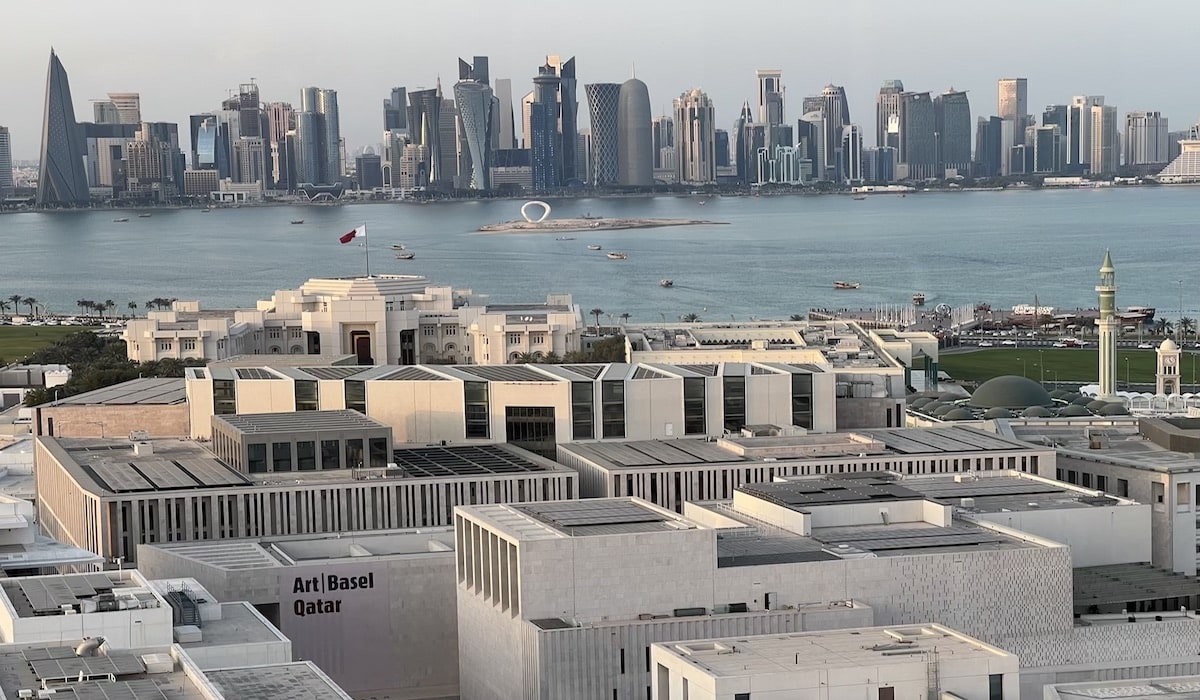
Doha is one of the most diverse cities on Earth, with a population of expats that outnumbers Qataris. This makes it the perfect place to host an international art exhibition that focuses on the shifting landscape of the contemporary art world and reflects the current shifts in global geopolitical power structures.
There were 84 solo presentations from artists with 87 galleries participating in the fair, the smallest scale Art Basel by far, and the show thoughtfully highlighted artists and their work rather than catering to the often overwhelming market-driven feel of many art fairs. There was an intimacy to the Art Basel Qatar experience that was refreshing, as well as a deep exploration of artists and their practices, significantly enhanced by the fact that about half of the artists were able to attend. This boutique feel, coupled with the embrace of the local community, ensured that the first edition of Art Basel Qatar was a unique experience. Wael Shawky was selected as Art Basel’s artistic director, a very smart choice given his significant international impact and projects, including the Egyptian pavilion at the 2024 Venice Biennale, among many others. Shawky also runs the Fire Station Artist residency program in Doha, an arts initiative that has been ongoing for over 40 years. It would be an understatement to call Art Basel Qatar a mere success, given how impressive the fair experience was and the nation’s embrace of contemporary art that speaks to the global south and far beyond. Art Basel Qatar was a triumph!
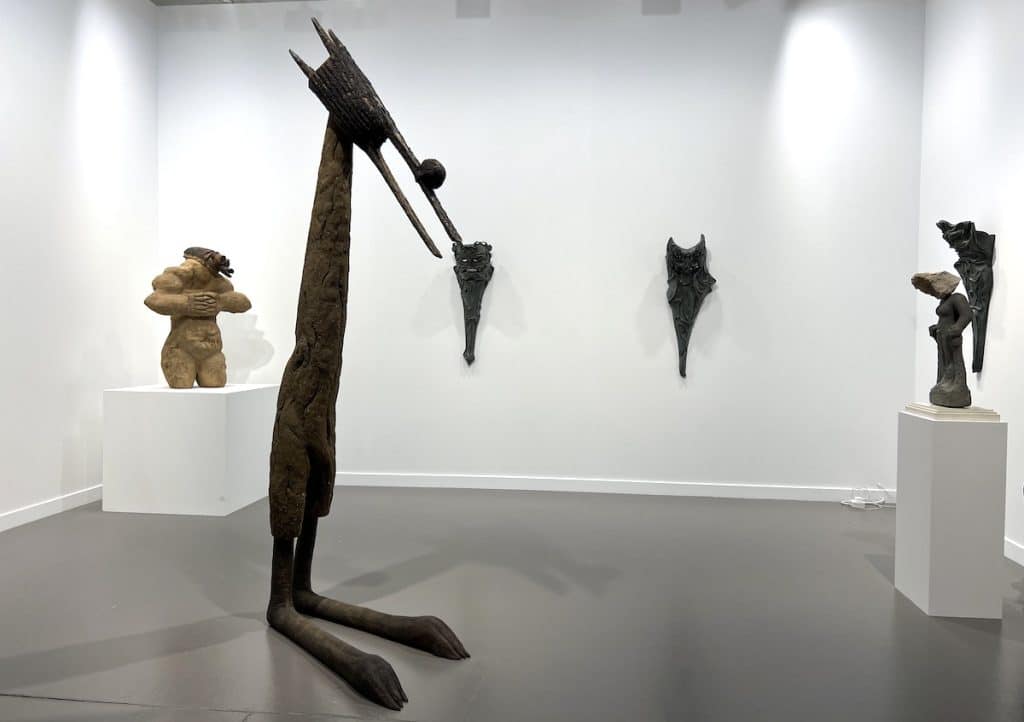
Ali Cherri, THE HOWLER, 2026 – Zoomorphic mask. Wood, epoxy, steel, clay, sand, pigments and acrylic – Unique © Ali Cherri, Almine Rech
The first piece viewers saw upon entering the fair was Ali Cherri’s breathtaking sculpture, THE HOWLER. This towering figure, as well as the rest of the sculptures on display, gave viewers a sense that this would not be your typical fair experience. This would be a chance for regional artists to shine and to proudly claim their place among some of the greats of art history; there were, after all, presentations by Guston, Basquiat, and Picasso nearby in addition to work by Katz, Christo, Kounellis, and Wong throughout the fair. The zoomorphic mask was beautifully placed atop a thin body with almost rabbit-like legs. The piece’s engineering is impressive, but the small details are even more so. The handcrafted element of the body’s worked surface, along with the strong structural feel, really conveys a creature ready to spring to life. The toes expressed a beautiful tension, as if they were keeping the creature balanced. The ball of clay and sand on the head was also a striking moment of balance, drawing the viewer closer to the mask’s details and the artist’s intervention.
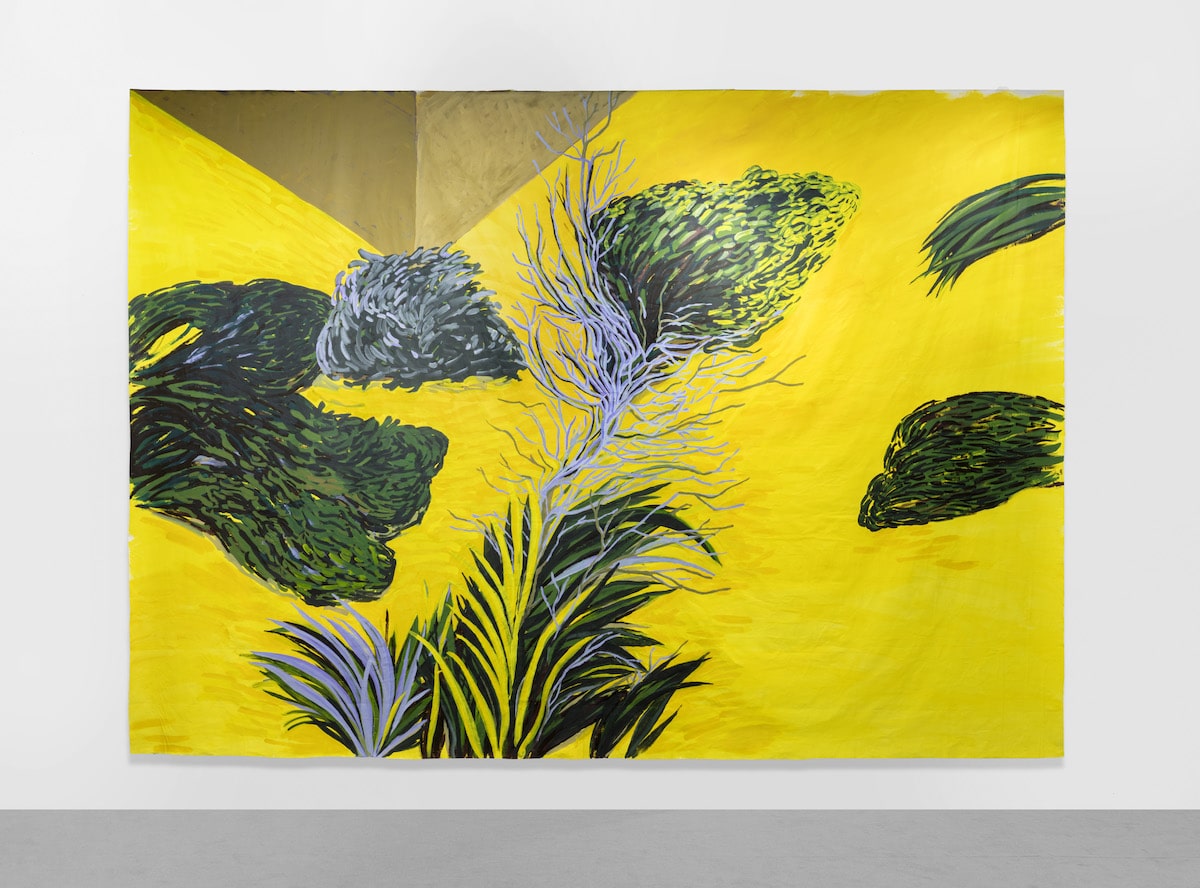
Farida El Gazzar, Desert Dance, 2025, acrylic on canvas, 3.8 x 5 m, Kalfayan Galleries
This large-scale canvas is impactful through its size and colour. The vibrant yellow ground starkly contrasts with the organic green and lavender palette of the vegetation. There were also several small paintings on display, which really offered a great view into the breadth of the artist’s oeuvre. There is certainly a rhythmic quality to the piece, as implied by the title, and the fact that the artist would have had to really engage physically to complete such a grand work in what can be understood as a dancelike performance in the execution. The energy is tremendous in this piece, and the work honours the desert and the resilience of people who call it home, in addition to the fortitude of the vegetation that grows there. The piece speaks to both humanity and nature overcoming a harsh environment.
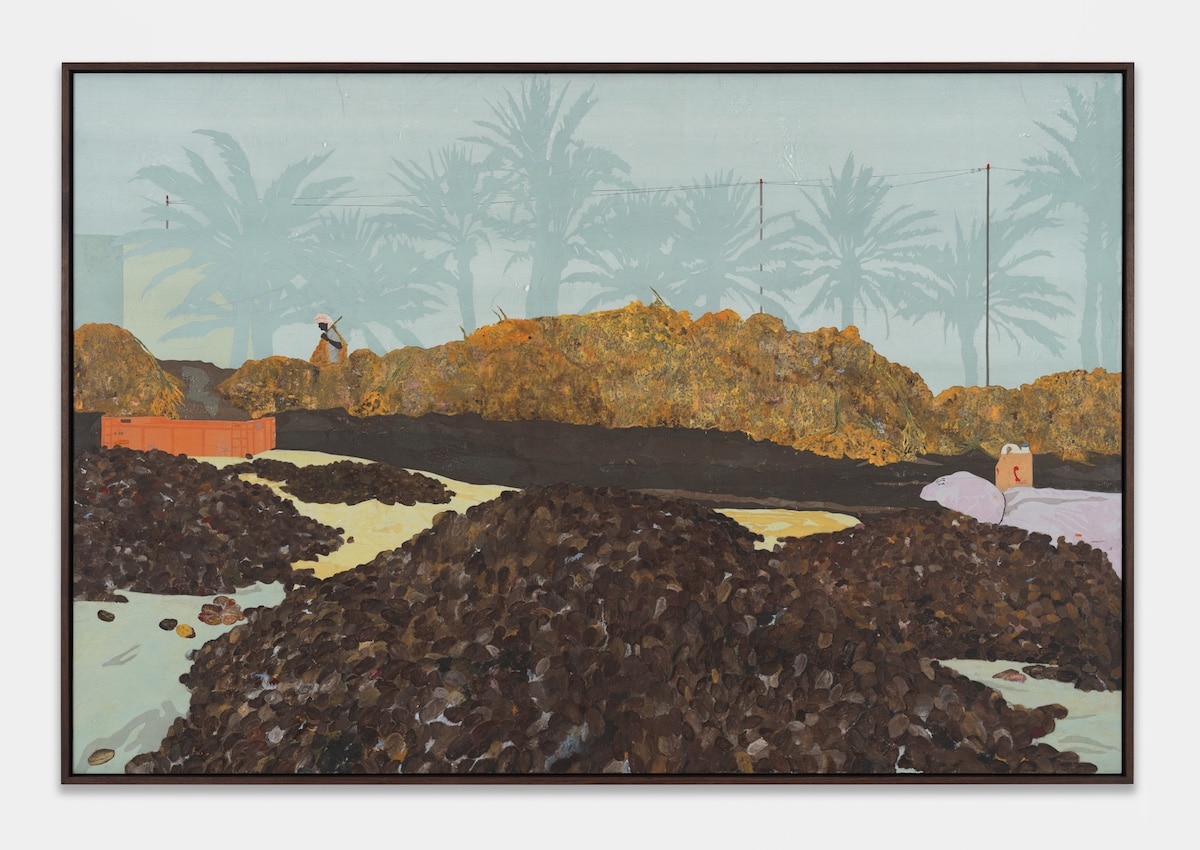
Hugo McCloud, assorted values, 2025, oil paint and single-use plastic mounted on panel, © Hugo McCloud. Courtesy the artist and Sean Kelly, New York
Dates are a symbol of sustenance in the Gulf region and elsewhere, as well as of immigration, given that they are often carried on long journeys over land or water. McCloud is keenly aware of the context of his work, and he includes content that speaks to both the region and the moment. His use of recycled plastic further enhances the narrative therein. Silhouettes of palm trees are subtly placed in the background, while the foreground is overflowing with dates. The work speaks to abundance; however, the small-scale worker in the background draws attention to the massive amount of human labour required to sustain this practice. The individual is overshadowed in this piece, which emphasises the collective effort required for date farming and highlights the difficulties individuals may face when societies make major technological or commercial leaps. McCloud’s painting is a metaphor for the present and future of the Gulf and the world at large.
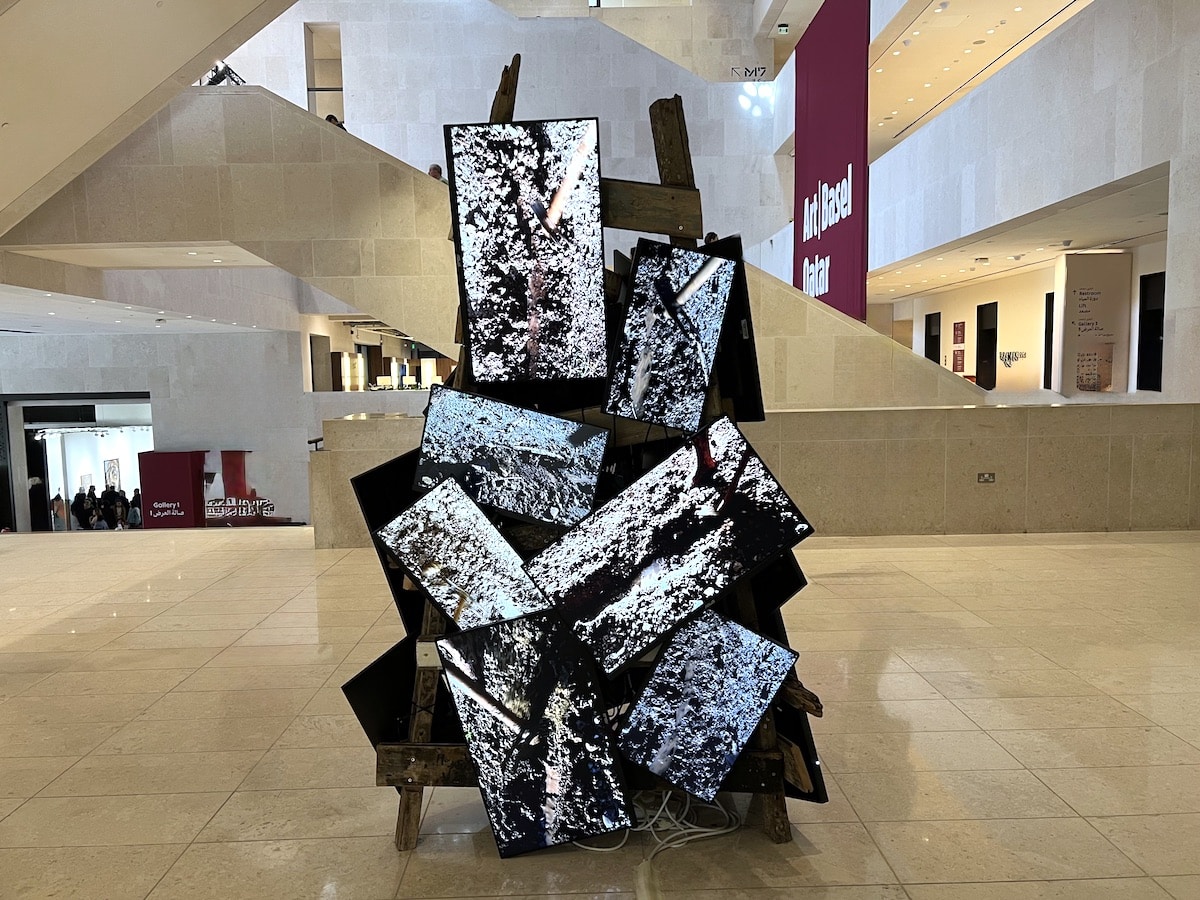
Kutlug Ataman, The Stream, 2022, 22 flat screens, wood, variable dimensions, Niru Ratnam
Ataman stayed away from the contemporary art scene for years, having last debuted a new work in 2015, preferring a life dedicated to farming. This piece should be a powerful return to the world stage with a striking presentation that references his current agricultural practice. Ataman is a farmer who has documented his quotidian life, digging irrigation ditches to bring water to the land. The installation is complete, with sound, and the framework for the screens is carefully crafted from found wood. Even though the work has digital components, it maintains a very strong manual feel and shows reverence for handcrafted work. It honours work and shows just how powerful individual efforts are. The artist was unable to attend the fair because it was planting season on his farm.
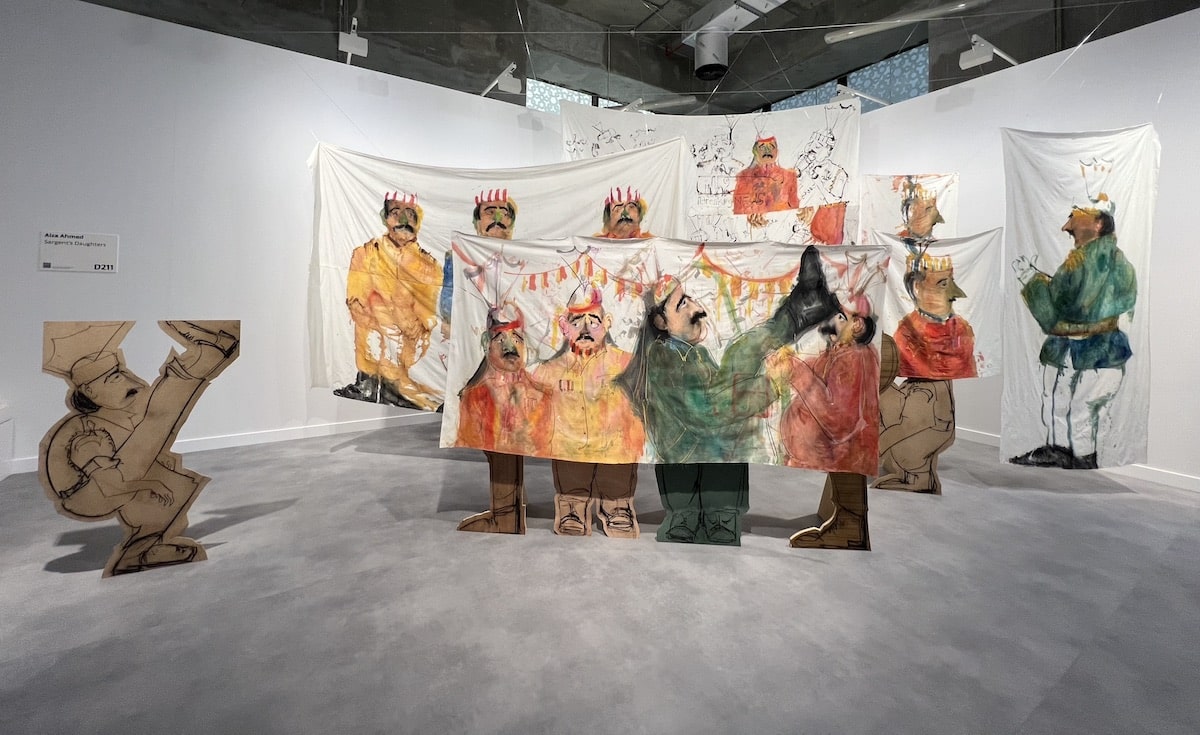
Aiza Ahmed, Footnotes Series (installation view), 2026, muslin and wood, Sargent’s Daughters
Aiza Ahmed is a Pakistani-born artist based in New York City who presented an installation from her Footnote Series, which represents the Wagah–Attari border ceremony on the Pakistan-India border. This references the over-the-top military pageantry between Pakistan and India. This hotly contested region maintains a show of pageantry and theatricality that is a strong example of soft power and the perception it creates. Multiple rows of large paintings on wood and muslin invite the viewer to be visually enveloped as they approach the installation. It is even possible to walk around the work and between these layers of paintings and sculptures. The soldiers have expressionistic glances, and the exaggerated leg-kicking of the soldiers gives the work a beautiful, harmonious composition while also lending it an absurdist quality. The viewer becomes immersed in Ahmed’s world, and the artwork’s larger-than-life feel enables a powerful face-to-face interaction. Ahmed asks the spectator to look at the concepts in her work head-on and to participate in the ceremony she depicts.
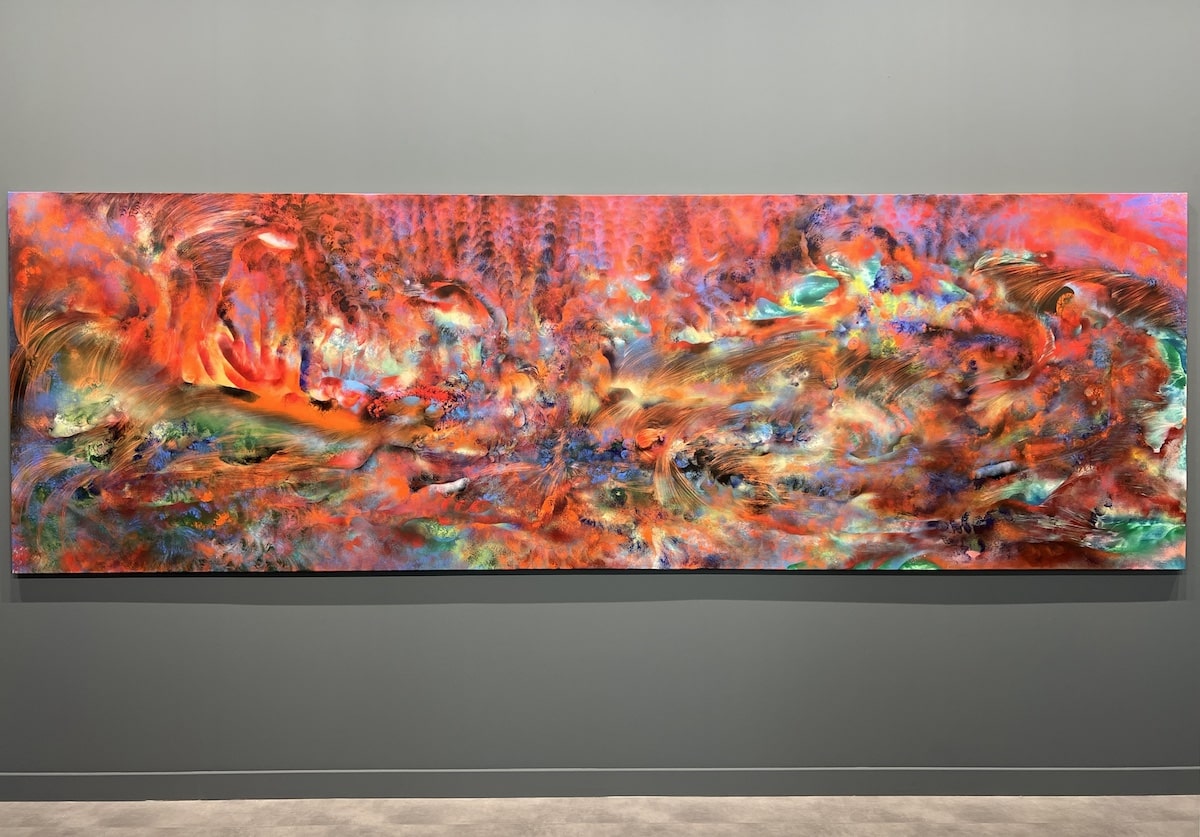
Lucy Bull, 13:23, 2025, Oil on canvas, David Kordansky
This strikingly colourful work by Lucy Bull is rich in both colour and technique. The sgraffito highlights the multilayered quality of the rhythmic composition while adding depth that only enhances its variety—one imagines Bull in her studio, undulating between broad gestural strokes and fine, precise painting techniques. The entire piece almost feels like a tempest of colour. The work feels like a dance: despite being a static painting, it conveys motion in an extremely compelling way. The piece is a tour de force, showcasing the immense power of colour, texture, and form, as well as Bull’s mastery of them.
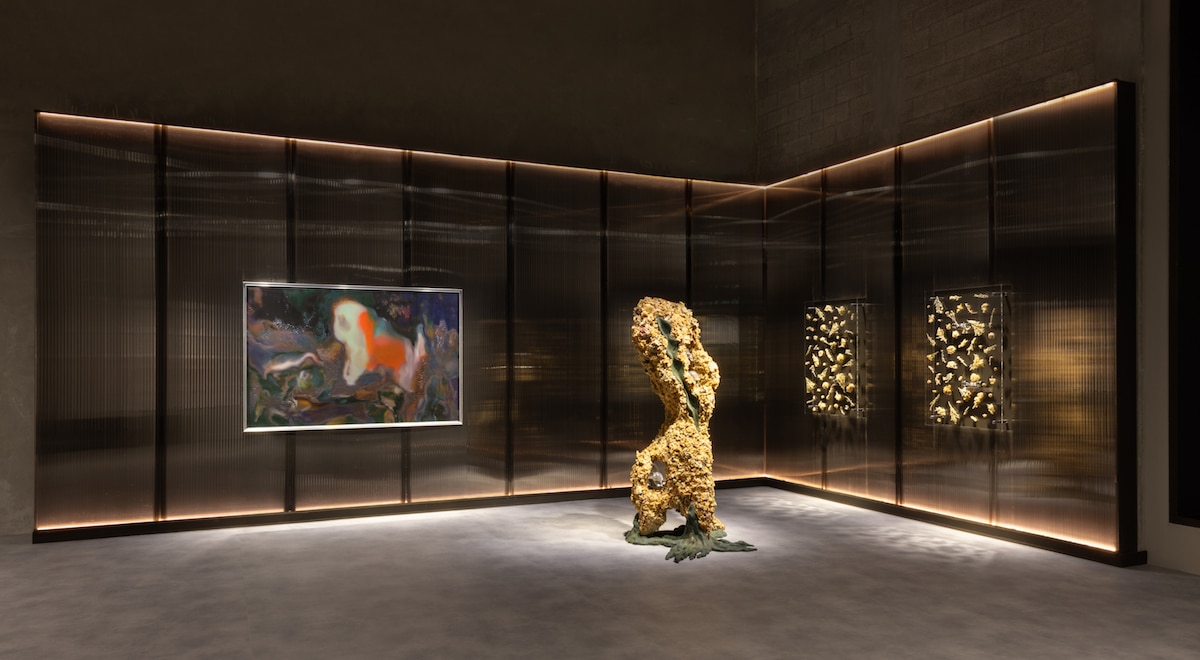
Anicka Yi, Installation View with works from 2024-2025, Image Courtesy of Esther Schipper, Photo © Andrea Rossetti
Anicka Yi’s installation felt almost like a peek into the laboratory of a scientist, where nothing is left to chance. Her vibrant paintings starkly contrast with her tempera and meticulously crafted resin sculptures. It is easy to get the sense that Yi is obsessed with the natural world and its physical structures; however, it is also clear that Yi is deeply thoughtful about our impact on and relationship to them. There are no sealed vitrines; rather, the entire space gives the feeling that the viewer is part of the experiment. There is an engaging sense of wonder as liquids are embedded in the larger sculpture, reminiscent of heart chambers or lungs, and hand weights are placed behind glass panels, with thoughtfully arranged sections of tempera. There is an urge to touch the work, but it also has a delicate, fragile feel, suggesting that touching it might destroy the entire ecosystem. The booth offers a glimpse into a world where things are preserved and documented, but also where they ask to be understood.
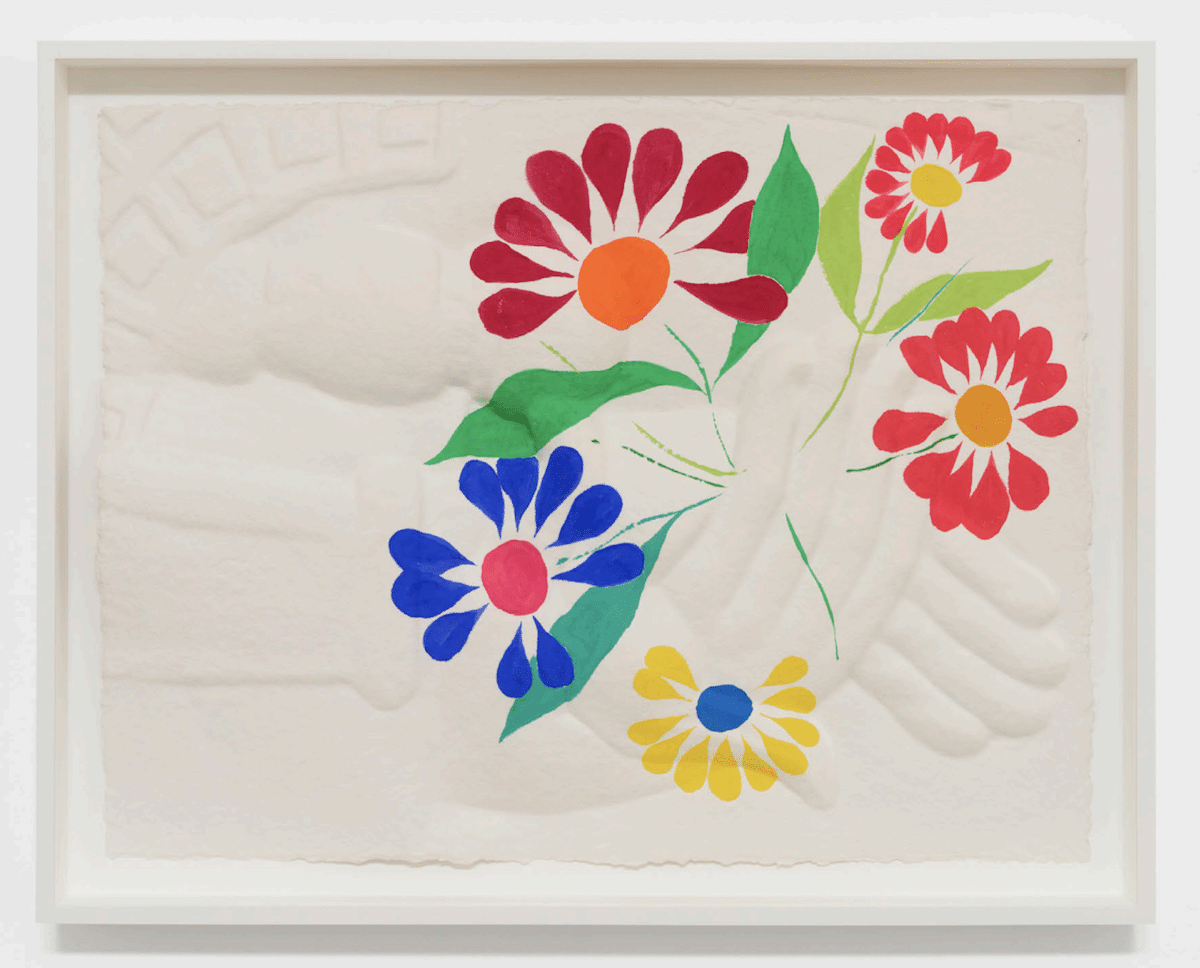
Charles Ray Untitled 2024 Gouache on handmade paper Matthew Marks Gallery, Image courtesy of Matthew Marks Gallery
Charles Ray showed incredibly powerful works on paper, as well as a chrome sculpture that many viewers might recognise him for. The smaller scale and deeply rich colour and texture of the works on paper left quite an impression. The works start with a sculptural form, which is then covered with handmade pulp paper to document the relief. The relief image in this work depicts chunky, soft hands held together in forms that recall Picasso or Léger. The deep relief of the paper’s background further amplifies the colours of the gouache flowers painted on the raised areas. There is a sculptural component created by this technique as well. The work is an offering of flowers to the viewer, a visual play expertly executed, also to evoke a sense of wonder in the audience. It is a beautiful gift and a gesture of peace or appreciation.
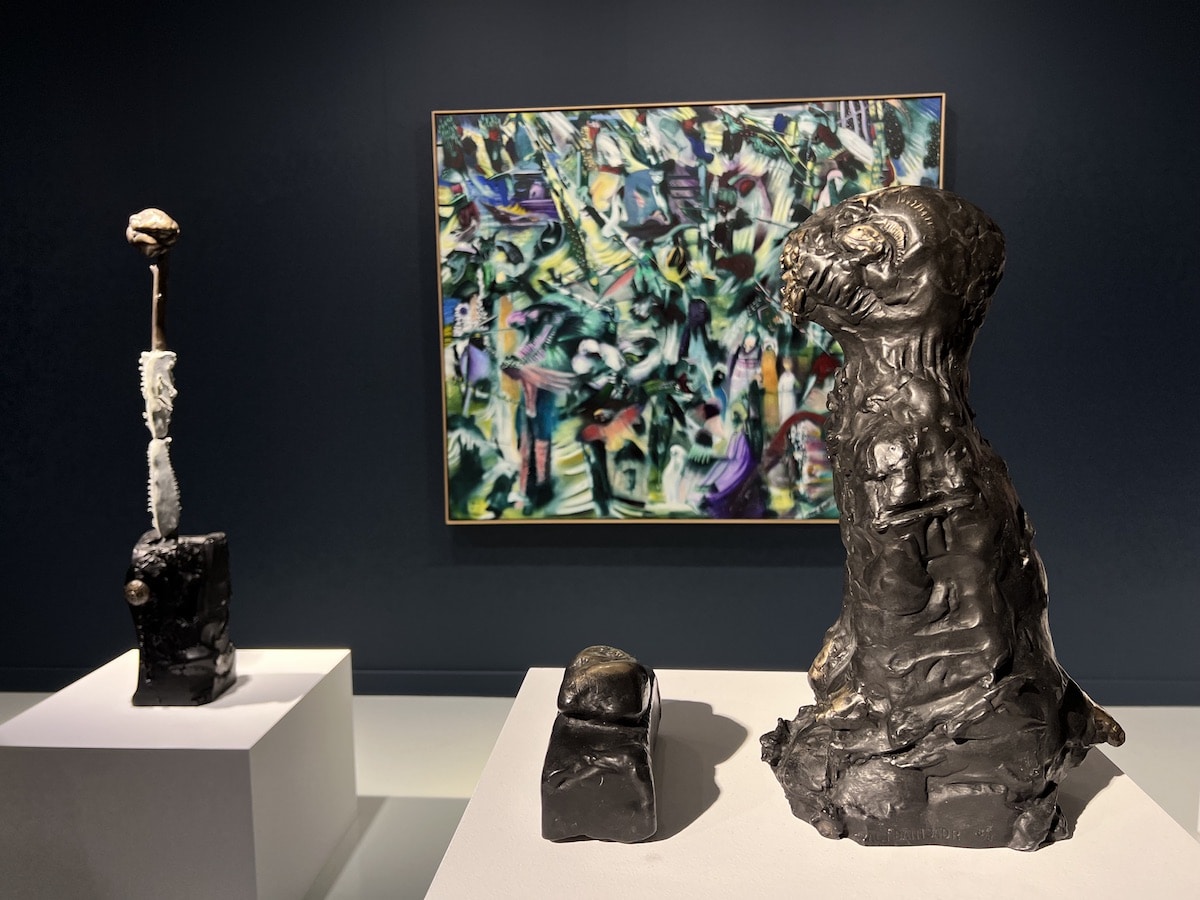
All Banisadr, Installation View with works from 2025-2026, Perrotin
Ali Banisadr’s presentation with Perrotin was a magical moment that showed the versatility of an artist at the top of his game. The bronze sculptures have forms that echo Twombly and Giacometti while also harkening back to ancient Cycladic sculptures and beyond. These offered a beautiful contrast to Banisadr’s vibrantly coloured paintings, full of fantastical figurative forms and hypnotic energy. This presentation offered a chance to be immersed in Banisadr’s world through the juxtaposition of many elements of his artistic practice, including a striking work on paper. Banisadr is known for his painstaking execution and for his limited production, given how much goes into each work. It was wonderful to have such a rare glimpse into what could almost pass for the artist’s atelier.
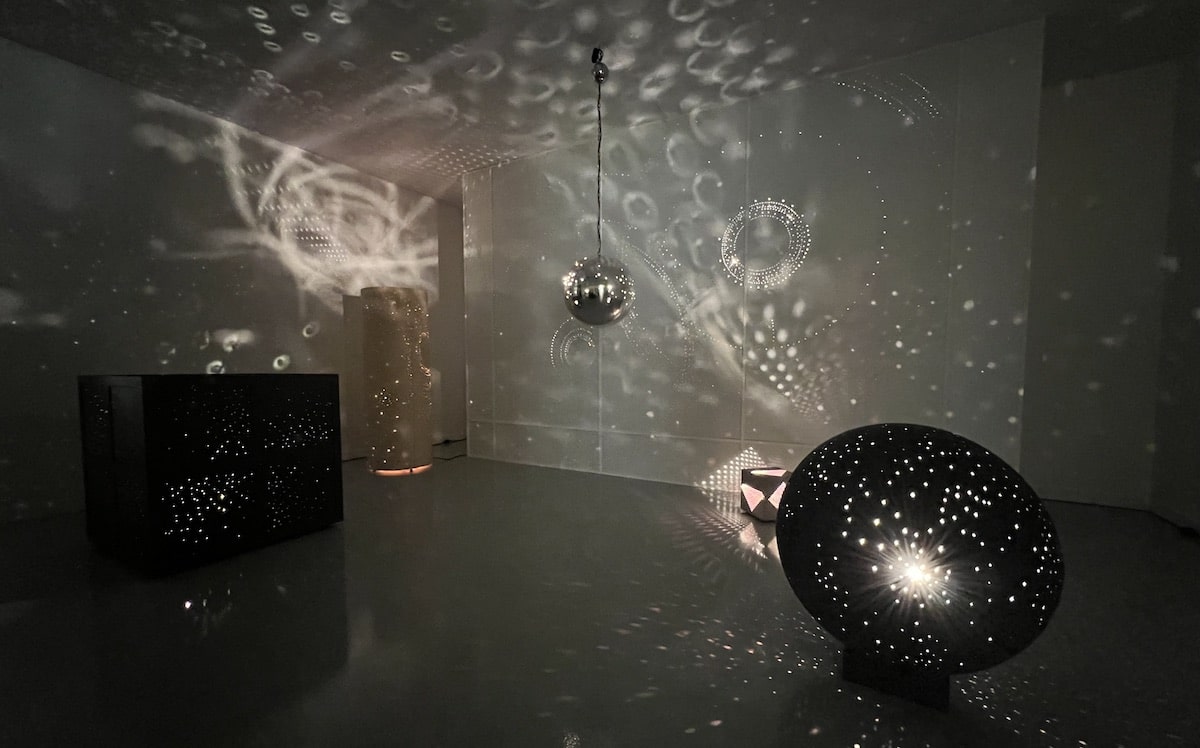
Otto Piene, Light Room with Mönchengladbach Wall (Installation View), 1963–2013, Sprüth Magers
This installation was wonderfully immersive, with different geometric sculptures activating throughout the spectacle, casting mesmerising shadows and light forms around the room. There was certainly a cosmic feel to the whole installation, homaging the Middle East’s historic astronomical and mathematical prowess. The rhythmic quality of the moving light, cascading and distorting as it passed around the room, was further enhanced when the elements interacted. This was a feast for the senses, and the gallery placed a bench in the room to encourage quiet contemplation. This work offered a moment of respite and wonder to anyone who wished to enter. The experience can be aptly described as a unique theatrical performance, using carefully crafted geometric elements to distort light and shadow, creating a magical moment of wonder.
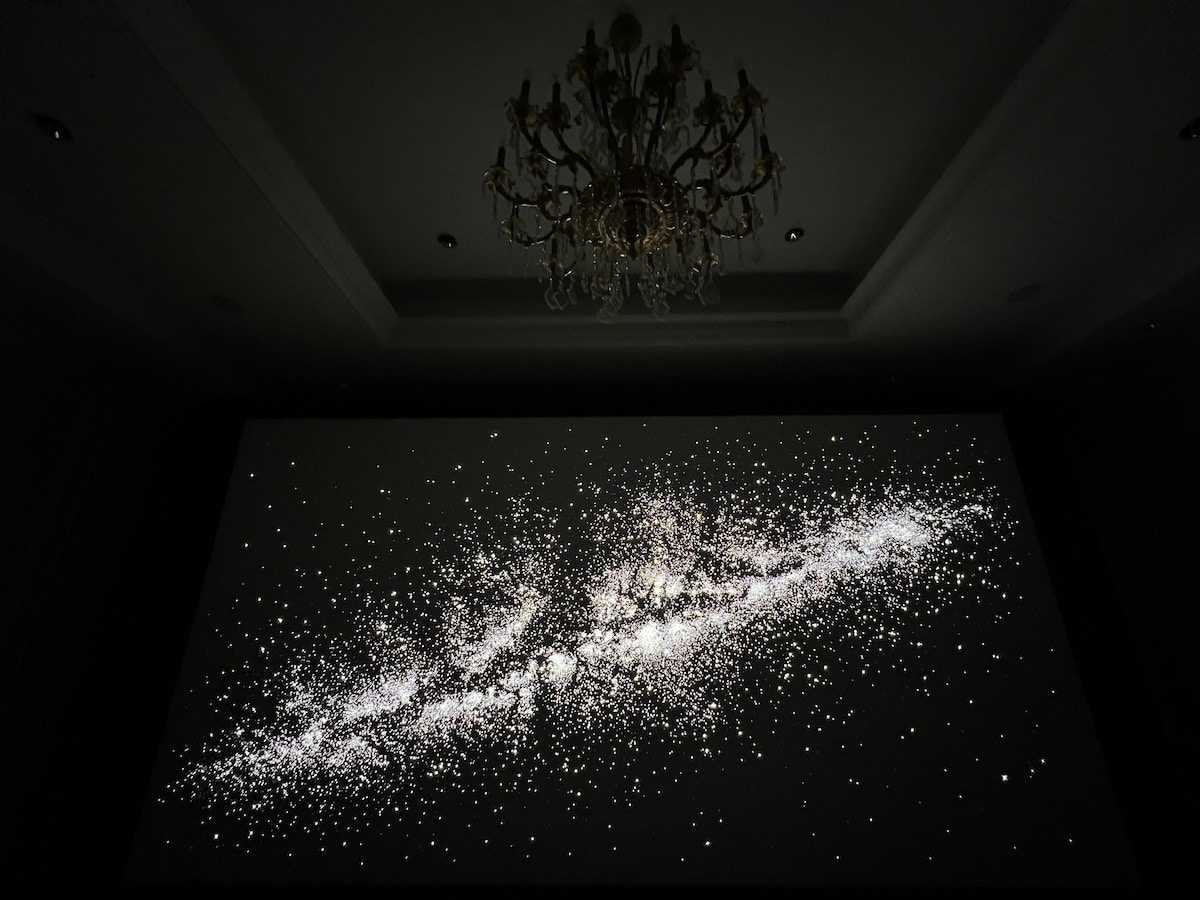
Petroc Sesti, Tracing The Void (Installation View), Four Seasons Doha
Qatar also offered many satellite experiences. The Four Seasons The Pearl-Qatar highlighted the work of Sassan Behnam-Bakhtiar through his residency and the presentation of richly textured, colourful paintings. Behnam-Bakhtiar’s work incorporates hand-ground natural pigments in deeply rich colorscapes that resemble pointillism while remaining completely abstract. The Four Seasons Doha also hosted installations by Petroc Sesti, including Tracing The Void, a stunning representation of the night sky and the Milky Way. Sesti creates work that often brings art and science together in unexpected ways, as evidenced by his sculptures displayed in the hotel lobby, which illuminated the entire space with rainbow prisms during sunrise as light cascaded in. Sesti’s work, Vanishing Point, is on view at the Qatar Foundation, and the artist graciously organised a tour for some fair attendees. Fairgoers even had the chance to visit the industrial zone of Doha to visit GubGub Studios, an innovative collective of young artists, curators, and writers doing very interesting work that will surely lead to a fruitful future. Visiting East-West/West-East was also something that many visitors took the time to do. It rarely rains in the desert, and yet there was a small rainstorm on Saturday and an ensuing rainbow that seemed to be a positive sign for the week at large.
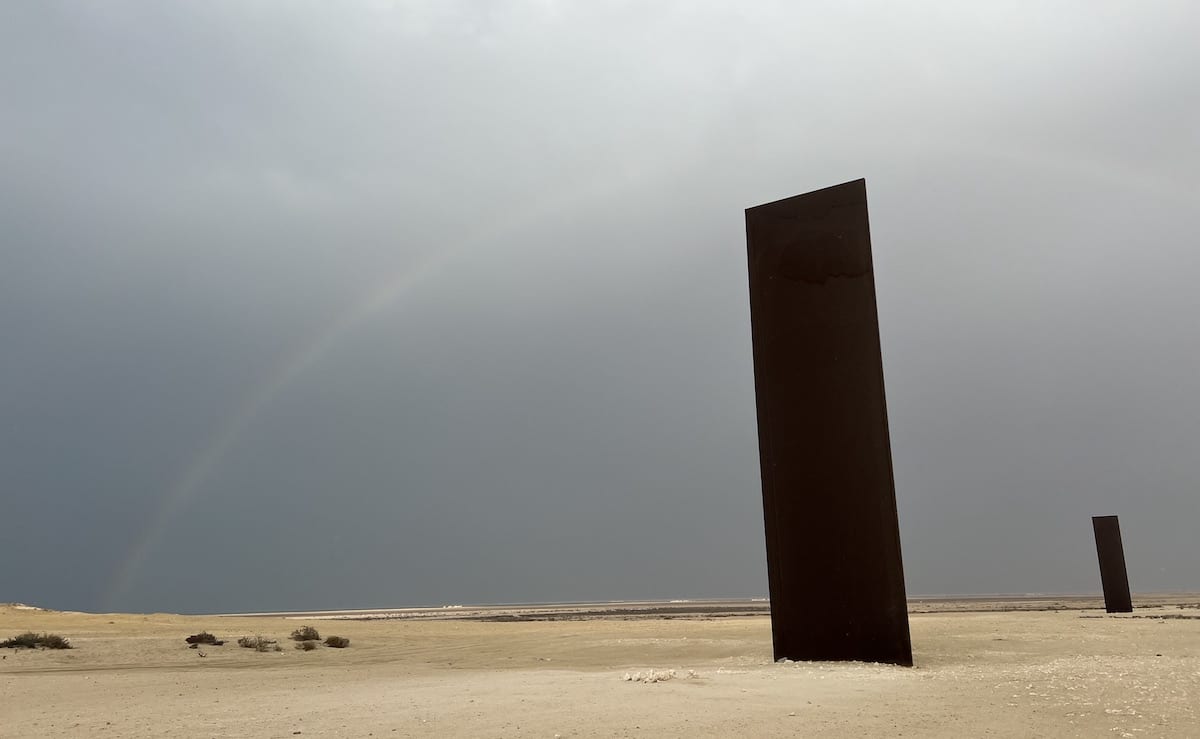
– Richard Serra East-West/West-East With Rainbow
The long-term vision for Qatar and the nation’s warm embrace of contemporary art make this moment so powerful. This comes at a time when many world leaders are sabre-rattling, and it is refreshing to see soft power guiding many of a prominent country’s policies. Perhaps the ethos of Art Basel Qatar and the country’s ambitions as a cultural capital can best be summed up in the words of Her Excellency Sheikha Al Mayassa bint Hamad bin Khalifa Al Thani, as she spoke with Hans Ulrich Obrist. “Qatar has a national vision called 2030, where culture is one of the main pillars for socioeconomic development and human development. We have always invested in culture as a means of human development, and for as long as I can remember, I can’t tell you how many art fairs came to us wanting to be here. We never felt that it was the right time; however, this is an important year for us with 50 years of Qatar National Museum, 20 years of Qatar Museums and we felt with the surplus of talent and the growing gallery scene that we have here that it was time to bring in this new talent because that is how we would spur the economic diversification from hydrocarbon to knowledge based society and bringing this kind of partnership to Qatar. So, as I said a few days ago, this is not your typical art fair. It is a healing art fair when engagement is more important than transaction and discourse more important than division, and curiosity more important than conviction.”
Top Photo: Art Basel Doha Taken from the Park Hyatt Terrace © Clayton Calvert for Artlyst 2026