
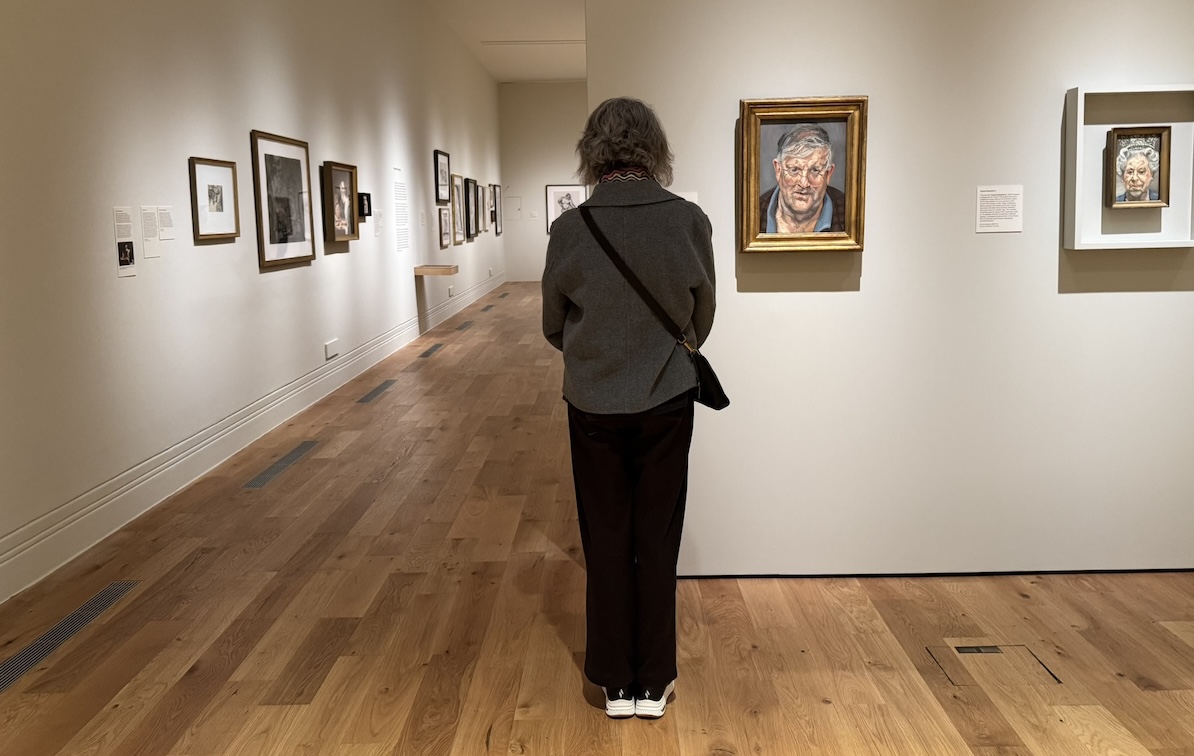
Lucian Freud: Drawing into Painting is the first National Portrait Gallery show since Lucian Freud Portraits in 2012. With 48 sketchbooks donated to the NPG as its starting point, this show is somewhat odd. You don’t know whether to say it is good or it is bad, as Lucian Freud was such a great master of the portrait, and some are in this show. But like the curate’s egg cartoon in the famous 1895 Punch cartoon by George du Maurier, the young curate says of the bad egg he is served at the Bishop’s table, “Oh no, my Lord. I assure you! Parts of it are excellent!”
Obviously, spurred on by the sketchbook donations and by the inspiring working documents that Freud had around his house and studio, the show came to be. In some parts, it is good, and in others, just bad. There is no Freudian slip to the drawings here, a curious trove of notational, presentational, or fine sketches for he was ultimately a realist.
Freud’s Lucian Freud Portraits show, held in 2012, was a well-balanced show, whereas this is a strange mix of great and insignificant. Some walls are exceptional; others, like the etchings, needn’t be exhibited. The childhood drawings his mother, Lucie, kept and brought to the UK from Berlin are simply childlike, but ordinary.
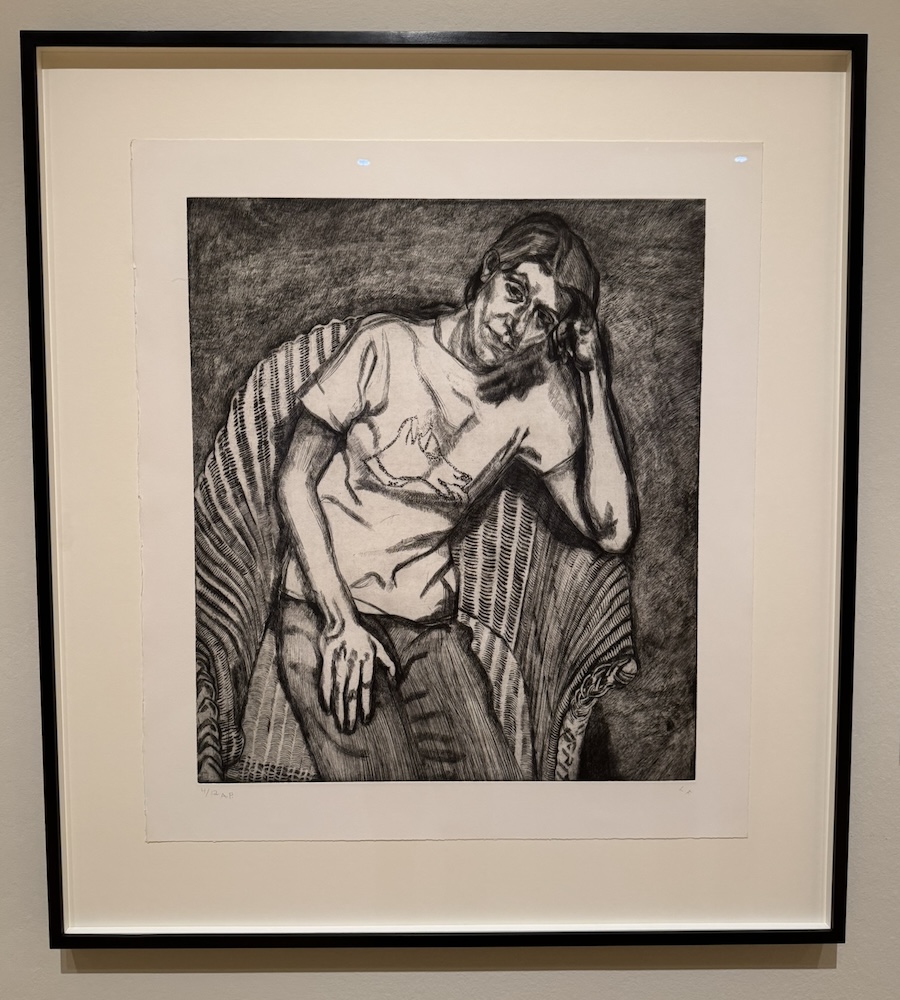
Lucian Freud, Bella in Pluto T-Shirt, etching 1995
How can one really do justice to one of Modern Art’s true renegades, who adhered to no movement or stylistic hegemony? One way is to unleash a fury of his sketches, unfinished studies, and early works on paper, making it clear that Freud’s way of painting involved a universe of unedited, personal, private moments of seeing. The National Portrait Gallery offers us all a glimpse of Lucian Freud’s process of visual communication in this way. These were never intended to succeed or be brilliant, but they elucidate the worldview of one of the 20th century’s great artists. That may be the problem with this show; ephemera may not be great, but it is simple working material.
The intriguing part of this show. “What is the relation between sketches and the completed portraits?” The sketches are lively, sometimes more than the paintings. There’s more fizz in the sketches, the stuff of life. Sometimes, they are points of departure for the portraits. Paintings from the 1940s and 1950s are less overtly completed, more linear and unsparing. In the best of the sketch portraits, there is an austere surreal feeling – poetry in immotion. Girl with Roses (1947-48) of Kitty is so sparse, line by line, the hairbrush treatment is worthy of Dürer. It’s all about fragility – truly a powerful portrait. The studies of his mother, Lucie, are more compassionate than others.
Born in Berlin, the son of Ernest Freud, the architect, and grandson of Sigmund Freud, Lucian once said, “People thought and said and wrote that I was a very good draughtsman, but my paintings were linear and defined by my drawing. (They said) You could tell what a good draughtsman I was from my painting. I’ve never been that affected by writing, but I thought if that’s at all true, I must stop.” In his 20’s, he was making some 200 drawings for every painting. As a young man,
his works were already pulled towards a psychological depth, something quite distinct from other painters of his generation. One sees this in an early portrait of Sir Cedric Morris (1940) or Peter Watson (1941). Man with a Feather (1943) has a true surreal austerity, as does Self-Portrait with Hyacinth (Self- Portrait) (1947-48). These works, to my mind, are as powerful as any of the later painterly nude exposes.
That universe of drawings and studies, includes quite powerful studies from nature like Scotch Thistle (1944) and Botanical Gardens (Landscape with Scillonian Pine) (1945) Other studies reveal Freud’s love of animals – zebra, monkey, dogs, foxes, horses…
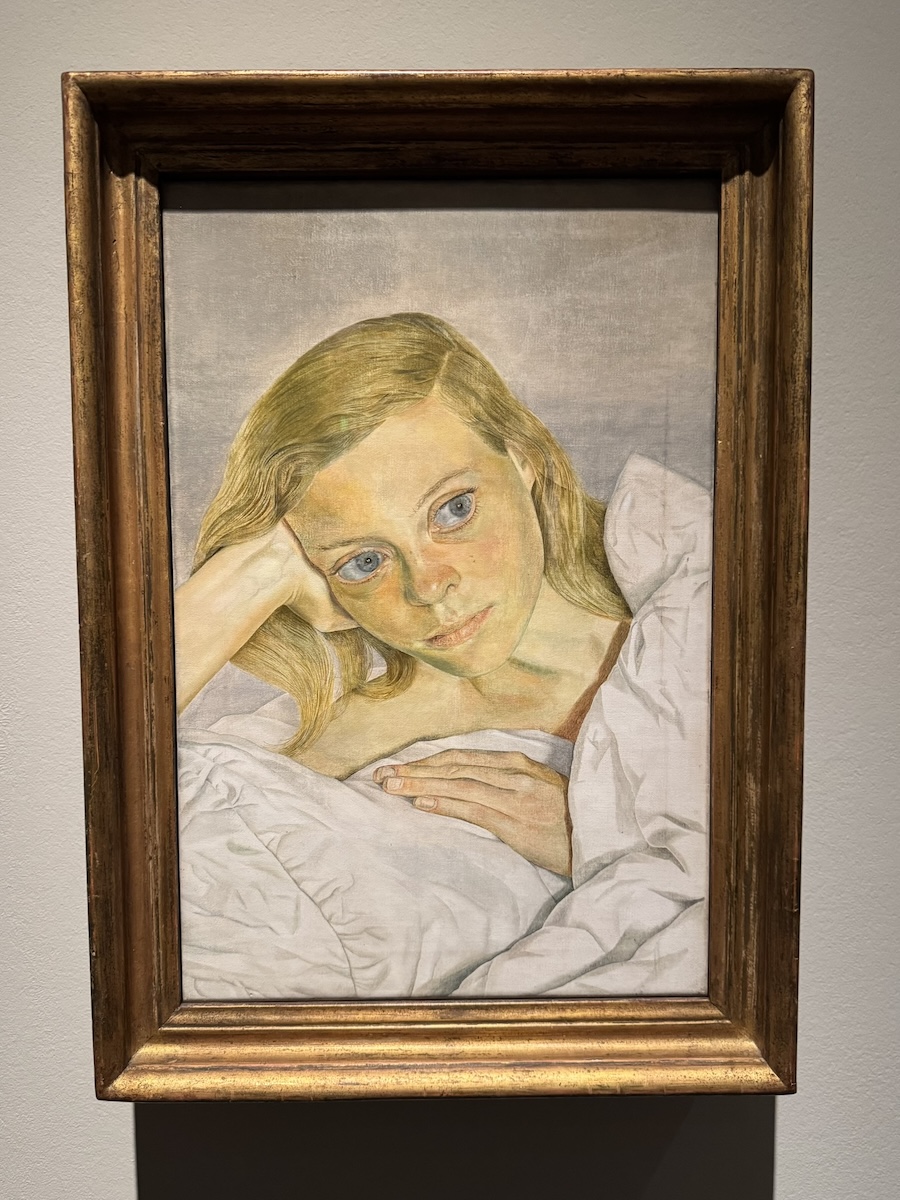
Lucian Freud, Girl in Bed (Caroline Blackwood) oil on canvas, 1952, private collection courtesy of Ordovas
For Lucian Freud, everything was a portrait, not just people. Freud believed, ‘everything is autobiographical, and everything is a portrait’. Boy with a Pigeon (1944), Man at Night (1947-48), and Christian Bérard (1948), displayed on one wall of the NPG Drawings into Painting show, make it clear why the art historian Herbert Read called Lucian Freud “the Ingres of existentialism”. Here is the mastery of Lucian Freud’s drawing, a world unto itself, all about communicating human emotions; the expressionism invisibly works its way into each subject.
After meeting Francis Bacon in 1944, Freud gravitated more and more to painting, and the switch to thicker hog’s-hair brushes gave the painting body as can be seen in Woman Smiling (1958-59). Drawings and etchings that transferred to painting feature in the show. Why are there so many? Some are downright ordinary transcriptions… Large Interior, W11 (after Watteau) (1981 – 3) features Freud’s own partners and family, but why the pretence of comparing this to Watteau?
The real-life undressed nudes seen in Freud’s late 1980s and 1990s challenge the very nature of nudity in portraiture. Some are harsh, but they include ordinary people. Sophie de Stempel, Celia Paul, Angus Cook, and his friend Sue Tilley are among the portraits.
The drawings are more personable, less cold, and have a sense of play, enabling the artist to envision variable compositions, situational combining, and for this the show works, but perhaps a few too many “work in process” sketch pieces? There is a lot of love in Lucian Freud’s Drawing into Painting show. Some real gems. It will travel on to the Louisiana Museum in Denmark this June, 2026.
Lucian Freud: Drawing into Painting, National Portrait Gallery, 12 February – 4 May 2026
Visit Here
Brief bio + publications for John K. Grande…
https://en.m.wikipedia.org/wiki/John_K._Grande
https://www.amazon.com/author/johngrande
Art Space Ecology; Two Views Twenty Interviews, Black Rose Books / U. of Chicago, 2018)
http://press.uchicago.edu/ucp/books/book/distributed/A/bo34137373.html
Lead image: Lucian Freud: Drawing Into Painting, installation shot, photo by Judith Burrows