
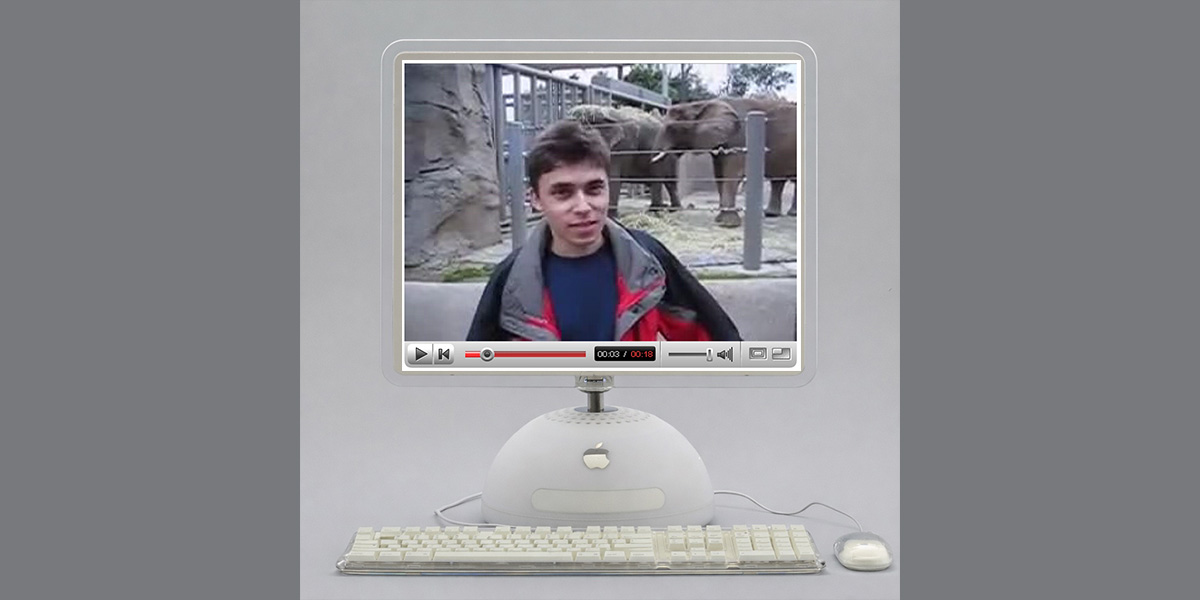
The Victoria and Albert Museum has acquired a small but consequential fragment of internet history, not an object in the traditional sense, but a reconstructed moment from the early days of online life. In a move that says as much about how museums are changing as it does about technology, the V&A has rebuilt an original YouTube watch page featuring the platform’s first-ever upload: Me at the zoo (2005), the 19-second clip by Jawed Karim often credited with ushering in the age of user-generated video.
From 18 February, the reconstruction goes on display in the Design 1900–Now gallery at V&A South Kensington, where it sits perhaps unexpectedly alongside objects that chart the evolution of modern design and communication. The presentation is deliberately faithful. Visitors encounter the video much as early users once did: Karim, then 25, standing in front of a group of elephants at San Diego Zoo, speaking directly to the camera in a grainy, unpolished clip framed by the clunky interface that defined YouTube’s formative years.
“A parallel display at V&A East Storehouse unpacks the painstaking process behind rebuilding the page itself a reminder that preserving digital culture is rarely straightforward.”
Corinna Gardner, the V&A’s senior curator of design and digital, describes the work as a snapshot of the Web 2.0 moment a time when the internet began shifting from static pages to participatory platforms shaped by their users. For the museum, she suggests, the acquisition opens new ways to tell the story of how digital technologies have transformed everyday life, from the rise of video-sharing to today’s creator economy and its relentless visual churn. It also, she notes, pushed the institution into unfamiliar territory: collecting something as fluid and technically complex as an early web interface, and attempting to preserve it for the future.
The original video has been viewed nearly 380 million times since it was uploaded on 23 April 2005, attracting more than 18 million likes. Yet its importance lies less in the clip itself than in what it signalled a decisive shift away from broadcast media models towards something more democratic, or at least more chaotic. Suddenly, anyone with a camera and an internet connection could address a global audience. The gatekeepers had, in theory, stepped aside.
Recreating that moment was no quick exercise. Over 18 months, V&A curators and digital conservation specialists worked alongside YouTube’s user experience team and the interaction design studio oio. Drawing on archival sources, including one of the earliest surviving records of the platform from December 2006, preserved by the Internet Archive, they reconstructed the interface, functionality and visual language of early YouTube with careful precision.
The result captures what now feels like the basic grammar of social media in its infancy: star ratings, share buttons, comment threads, recommendation panels, badges. Features so familiar they have become almost invisible. Seen together, though, they reveal how interface design quietly shapes behaviour, guiding attention, encouraging participation, and nudging users towards particular forms of interaction.
The acquisition also reflects the V&A’s growing interest in what might be called born-digital culture and the thorny questions surrounding its preservation. The reconstructed page joins a collection that already includes digital artefacts ranging from the Chinese messaging platform WeChat to the viral mobile game Flappy Bird, as well as more unexpected items such as the design of the mosquito emoji. These acquisitions suggest a broader definition of design, one that now encompasses software, symbols, and online environments as readily as furniture or typography.
Seen in this context, the decision to place a low-resolution video — shaky, awkward, entirely unremarkable on the surface within the museum takes on a certain logic. The V&A is more interested in infrastructure than in nostalgia. YouTube appears here not simply as a platform for entertainment, but as a system that reshaped ideas of authorship, self-expression and public life in the 21st century.
YouTube’s chief executive, Neal Mohan, described the acquisition as a moment of recognition for what began as a simple act of self-expression. Reconstructing the early watch page, he said, allows visitors to step back to the beginnings of what would become a vast global phenomenon, one that fundamentally changed how stories are told and shared.
It is, in its way, an oddly modest object for a museum to acquire: a short video, an obsolete interface, a fleeting digital experience painstakingly revived.