

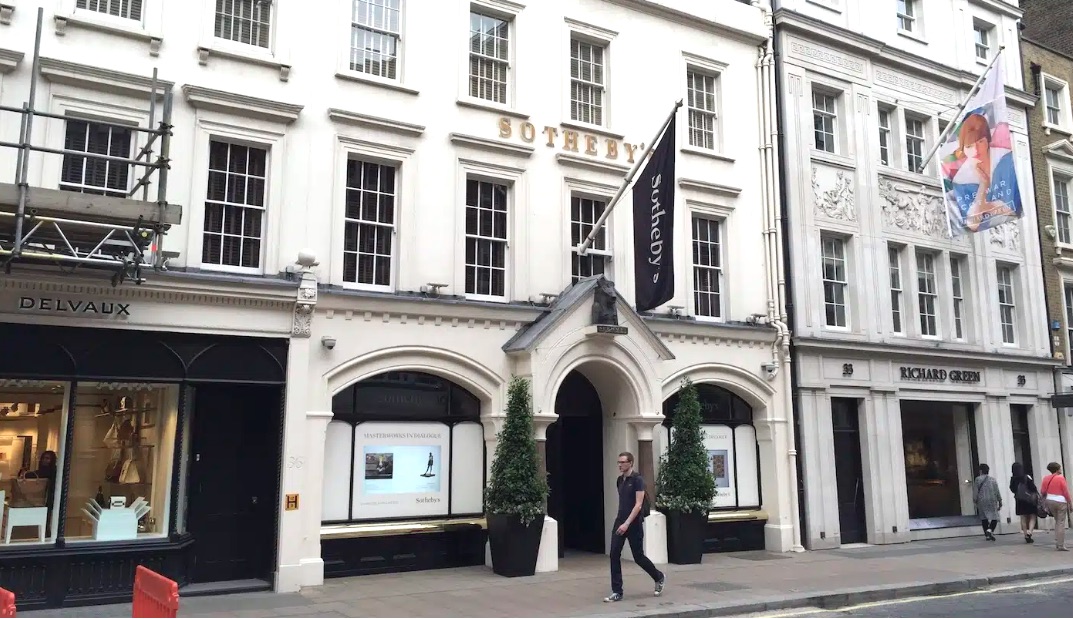
Sotheby’s has redrawn its fee structure, and other market leaders are expected to follow. The auction house has raised its buyer’s premiums worldwide, adjusting one of the firm’s most reliable revenue streams at a moment when the market is still unsettled, after consecutive, leaner years; it shows little sign of recovery.
The buyer’s premium, added on top of the hammer price, has long been the backbone of the saleroom’s business. But with fewer headline lots offered and consignments harder to come by, auction houses are rethinking how to extract revenue without alienating buyers or sellers.
Under Sotheby’s revised structure, the buyer’s premium in New York rises from 27 per cent on lots above $1m to 28 per cent for all works selling up to $2m (£1.5m in London). The middle tier stays at 22 per cent, now covering lots between $2m and $8m (£1.5m–£6m), whereas previously it began at $1m. For the highest-value works, those hammering above $8m (£6m), the premium remains unchanged at 15 per cent.
The move follows a similar recalibration at Christie’s, which last September raised its buyer’s premium to 27 per cent on lots selling up to $1.5m, 22 per cent on works between $1.5m and $8m, and 15 per cent above that threshold. Previously, the house had levied 26 per cent on the first $1m and 21 per cent on the middle range. The direction is clear enough: more buyers will pay more.
The shift speaks to the current market. While confidence has faltered and high-value consignments have slowed, interest in lower-priced works has remained firm. Auction houses, conscious of the risk of unsold lots, are setting more cautious estimates, prioritising certainty over ambition. By the close of last year, both Sotheby’s and Christie’s were projecting stronger revenues, with less from flagship evening sales and more from private deals and luxury goods categories.
In September 2025, Phillips introduced a buyer’s fee structure designed to reward early participation. Bidders who submit a binding written offer at or above the lot’s low estimate at least 48 hours before the sale benefit from a noticeably reduced fee if their bid wins.
Sotheby’s has tried this before and quickly retreated. In early 2024, the auction house introduced a pared-back structure, setting buyers’ premiums at a flat 20 per cent on most lots and 10 per cent for works selling above $6m. Lost revenue was made up by placing greater financial weight on consignors of top-tier works. The response from sellers was muted. Chief executive Charles Stewart later admitted the experiment had done little to attract vendors, and the house returned to a more conventional arrangement within the year.
The latest adjustment arrives alongside a broader financial strategy. Only weeks earlier, Sotheby’s announced that its lending arm, Sotheby’s Financial Services, would issue $900m in asset-backed notes tied to loans secured against art and, for the first time, collectable cars. By bundling these loans and selling the expected returns to investors, the auction house secures immediate capital rather than waiting for repayments to accrue over time.
The deal, issued under the title Sotheby’s ArtFi Master Trust, Series 2026–1, was finalised on 3 February. Ron Elimelekh, chief executive of Sotheby’s Financial Services, described demand as comfortably outstripping supply, a sign, he suggested, of investor faith in the firm’s loan book. The credit agencies Morningstar and DBRS awarded the notes robust ratings, indicating a low likelihood of default.
The combination of higher premiums and financial manoeuvres suggests a house focused on protecting its margins while finding new streams of revenue. The numbers are being scrutinised. In a market adjusting to restraint, even long-established institutions are rethinking what it takes to stay profitable.