
Chiharu Shiota’s immense, intricate web-like installations invite us to reflect on the fragile ecosystem of body, memory, and consciousness, and on the wonder of existence.
“When my feet touch the earth, I feel connected to the world, to the universe that is spread like a net of human connections,” said the artist Chiharu Shiota, describing her expansive, site-specific installation, Me Somewhere Else, London in January 2019 (at Blain Southern). It was unforgettable, and perhaps my first truly immersive fine art experience (beyond the theatre). It felt like walking into the artist’s body and then – once I had adjusted – sensing something spectral, that was both absence and presence. It featured an expansive, suspended lattice made from blood red yarn, delicately touching ghost-white feet. It both emulated the cluster of arteries that spread through a body and housed a kind of consciousness, one that extends beyond the tangible.
Threads of Life , now open at the Hayward Gallery, alongside a solo show by Yin Xiuzhen: Heart to Heart, is Shiota’s first major solo exhibition in a London public gallery following a string of critically acclaimed exhibitions in Beijing, Osaka, Tokyo and Paris. Accompanied by new large-scale sculptures, drawings, early performance videos and photographic documentation, this landmark takeover sees the artist weave immersive works from floor to ceiling across the Hayward Gallery’s top floor. Often tangled with vessels like boats and beds, these installations engulf ordinary possessions – shoes, keys, sheets of paper – suspended like ghostly memories. Sensationally photogenic environments, they are also the ultimate balm for a web-weary mind.
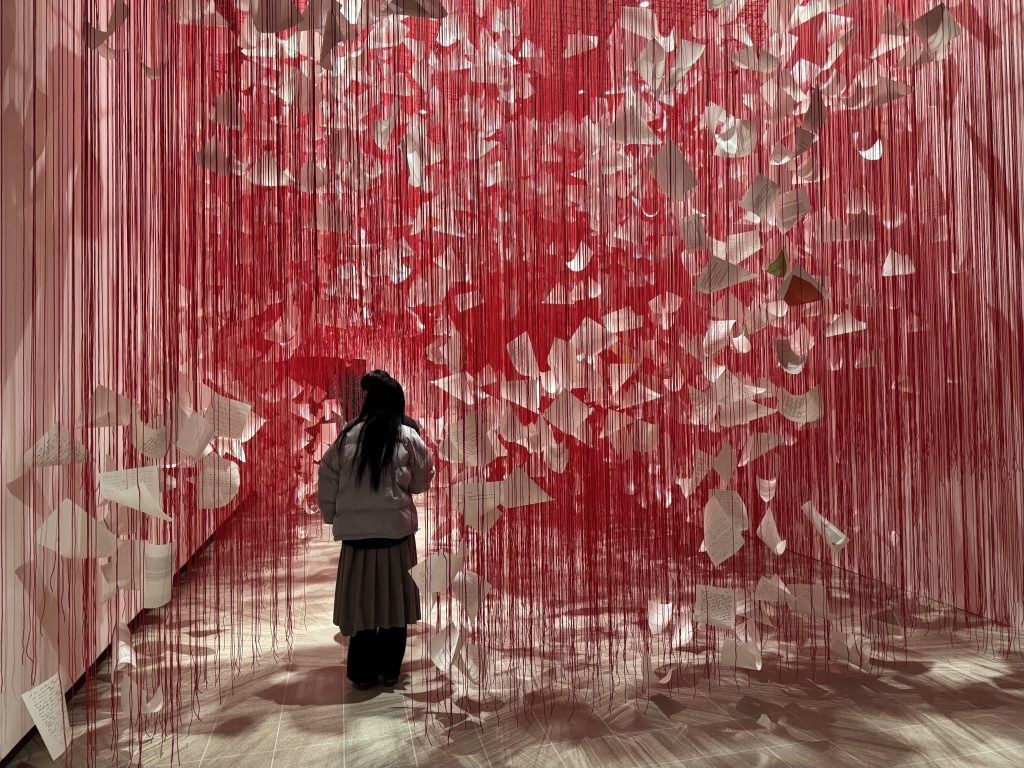
Chiharu Shiota, Hayward Gallery installation view ©Artlyst 2026
The Osaka-born, Berlin-based artist uses a distinctive triangular schematic in dense installations of knotted and wound thread, typically in red, white or black, that ascend from floor to ceiling. In this exhibition, she transforms the Hayward’s iconic, brutalist rooms into monochromatic labyrinths through which visitors can wander, linger and ponder. Part cascade, part web, her work activates the spidery senses unlike any other artist I know, drawing you into strange, incomplete narratives that continue to unfold long after you leave.
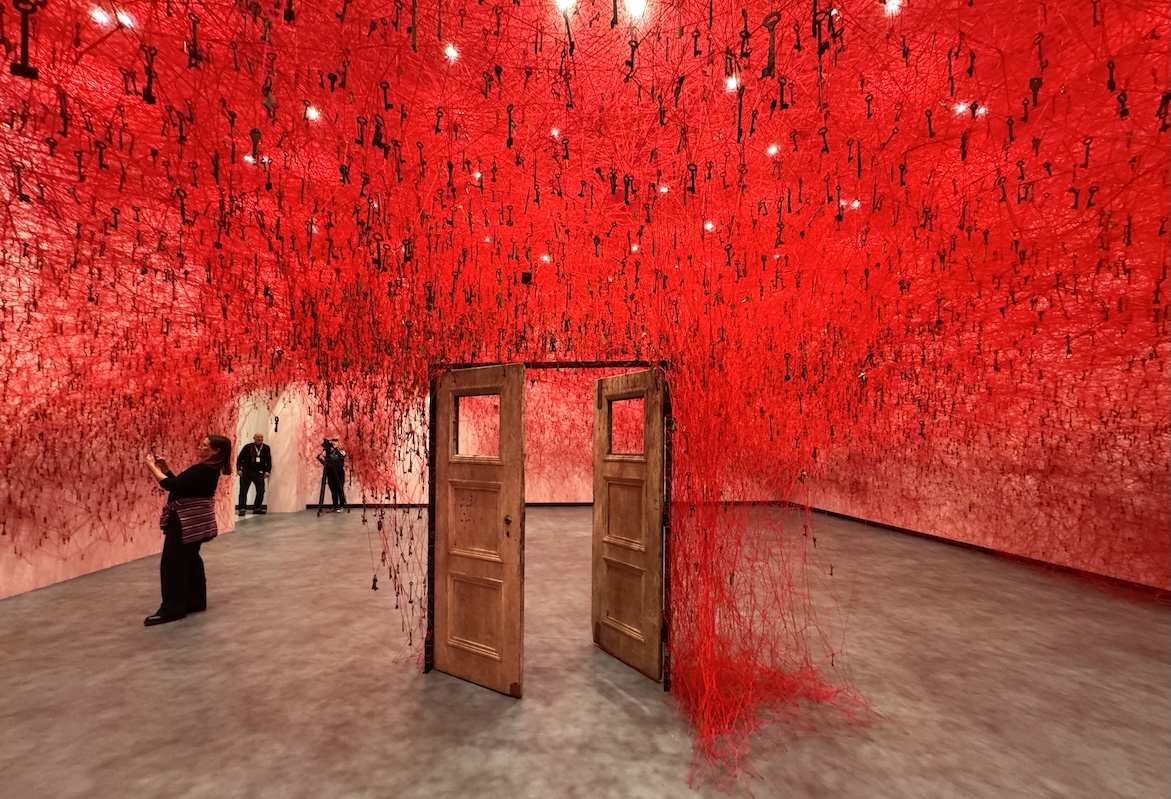
The exhibition features new iterations of Shiota’s past monumental installations, such as The Locked Room (2016), which also references her 2015 installation for the Japan Pavilion at the 56th Venice Biennale titled “The Key in the Hand”. A door frame is held in place by a vast network of scarlet thread, in which thousands of keys are suspended. By contrast to the work’s title, the door stands ajar. The room is full of tension, which both literally and figuratively holds each thread in its place and seems to express a kind of yearning. For Shiota, many of her installations address a “longing for her motherland” or “the loss of her future lifeblood through ovarian cancer”.
Shiota works in scarlet more than any other colour, and for good reason: it’s a hue with extraordinary resonance. In the western world, its deep religious associations are entwined with displays of power and wealth. Scarlet is central to the Judeo-Christian story: the colour of sacrifice and atonement, of Christ’s blood. In 1464, Pope Paul II decreed that all his cardinals wear robes of scarlet, as they do to this day, both a reminder of Christ’s sacrifice and a display of control. Scarlet dye was achingly expensive – in fact, the word scarlet comes from the Arabic siklāt, meaning cloth dyed red. The original scarlet dye came from a tiny, grub-like insect called kermes ilices, known in biblical times as the crimson worm: 80 kermes were needed to produce just 1 gram of dye. This colour draws on the very essence of life, one that usually remains pulsing beneath the skin. To see it is to be shocked, and this keys into Shiota’s search for “presence in absence”.
“Through my work, I try to make sense of life and its uncertainties; each installation has grown from personal experiences, such as losing my father, facing death and questioning what it means to be human,” says Shiota. “Whilst we live our lives separately, we are, at the same time, deeply connected.”
Moreover, the use of red string has very specific connotations in Eastern culture and specifically in Japan. In China, the colour red represents happiness and good luck; the Chinese New Year (Year of the Fire Horse) is announced with a riot of scarlet and gold. In Japan, it is the hue of life – the central dot of national identity. Scarlet double-T torii (gates) at the threshold of Shinto shrines are there to ward off demons; Japanese red string theory, or Akia Ito (赤い糸), is a belief that there is an invisible, unbreakable red thread that connects those destined to find each other. It can stretch or tangle but never break, uniting soulmates across time and distance; an important symbol for an artist who moved across the world to develop her practice.
This colour will trigger any number of responses in each viewer, and associations with other artists invested in the hue (Louise Bourgeois painted whole rooms with it and sewed stories with it; Anish Kapoor amplifies the monumental with scarlet in his sculptures). The saturation of colour in Shiota’s installations calls to mind Derek Jarman’s Chroma, written the year before he died in 1995 of HIV related illnesses. “Each victory of the red cells brings death…for the virus is red. The dance of death… Red wool tied around the neck protected. Like for like. Colour for cure. Red moved the blood. Avicenna made medicine from red flowers. If one gazed intently at red the blood would flow……RedStopRedStopRedStop”
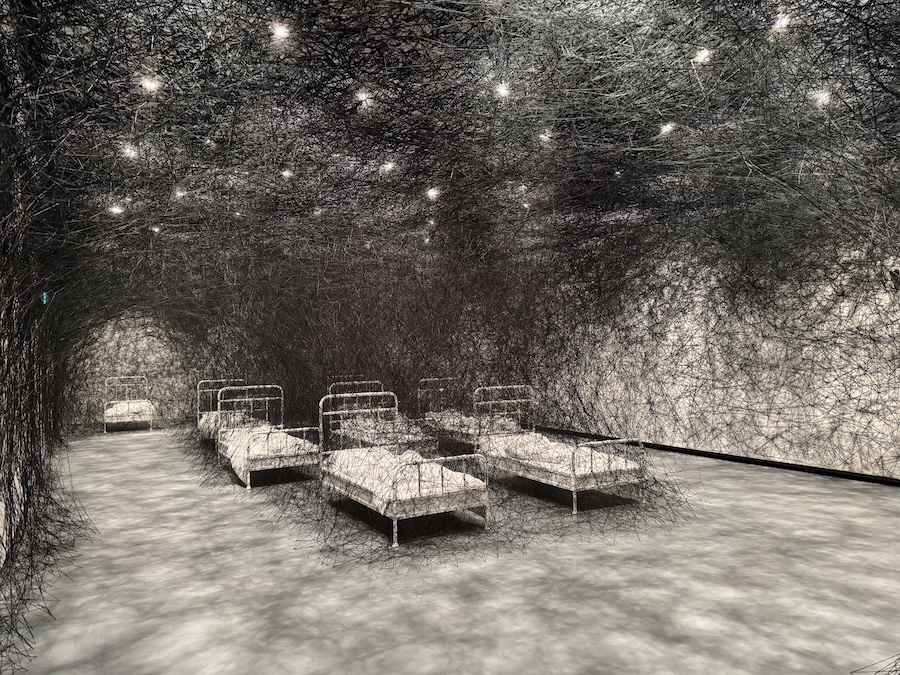
Chiharu Shiota , During Sleep 2026
By contrast, the next installation, During Sleep (2026), which is activated through performances throughout the run of the exhibition, amplifies our sense of absence by swapping red for a black web that hangs ominously above a suite of small, white hospital beds. Magnificent and triggering in equal measure, it can also be read as the artist’s meditation on the reality of death: not darkness, but acceptance, not absence but process. Giving form to what is usually invisible, to me, these works are like an analogue version of “open source”; we are given the opportunity to follow the many threads of ponderous, existential questions, and then leave – completing the work in our own time, in unexpected, embodied ways. “With this exhibition I want to highlight the marvellous aspects of ordinary existence,” says Shiota.
Additionally, Threads of Life includes a wall dedicated to her most recent collaboration with the writer Yoko Tawada, for Tawada’s daily series The Trainee (2023-24), published in the Yomiuri Shimbun newspaper, Japan. Shiota created around 400 watercolour and charcoal drawings, each stitched with her signature red threads and showing us her capacity to create worlds in the two-dimensional.
Movingly, it is also the last show that director Ralph Rugoff will stage. “Both Yin and Shiota elevate humble, everyday materials into profound and poetic artistic statements. Exploring the tension between personal and collective memory and the transience of contemporary life,” says Rugoff, “each artist’s work emphasises intimacy through tactile traces of human presence, while their immersive installations draw audiences into reflective, almost meditative spatial interactions.” In this statement, Rugoff reminds me why I first started visiting galleries as a slightly lost, often rootless young woman; in retrospect, art is the thread.
Downstairs is another solo by Chinese installation artist Yin Xiuzhen: Heart to Heart. Like Shiota, Xiuzhen creates immersive installations that explore memory, identity, and human connection, but they differ significantly in their materials and conceptual focus. Yin Xiuzhen uses secondhand clothing, concrete and domestic objects to show how memory is embedded in physical materials shaped by social change and globalisation, particularly in contemporary China. Her work feels grounded, tactile and socially engaged, by contrast to Shiota’s dreamlike webs. Yin’s work feels archival, showing memory as something materially and historically rooted; Shiota presents memory as something suspended in the architecture of the mind.
Words: Nico Kos Earle
Photos: Sara Faith ©Artlyst 2026
Chiharu Shiota: Threads of Life, Hayward Gallery, Tue 17 Feb – Sun 3 May 2026
Yin Xiuzhen: Heart to Heart, Hayward Gallery, Tue 17 Feb – Sun 3 May 2026
During Sleep performances are free with a ticket to the exhibition and take place on Saturday 7 March, 11 April & 2 May, 10am – 1pm.
Visit Here