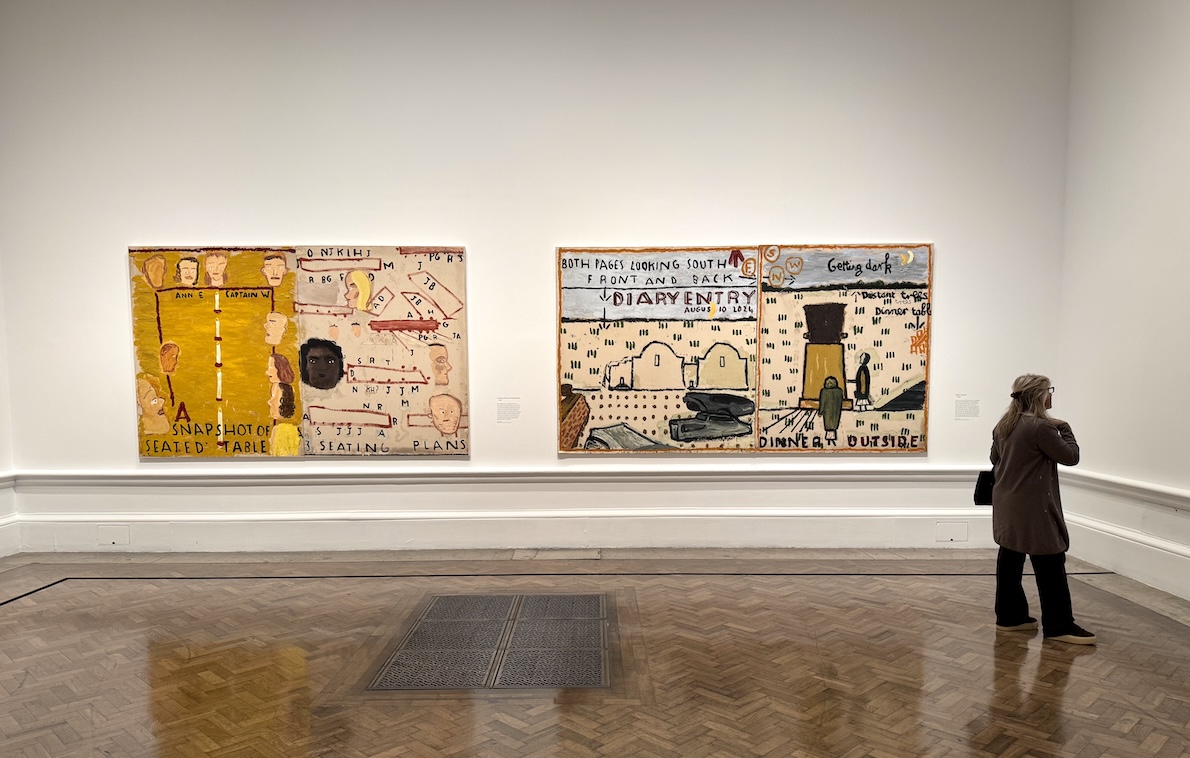
There is something gratifying about the fact that the first female painter to have a solo exhibition (unbelievable though it may be in the 21st century) in the main galleries of the Royal Academy is a 92-year-old woman who dresses like a teenager. Rose Wylie’s short skirts and trainers, her Harry Potter glasses, grey bob and dark lipstick are deliciously iconoclastic. You wonder what Joshua Reynolds would have made of her. Almost certainly, he would have hated her large, colourful, messy, irreverent paintings with their lack of scale and proportion. Images that might have been taken from a comic or the pages of a child’s drawing book.
There’s a splodgy red elephant, and a blue frog that looks like the one my son painted when he was three. There’s also an Indian Bird with a red beak, beady eyes and stick legs that might have just escaped from a kindergarten. But it takes a good deal of dedication to paint this badly – if by badly one means creating images that are simplified to their essence, like a child’s, without any concern to make them look ‘real’. Though Wylie’s work is not naïve but deeply considered. Her decisions are deliberate, informed by a knowledge of art history and painting. For her, it is very fragile where a painting actually ends, as it always hovers on a “precarious edge”. As Picasso famously said: It took me four years to paint like Raphael, but a lifetime to paint like a child’.
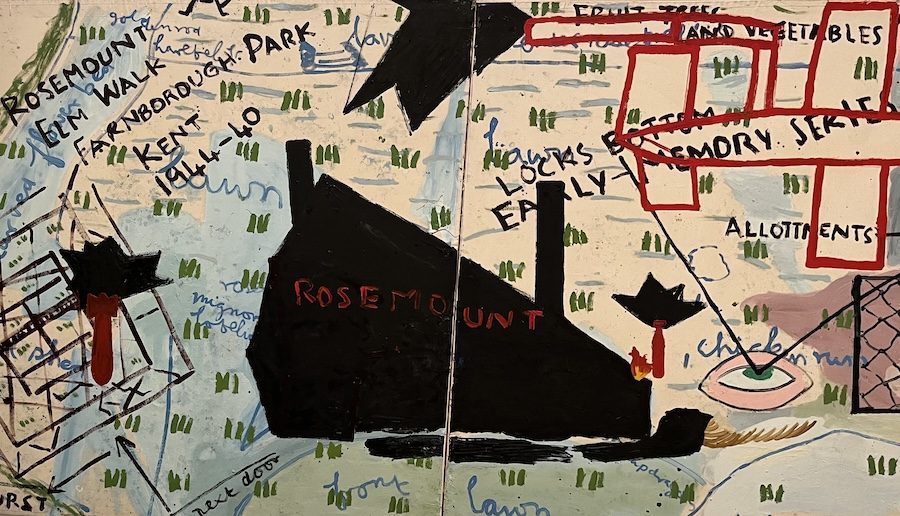
Rose Wylie, Rosemount (Coloured) 1999
Her trajectory has been unconventional. She gave up painting for years to bring up her three children. Something no male artist would be expected to do. So it makes her recent success all the more sweet. There is a Proustian element to her work. Everyday objects and places are used to trigger recollections of the past. Her earliest memories go back to the Second World War when she was living in Kent and Bayswater in west London. The family home, Rosemount, took a direct hit in a bombing raid, and her sisters extinguished the fire. Painting acts as an aide-memoire, and Rosemount (Coloured) 1999 maps the neighbourhood where she lived in the 1940s. The allotments, the chicken run, the park, a falling bomb. Another painting shows a cartoonish doodlebug crossing from Calais to London, and, in case we are in any doubt as to what the painting is about, she has written the details on the surface in large childish print. Painting is, for her, a form of psycho-cartography. A memory relived and shared becomes real, takes on a new life.
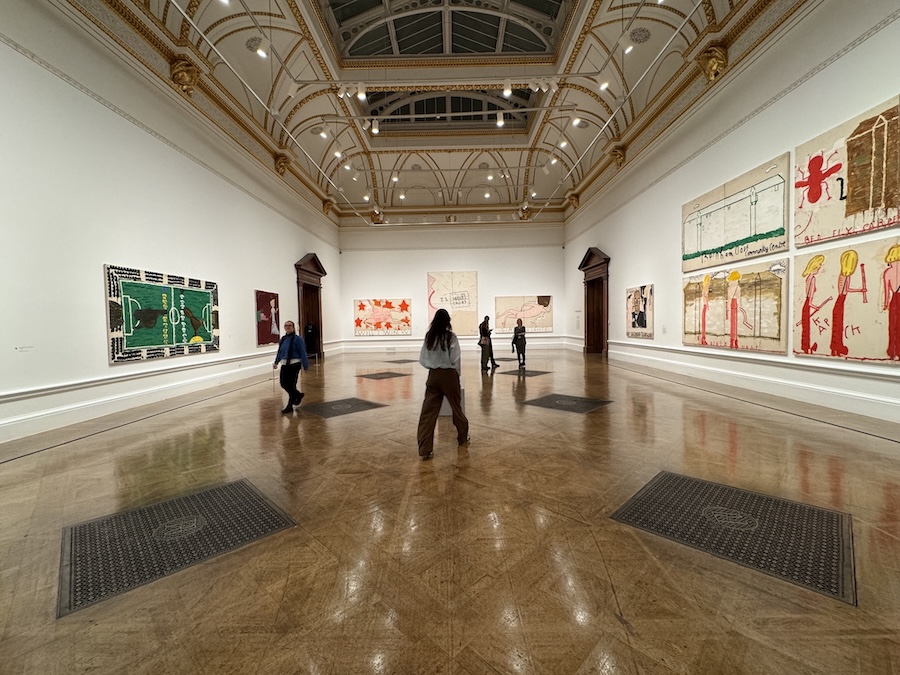
Rose Wylie, Royal Academy of Arts – installation view
When she started as an art student at Folkestone and Dover School of Art in the 1950s, she studied academic anatomical drawing and figurative painting. The art world, then, was just coming to terms with Abstraction. This was seen as rather foreign and intellectual compared to the figuration favoured by English artists such as John Minton and John Piper, and the neo-Romanticism of Graham Sutherland, all of which were considered a bit dreary and dull. Although attracted to the freedoms of Abstraction with its possibilities for invention and changes of scale, Rose Wylie has always considered herself primarily a figurative painter, even when to be a storyteller, stimulated by observation of the real world, was denigrated and unfashionable.
Her paintings are found rather than invented. The catalyst often comes from a memory. Brown Horse Anatomy Drawing 2017 ─ a pantomime looking nag with radius, femur, and tibia all labelled as if in a school diagram ─ is a wry comment on traditional art-school training with its emphasis on technical ability and correct anatomy. Other paintings are stimulated by nature, film or domestic objects, even by breakfast or an omelette. It’s been her practice for years to keep a visual diary of what she sees. The drawings may, then, be transferred to paint where the image becomes pared back, distilled; an essence of itself rather than a photographic likeness.
Popular culture, particularly film, provides her with fecund imagery. Working from memory, she aims to recreate something of the original visual excitement of, say, a Tarantino film, or there’s her cartoonish Penélope Cruz sitting on a bench in Pedro Almodóvar’s film Volver (2006). She likes the way that the camera can zoom in for a close-up or take things from surprising angles. She still remembers the terrifying experience of being taken to see Disney’s original Snow White in 1937, the impact of its dramatic graphic style. In her ironic Snow White (3) with Duster 2018, Snow White’s lack of agency results in her becoming an accidental housewife, reliant on a prince’s kiss to rescue her from her catatonic state.
Wylie’s studio floor is covered with layers of newspapers that arrive through her door each day. Though she claims her work is not overtly political, newspapers provide her with a constant source of imagery: sportspeople, TV reality stars and politicians. “I love chance, she says. “Chance is like the break in the dotted line. Anything that is out of control, I like” She spends hours browsing on her computer for images that have a visual impact. A picture much disseminated by the press will, in her hands, again become unique through the manipulation of paint and her inimitable style.
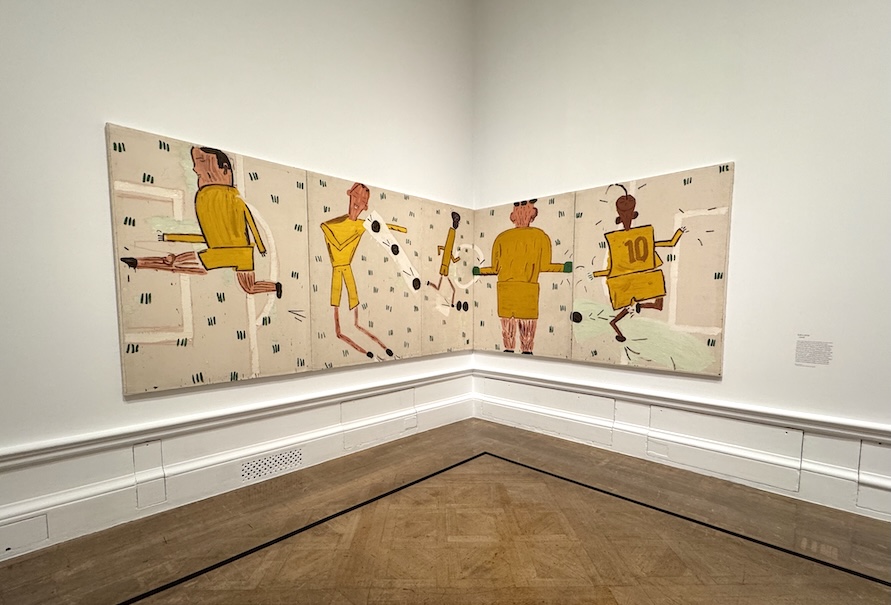
Rose Wylie, Yellow Strip 2006
There is a filmic quality to much of her work. Yellow Strip 2006 depicts footballers in movement, often from different perspectives at the same time. There is something reminiscent of Eadweard Muyerbridge’s famous The Horse in Motion, an early example of chronophotography. This late 19th-century technique captured successive phases of motion in a single image or a sequence to illustrate the passage of time. Her footballers suggest energy and movement, and the panels are laid out at right angles, reminiscent of an ancient Knossos frieze or the Bayeux Tapestry.
Hanging in the final gallery are four large monochromatic paintings of animals in ginger, black, blue and red. Here, Wylie has abandoned the paintbrush to work directly with her hands, letting the materiality of the paint determine the outcome. Looming five metres wide, the images are reduced to their simplest possible forms, just about readable as a spider, a horse, and an elephant. Despite their infantile quality, these may, in fact, be her most sophisticated paintings in the show. Hovering between Abstraction and figuration, the smudged paint and tactile surfaces are full of panache. Not only do they reflect the sensuous enjoyment with which they were made, but they honour the endless possibilities of the medium of paint.
Rose Wylie: The Picture Comes First, Royal Academy of Arts, 28 February – 19 April 2026
Visit Here
Sue Hubbard is an award-winning poet, novelist and independent art critic www.suehubbard.com. She has published five collections of poetry and four novels, the latest, Flatlands from Pushkin Press and Mercure de France.