
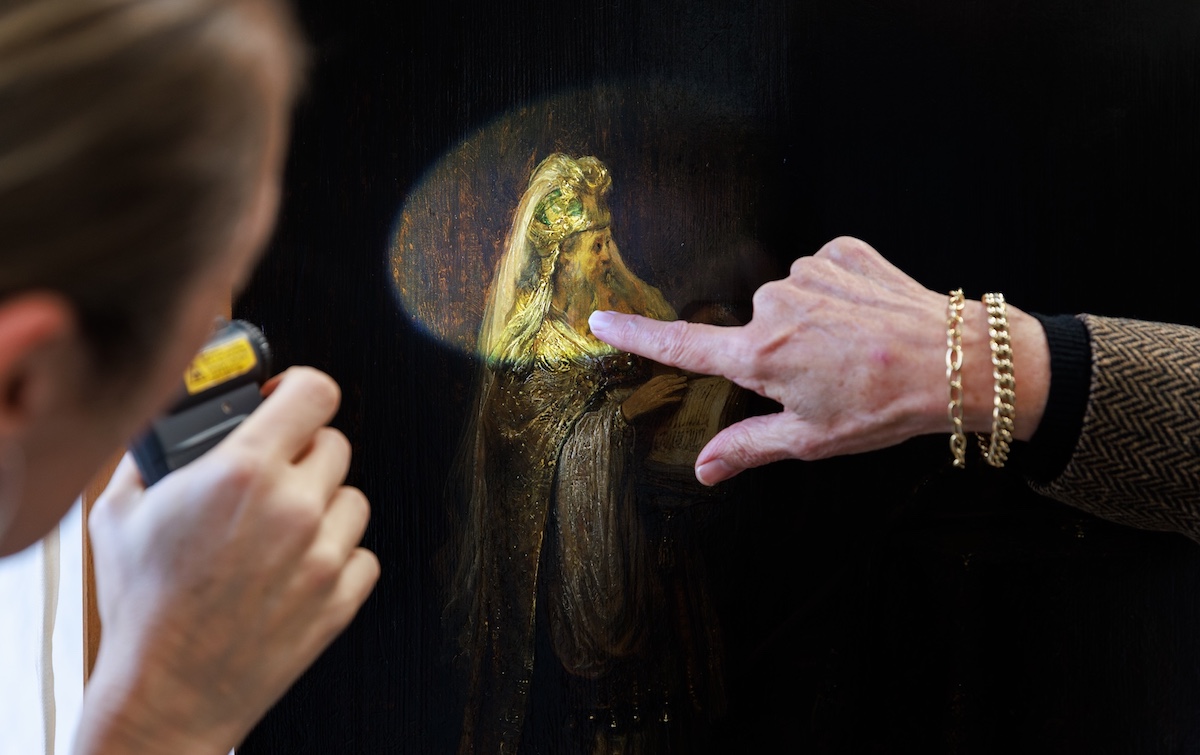
The Rijksmuseum has announced that Vision of Zacharias in the Temple from 1633 is indeed by Rembrandt van Rijn, overturning a judgement that has stood since 1960. For more than six decades, the painting hovered at the edges of the master’s oeuvre, doubted, then largely unseen. Now it returns, with fanfare, with the weight of evidence.
The work, on long-term loan from a private collector, goes on public view from Wednesday, 4 March. It arrives with the type of technical backing reserved for national treasures. Researchers subjected the painting to the same battery of advanced examinations used during Operation Night Watch. Macro XRF scans. Paint analysis. Dendrochronology. The full arsenal.
What they found was dramatic in the tabloid sense. No hidden self-portrait. No overpainting. Instead, an accumulation of facts. The pigments match those found in other works by Rembrandt from the early 1630s. The layering of paint, the handling, the subtle build-up of light, all align with the young artist newly arrived in Amsterdam from Leiden. Even the signature holds up under scrutiny. It is original. The wooden panel, tested by tree rings confirms the date of 1633.
Taco Dibbits, director of the Rijksmuseum, has described the painting as a poignant example of the young Rembrandt at a moment of transition. He was 27. Ambitious, newly embedded in Amsterdam’s competitive art market, and already testing how far narrative painting could be pushed.
The subject is drawn from the Gospel of Luke. The high priest Zacharias stands in the Temple when the Archangel Gabriel announces that he and his wife, Elizabeth, will have a son, John the Baptist, despite their age. The angel is not visible. Instead, there is light, falling sharply from the upper right, cutting across the darkness like a blade. Zacharias looks up, startled, sceptical, almost offended by the suggestion. It is the face that gives the game away. That flicker between disbelief and dawning fear feels unmistakably Rembrandt.
For years, the painting slipped under the radar. In 1960, it was excluded from the accepted canon. A year later, it was purchased privately and vanished from public view. Scholars could not study it, so the painting disappeared from memory. Then, recently, the current owner approached the Rijksmuseum. After 65 years in the dark, the panel was brought back into the light, literally and metaphorically.
Two years of research followed. Conservators compared it closely with works from the same period, including Jeremiah Lamenting the Destruction of Jerusalem in Amsterdam, Simeon’s Song of Praise in The Hague, and Daniel and Cyrus Before the Idol Bel in Los Angeles. The thematic parallels are persuasive. So too is the quality. This is not a tentative studio piece. It has confidence. The composition shifts under examination reveal an artist thinking as he paints, adjusting and refining. Those changes, detected through scanning, are the sort of living decisions that copies rarely carry.
It is also a reminder of how fluid Rembrandt’s catalogue has always been. Attribution is not fixed in stone. It moves with scholarship, with technology, with access. In this case, access proved decisive. Without the owner’s decision to come forward, the debate might have lingered for another generation.
The Rijksmuseum has, in recent years, positioned itself at the forefront of technical art history. Operation Night Watch was as much a public demonstration of scientific rigour as it was a conservation project. This latest confirmation extends that narrative. The tools are sharper now. So, these are the conclusions.
From 4 March, visitors will be able to judge for themselves. Stand before the panel and look Zacharias in the eye. The doubt. The sudden intrusion of the divine into an ordinary ritual. If the research persuades the mind, the painting does the rest.