In the 1990s, GLASGOW restored its reputation by championing the arts. From the end of the 1980s, when GLASGOW was nominated as European Capital of Culture 1990, even represented centre stage at the 1990 Venice Biennale, and served as UK City of Architecture and Design 1999, the city’s international identity rested on the arts.
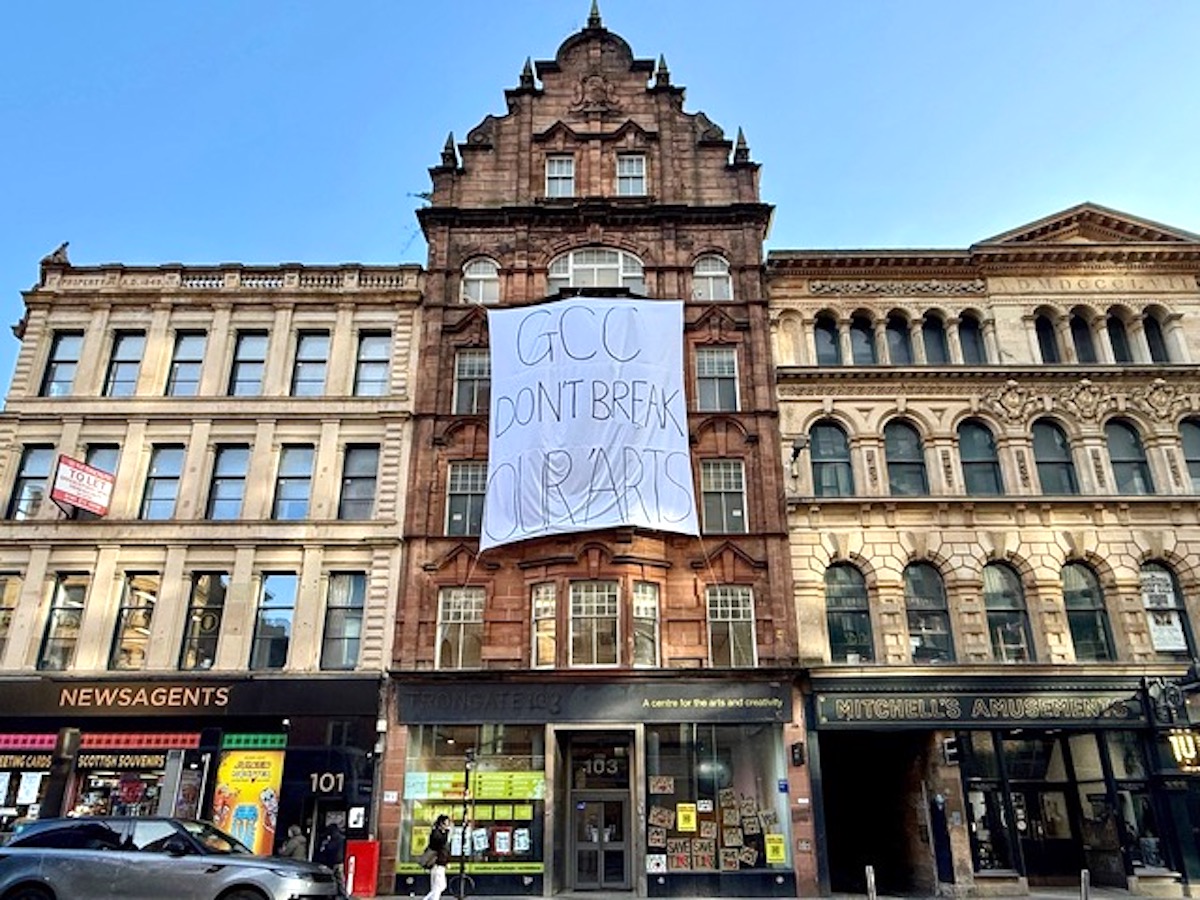
Now, Glasgow City Council (GCC) is determined to destroy its key arts venues by exorbitant rent hikes. In effect, they are killing the goose that laid the golden egg. Already, Glasgow’s CCA Centre for Contemporary Art, the Lighthouse Centre for Design and Architecture, and events space The Arches have closed. This week, the eviction threat moved to Glasgow’s key visual arts hub, 103 Trongate—a crisis.
JOHN GRADY MP told Artlyst, “This affair defines logic. It’s cultural vandalism. GLASGOW PRINT STUDIO is a world-renowned organisation which includes artists like Elizabeth Blackadder, Alasdair Grey, Barbara Rae and Jo Ganter. It’s a huge part of Glasgow and Scotland’s cultural heritage and more importantly, its cultural future.”
103 Trongate houses seven cultural organisations – famous Transmissions (original home to numerous Turner Prize winners, including Douglas Gordon), the internationally renowned Glasgow Print Studio, the well-known Photography Gallery Street Level, and several other flourishing arts charities.
Via their landlord, City Property, GCC are raising the rent by fourfold and the service charge by tenfold. GCC claim this has nothing to do with them – totally misleading, as City Property is 99.9% owned by GCC. In other words, a publicly funded cultural centre established 17 years ago to support the arts is now being operated as a revenue-generating property asset. “This is a national issue “, says Claire Forsyth, GPS director. “We all came to Trongate 103 with the promise that it was a specially developed arts hub with a 25-year lease that would stand.
Moreover, GCC ignored a #25,000 independent study commissioned by them and Creative Scotland in 2023, funded with 25,000 in public funds, to identify a sustainable future for Trongate 103. Reality is that, for example, Glasgow PRINT STUDIO’s new monthly rent has gone from 2000 to 9000. Quite how is an artist-run PRINT STUDIO supposed to find an extra 7,000 quid a month?
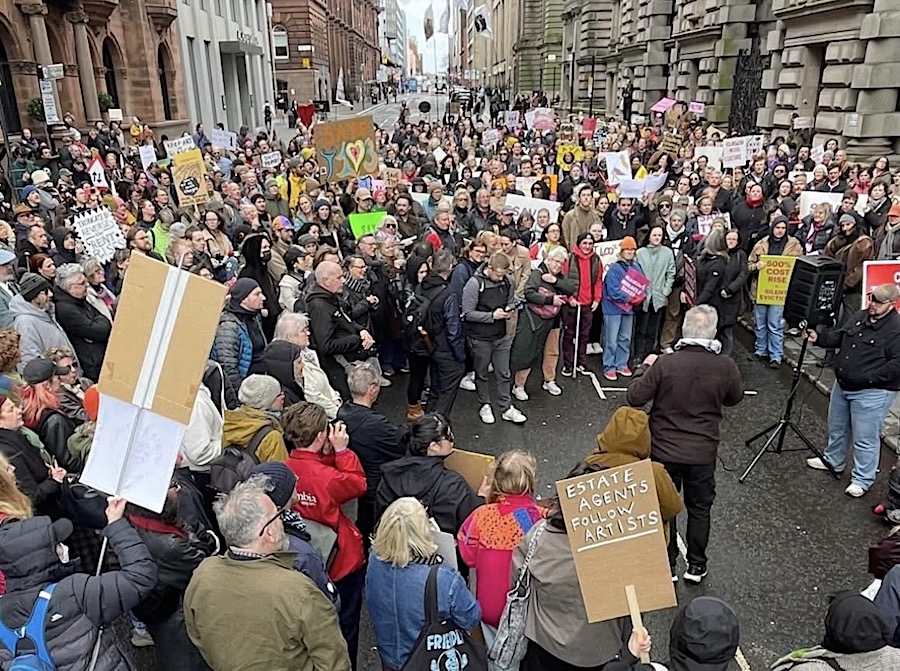
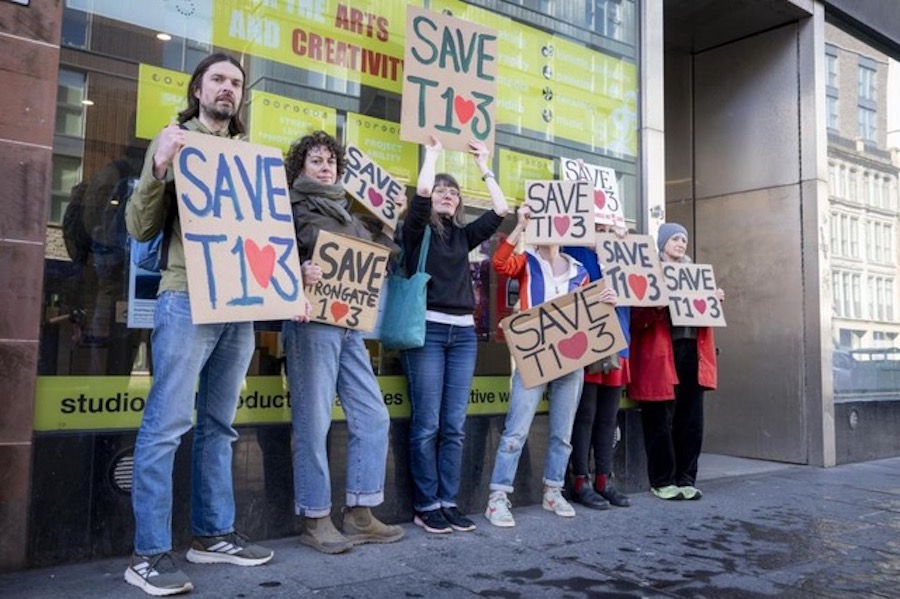
Protester in Glasgow last Friday
The GCC’s shortsighted policy resulted in last week’s crisis, and a mega, heartening demo of around 1,000 people and a petition now numbering 20,000-plus signatures. Now thousands of emails and letters are deluging Glasgow MPs, councillors and Angus Robertson, Scottish Arts Minister. After years of dispute, Trongate tenants are fighting tooth and claw, still determined to secure a happy ending.
So why are GCC doing this? Why pick on the arts? Does Glasgow’s impressive, world-renowned visual art culture mean nothing to the powers that be? It seems money is the reason. City Property think the rent is reasonable, and the GCC, rescued from insolvency and bankruptcy by City Property’s clever financial engineering, agrees. Yes, it’s below market rate – but it’s still completely beyond the artist tenant’s ability to pay.
And what are their plans for the beautiful Victorian (listed) building once it’s empty? No one knows. Moreover, the new, much vaunted Glasgow City Centre Strategy makes no mention of the arts. What is going on?
Glasgow PRINT STUDIO and 103 Trongate are very close to my heart as I have been involved with GPS since 1972, when it began. I was also chairman in the 1970s. GPS moved into this building in 1988, when no one wanted the property, and it was affordable. In 2009, 103 Trongate was established with grants from the National Lottery, Scottish Enterprise, and the Merchant City Heritage Trust to provide reduced-rent support to cultural charities. This was never supposed to be a revenue-generating property asset.
The demonstration was a huge success – but what now?