
The National Gallery has named its architect. Kengo Kuma and Associates, the Tokyo-based practice behind V&A Dundee and the Calouste Gulbenkian Foundation extension in Lisbon, will design a new £350m wing on the site of St Vincent House, just north of the 1991 Sainsbury Wing. The building is due to open in the early 2030s, forming the centrepiece of Project Domani — a wider £750m transformation that, in the Gallery’s own words, represents the most significant change to the institution since its foundation two hundred years ago.
Sixty-five architects entered the competition, launched last September. Six were shortlisted in December, including New York-based Selldorf Architects, who designed the recent Sainsbury Wing refurbishment. The jury awarded Kuma’s submission — developed in partnership with UK-based practices BDP and MICA — the highest available score and reached a unanimous decision. That level of agreement on a project of this scale and complexity is nothing.
“The National Gallery was formed to make great art accessible to all. With this new physical and artistic expansion, we are reaffirming our commitment to the UK public and visitors from all over the world.” – Sir Gabriele Finaldi Director of The National Gallery
Finaldi also described Kuma’s work as demonstrating “exceptional design elegance, a keen sensitivity to location and to history, and a supremely beautiful handling of light and of materials.” Those qualities are visible in his existing museum work. V&A Dundee, which opened in 2018, is a building that manages to be formally distinctive without overwhelming its surroundings — no small feat on a waterfront site with strong competing visual pressures. The Gulbenkian extension in Lisbon works with a similar restraint. Kuma tends toward materials and forms that settle into their contexts rather than announcing themselves, which, at Trafalgar Square — one of the most architecturally contested sites in London — is probably the right instinct.
The exterior of the new wing will be clad in light-coloured Portland stone, tying it to the Wilkins building’s classical language without pastiche. Each floor will have a distinct character. The ground floor, designed for public facilities and temporary exhibition galleries, will have street-level access — meaning shows could, if required, run longer hours than the permanent collection. That’s a practical detail with real programmatic implications for how the Gallery stages large-scale exhibitions going forward.
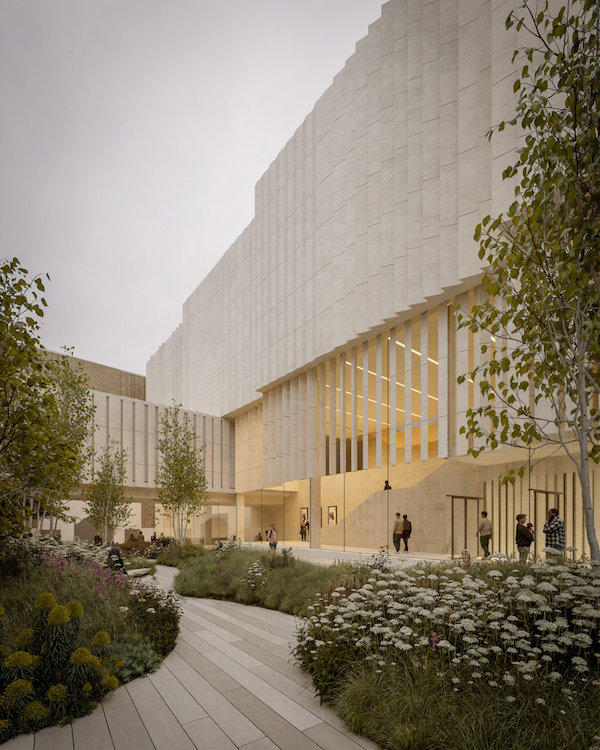
Kengo Kuma’s Design for the National Gallery’s New £350m Wing
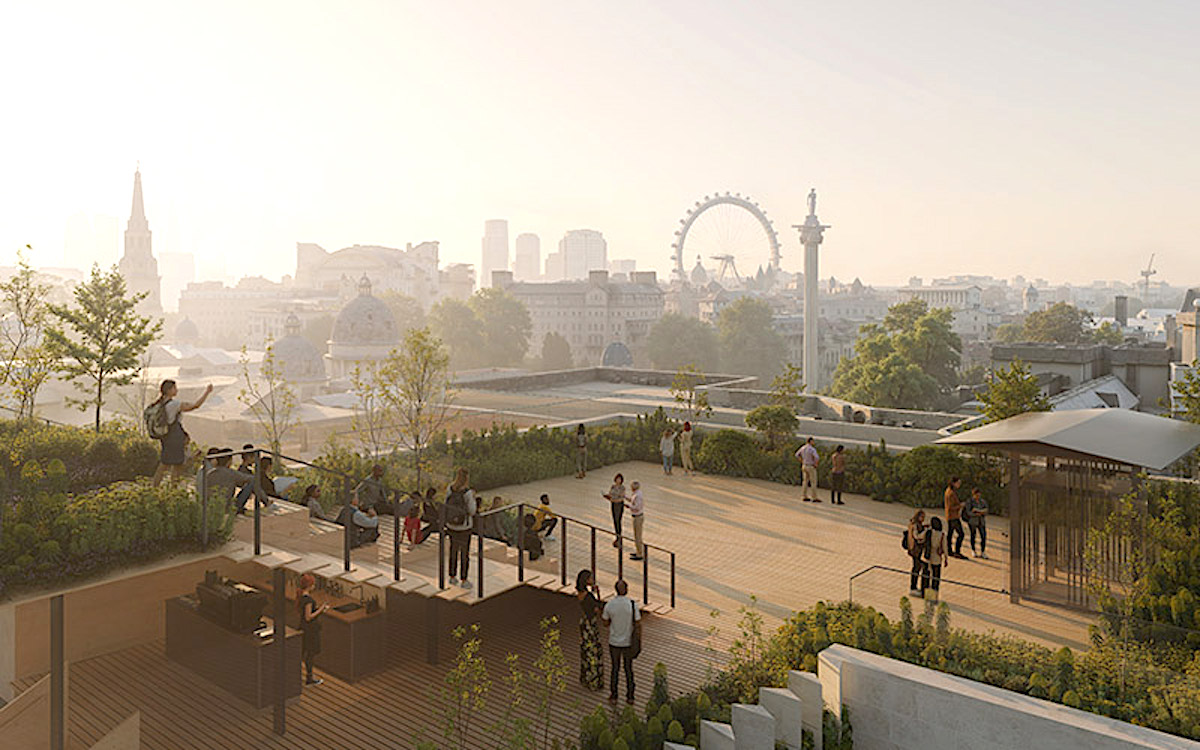
Higher up, the main floor will incorporate vaults and arches that create continuity with the Sainsbury Wing and Wilkins galleries — a deliberate visual and spatial handshake across the buildings. The upper floor takes a different approach: more geometric, its own architectural logic, offering what the jury described as “variety and a change of design pace to the overall scheme.” Bridge links will connect all three buildings at these levels. At the top, a public roof garden with views toward Leicester Square. London could use more of those.
In terms of hanging space, the permanent collection gains 1,500 square metres — a 15% increase on the existing 9,500 square metres across the Wilkins building and Sainsbury Wing. The temporary exhibition space tells a more dramatic story: 800 square metres at ground level, nearly double the 450 square metres in the Sainsbury Wing basement. The Gallery will be able to mount substantially larger exhibitions or divide the space for concurrent smaller shows. Both options change what’s programmatically possible in ways that will matter.
The floors above the ground level will be hung with paintings from the late nineteenth century to the present day. This connects to the other major announcement embedded in Project Domani: the Gallery’s decision to extend its acquisition strategy beyond 1900, which Finaldi announced last year. Until recently, the National Gallery stopped at around 1900, leaving the twentieth and twenty-first centuries to Tate. That boundary has now been removed. The new wing will be the physical space in which that expanded ambition is realised — making the National Gallery, as it states with some confidence, “the only museum in the world which exclusively displays paintings, where visitors will be able to view the entire history of painting in the Western tradition.” That’s a large claim. It’s also, if the collection development follows through, a defensible one.
Project Domani also includes plans for an endowment fund designed to provide long-term financial stability. The Gallery recently launched a voluntary exit scheme for staff to address a projected £8.2m deficit by 2026–27. Those two facts sit in some tension with each other — the ambition of a £750m transformation programme running alongside immediate cost-cutting measures —, but the endowment logic is that sustainable structural funding removes the dependency on annual government grant-in-aid that has created recurring financial pressure. Getting there requires the capital campaign to succeed, which is a significant undertaking in the current philanthropic environment.
Kuma himself was characteristically measured. “It is a privilege to join the National Gallery in this historic project,” he said. “The National Gallery’s collection is a treasure of humanity, and to be entrusted with the expansion that will hold these masterpieces is a responsibility we carry with the greatest care and humility.” Japanese architects tend to speak about their projects this way, and Kuma more than most — but the care shown in his best buildings suggests the language reflects something real about his practice.
The Sainsbury Wing, designed by Robert Venturi and Denise Scott Brown, opened in 1991 and was controversial enough to generate its own chapter in the history of British architectural debate. Prince Charles famously described an earlier proposal for the site as a “monstrous carbuncle.” What Kuma delivers will be judged against that context, and against the weight of the collection it’s being built to house.
Portland stone. Vaults and arches. A roof garden. Early 2030s. The next chapter of one of the world’s great museums has found its architect.