Walking my dog on Primrose Hill, I am constantly reminded of William Blake (1757-1827) and his pantheistic views. Blake’s words ‘I have conversed with the spiritual Sun. I saw him on Primrose Hill’ are etched on a low wall at the summit of the hill. The vast expanse of sky blends with the green of Primrose Hill, Regent’s Park and the skyline of London beyond.
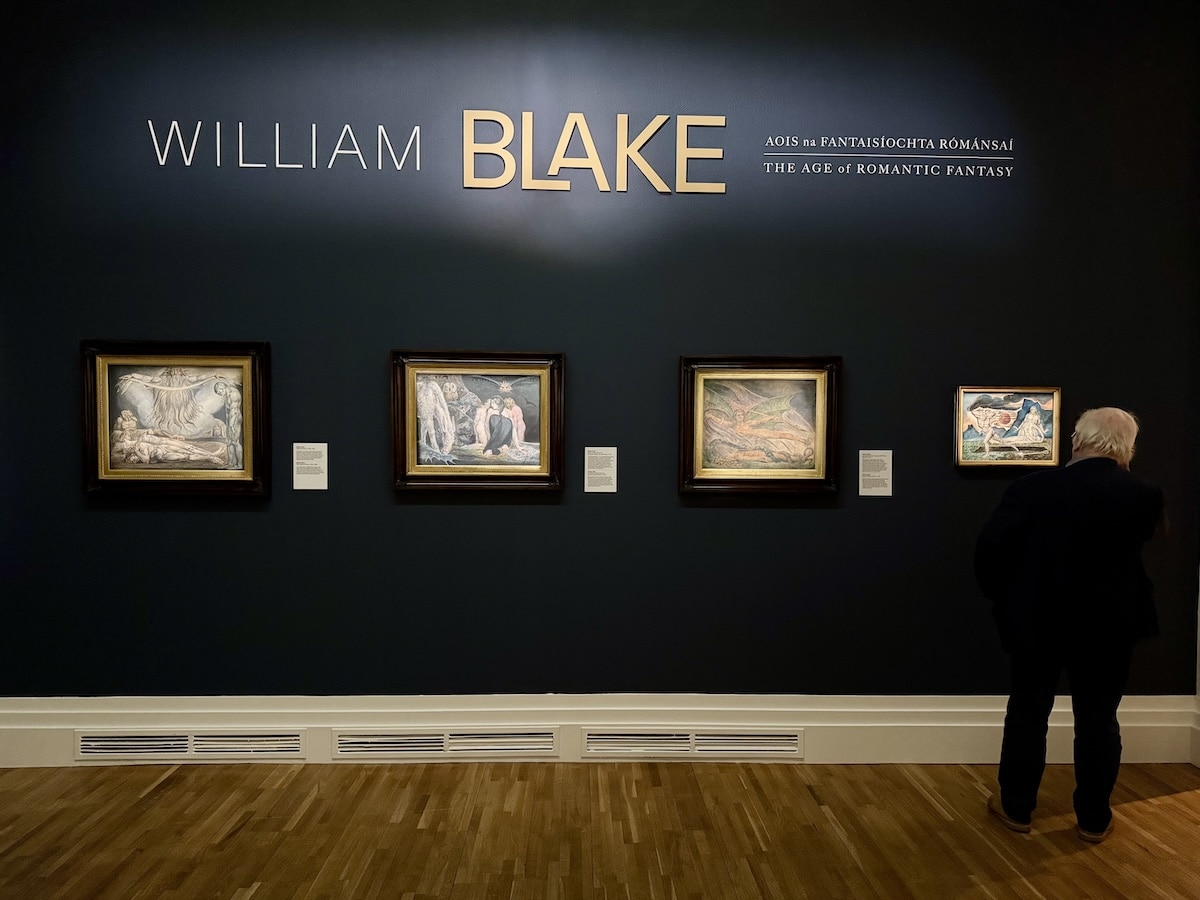
Recently, this spot with its vista over London has once again been tarnished by the brutal and fatal stabbing of a young life. At first, this scene of horror and the beauty Blake felt seems incongruous, but The National Gallery of Ireland is staging a show of Blake’s fantastical works, full of demons, monsters, fairies, ghosts, and horrors, that reveals a deeper connection. It matches Edmund Burke’s idea of the sublime, in which beauty can provoke feelings of fear and awe.
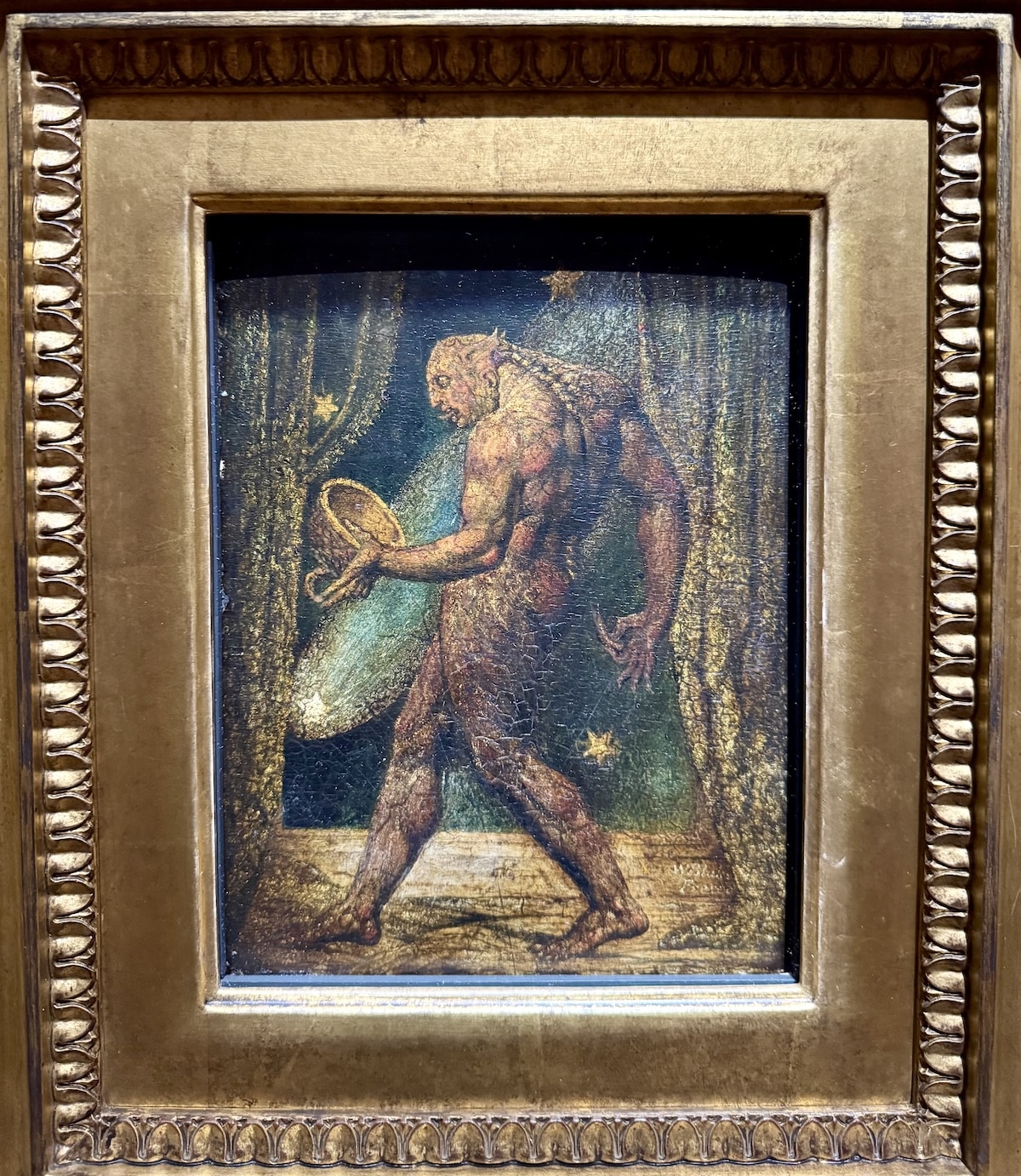
William Blake, The Ghost of a Flea 1819-20
There have been several Blake exhibitions over the last few years that have explored different aspects of his work, including shows at Tate Britain, Tate Liverpool, The Fitzwilliam Museum, The Ashmolean Museum, the Yale Center for British Art, and The Getty Center but this is the first time William Blake’s work has been shown in Ireland. This is surprising as Blake was, and still is, highly significant to Irish artists and writers over the years, from WB Yeats and Francis Bacon to U2. The Irish have long wanted to claim Blake as their own: an idea introduced by Yeats that has proven to be untrue. Bacon owned the plaster life cast of William Blake’s head, originally made by James Deville in 1823 and recast in 1953, on display in the exhibition.
The exhibition places Blake’s work alongside his peers who worked on similar themes. Of the 110 works in the exhibition, 36 are by Blake, all from Tate Britain’s collection. Other artists include Francis Danby (1793-1861), JMW Turner (1775-1851), George Romney (1734-1802), Henry Fuseli (1741-1825), Samuel Palmer (1805-81), and James Barry (1795-1865). The exhibition starts and ends with a wall of powerful works by Blake and is divided into six sections across five rooms: Horror and Peril, Fantastical Creatures, Enchantments, The Gothic, Romanticising the Past, and The Underworld.
Blake and his fellow artists responded similarly to the social, political, and economic changes around them, as reflected in the exhibition’s separate sections. Wars such as the Seven Years’ War, the American Revolutionary War, and the French Revolution influenced the artists’ subject matter. Britain’s defeat in the American Revolutionary War led to poverty and urban discontent, prompting artists to explore the national past, as seen in the Romanticising the Past and The Gothic sections. While the French Revolution initially inspired ideas about freedom, the execution of King Louis XVI in 1793 tainted perceptions of the revolutionaries. In response, artists turned to their imaginations, depicting monsters, fairies, and other fantastical beings.
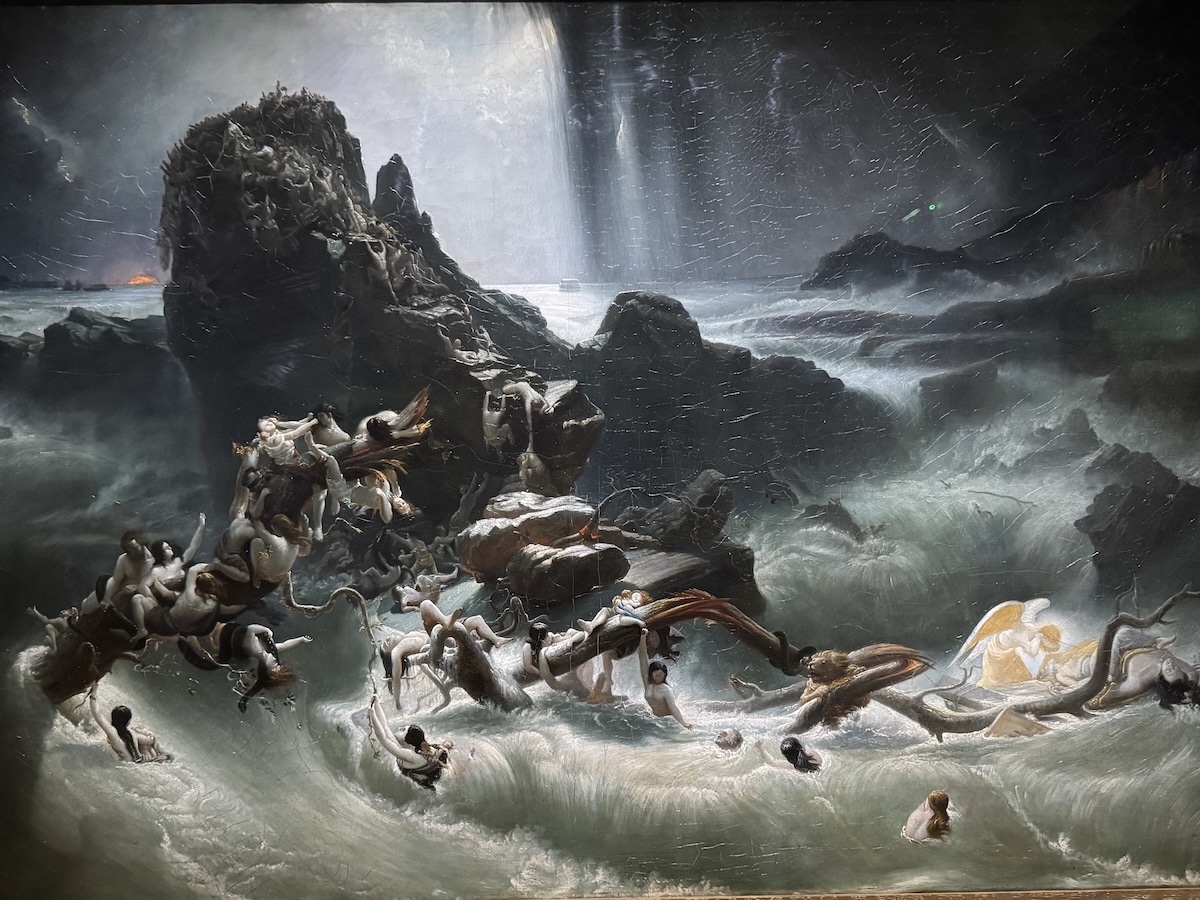
Francis Danby, the Deluge 1840
Among the highlights of the exhibition is Francis Danby’s giant painting, The Deluge of 1840, which epitomises the Horror and Peril section. It illustrates the biblical flood described in the book of Genesis and sets humanity against nature’s destructive forces. Bodies desperately clutch tree branches as a colossal wave overwhelms them. The sense of doom is emphasised through dark, brooding colours. A glow representing Noah’s Ark is a glimmer of salvation and hope amid the destruction.
A wall of Blake’s large colour prints shows his admiration for Michelangelo’s use of muscular, sculptural figures. The House of Death, c1795-1805, is an illustration of Milton’s Paradise Lost XI, 477–93. Death hovers above while Despair stands on the right. The Body of Abel Found by Adam and Eve c1826 shows Cain fleeing the scene having murdered his brother, his contorted face betrays his guilt and anguish, while the stylised figure of Eve bends over the corpse of Abel. It is easy to see why Dante Gabriel Rossetti was so enamoured with Blake that he bought his famous notebook. (2)
One of Blake’s most familiar paintings is the miniature The Ghost of a Flea, c1819-20, painted in a tempera mixture with gold. This anthropoid ghost of a flea appeared to Blake in a vision. It was part of a series depicting “Visionary Heads” commissioned by the watercolourist and astrologist John Varley (1778–1842). In contrast, there are two paintings by JMW Turner: The Goddess of Discord Choosing the Apple of Contention in the Garden of the Hesperides, exhibited in 1806, and a Sketch for Ulysses Deriding Polyphemus. Turner’s fantastical beasts are subtly hidden in both paintings. The former shows the ghost of a dragon perched high on a mountain top, while the second, a scene from The Odyssey, depicts Cyclops hiding in the clouds.
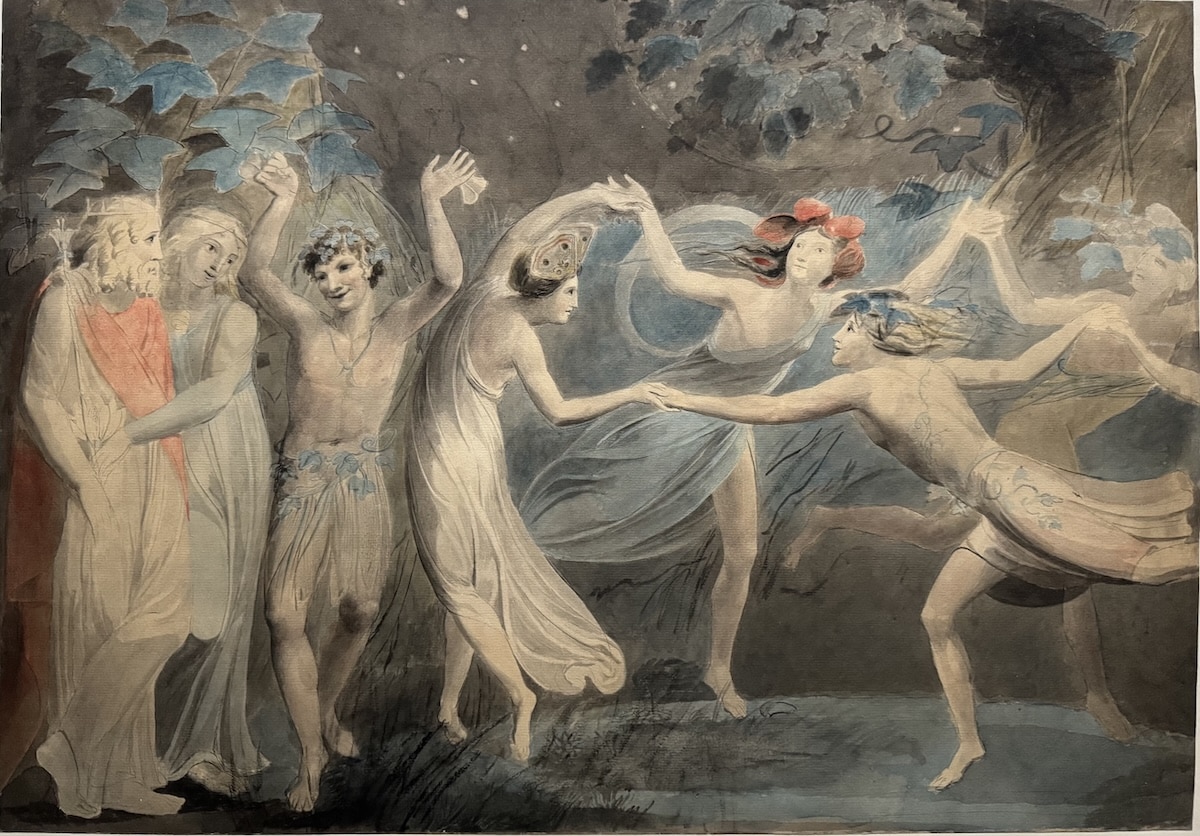
William Blake, Oberon, titania and Puck with Fairies Dancing c1786
Another highlight is Blake’s painting of Oberon, Titania, and Puck with Fairies Dancing, c1786, from Shakespeare’s A Midsummer Night’s Dream, which moves away from earlier images of fairies as disturbing or threatening on show in the exhibition and depicts them as graceful and ethereal, more akin to Art Nouveau representations.
The most ominous images are in the final section, The Underworld, which depicts Satan hovering over the living, with some scenes drawn from the Bible and others from Milton’s Paradise Lost. James Barry’s print Satan, Sin and Death, c1792-1808, Nathaniel Dance-Holland’s A Devil with Torch and Spear and the painting of bright red lakes of fire and jagged rocks of The Fallen Angels Entering Pandemonium from Paradise Lost Book 1, formerly attributed to James Martin, leads us to the suite of images by Blake to complete the exhibition.
The interspersing of Blake’s work with that of his contemporaries underpins the exhibition’s themes and lends it credibility, introducing an Irish audience to the breadth and originality of Blake’s work that go far beyond his poetry.
William Blake: The Age of Romantic Fantasy, National Gallery of Ireland, 16 April – 19 July 2026
Visit Here
Words and photos by Sara Faith ©Artlyst