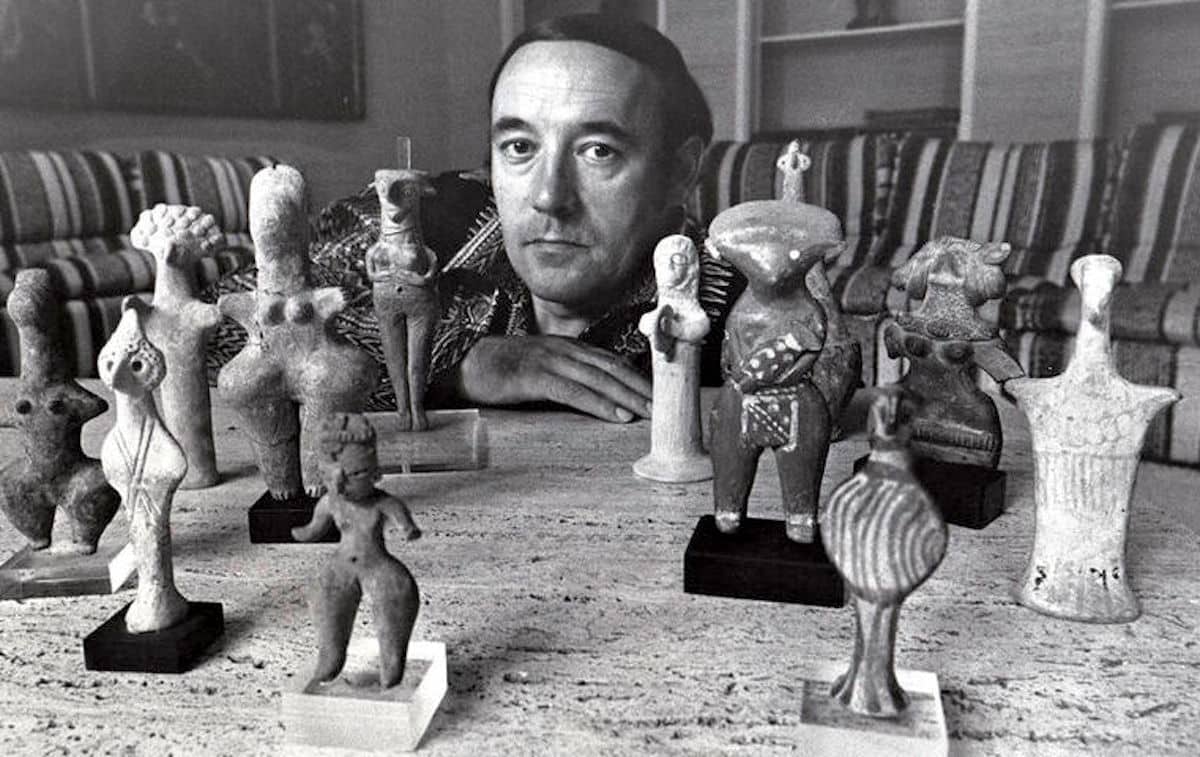
Desmond Morris, who died on Sunday aged 98, was a rare figure who lived several significant careers in a single lifetime. He was a zoologist of international standing, a bestselling author whose work (The Naked Ape) reached audiences far beyond the academy, and a painter who belonged to the last generation of British Surrealists. He managed to sustain all three careers simultaneously.
Morris faced significant controversy with feminists following the publication of his bestseller The Naked Ape (1967). Critics took particular issue with his biological determinist view of gender, which they argued naturalised male dominance and relegated women to a secondary role in human evolution. Morris argued that gender differences were hard-wired rather than purely cultural.
His son Jason, paying tribute said, “His was a lifetime of exploration, curiosity and creativity. “He was still writing and painting right up until his death.”
Born in Wiltshire in 1928, Morris completed national service before studying zoology at the University of Birmingham, where an early and decisive encounter with microscopic organisms set the terms for much that followed. The drawings he made under the microscope during his degree planted the seed of a visual language he would spend the next seven decades developing. After Birmingham, he completed a doctorate in animal behaviour at Oxford, where he studied the reproductive behaviour of birds, and it was there that his academic reputation was established. But the paintings never stopped.
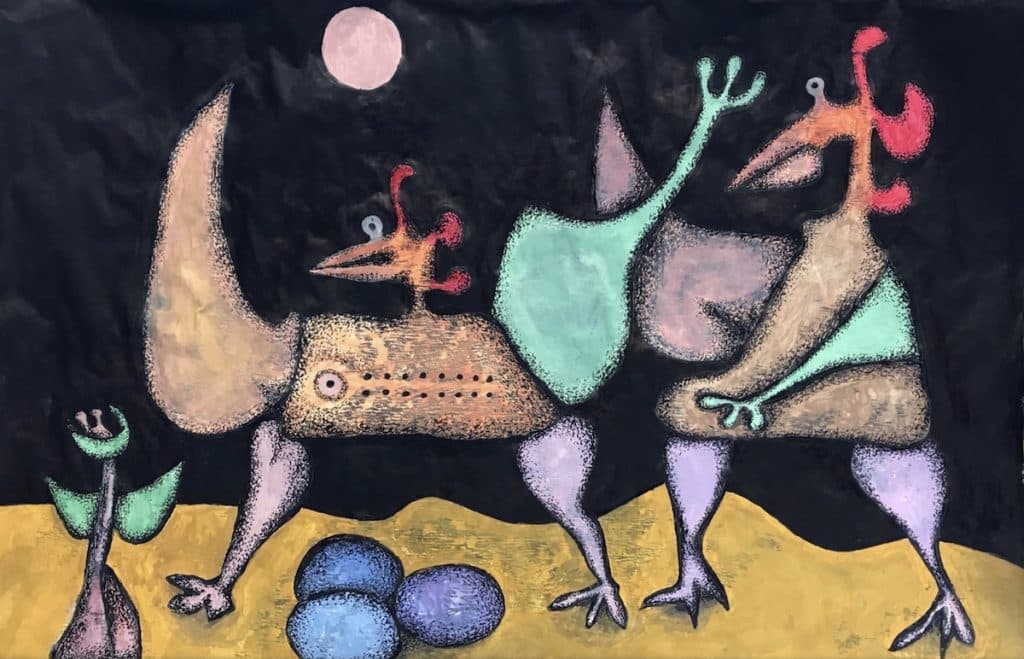
Desmond Morris Intruder I, 2019 Mixed media on paper Photo Courtesy Redfern Gallery
His public profile was built initially through television. From 1956, he became the face of Granada’s Zoo Time. This weekly programme ran for over a decade and made him one of the most recognisable scientific communicators of his generation. BBC programmes followed, among them Life in the Animal World, Manwatching and The Human Animal. Then, in 1967, came The Naked Ape, his study of human behaviour viewed through a zoologist’s lens. It was an immediate sensation. The book has sold more than 12 million copies, has never been out of print, and ranks among the hundred best-selling books ever published. Follow-up titles, including The Human Zoo and Manwatching, extended his reach further still, and over the course of his career, he contributed to more than 90 publications.
What the public profile obscured for much of his life was the parallel existence he led as a painter. Morris himself acknowledged that it was only in the late 1980s that his double life as an artist began to be more widely known. By then, he had been painting seriously for four decades, often working through the night, sometimes until four in the morning. The works he produced, which he termed biomorphs, were populated by bizarre, invented creatures that, as he described it, evolved on the canvas, belonging to their own dimension. They owe a clear debt to Joan Miró and Yves Tanguy, both of whom Morris knew personally. Miró visited him, and in 1950 they held a joint exhibition in London. That Picasso and Miró both ended up with works from Morris’s 1957 ICA exhibition of chimpanzee paintings in their private collections tells you something about the company he kept and the seriousness with which he was regarded in those circles.
That 1957 exhibition, curated by Morris with the support of Herbert Read and Roland Penrose, was a landmark moment in its own right. The first occasion on which zoology and fine art were formally brought together sparked what contemporary accounts describe as an international media sensation. The major American Surrealist collector William Copley flew in from New York to attend. It led directly to Morris’s book The Biology of Art, a pioneering study of picture-making behaviour in chimpanzees and its relationship to human artistic practice.
His place within British Surrealism was secured early. While at Birmingham, he had fallen in with the last organised group of Surrealists in Britain, headed by Conroy Maddox and including Emmy Bridgwater, William Gear and John Melville. After his first solo show in 1948, he won the support of the dealer ELT Mesens. He was, by the time of his death, the last surviving artist of the Surrealist movement. That distinction carried with it a responsibility he took seriously. In 2018, his show at the Redfern Gallery coincided with the publication of The Lives of the Surrealists. This critically acclaimed account drew on his personal friendships with many of its subjects. More than 100 works were sold, and the Ashmolean Museum acquired several drawings as well as The Dove, painted in 1948.
Public collections gradually recognised what the market had been slow to acknowledge. Tate acquired The Arena in 2000. The National Galleries of Scotland purchased War Woman. Birmingham Museums holds The Jumping Three. His final institutional gesture was characteristic in its ambition: earlier this year, he opened his own Institute of Visual Arts in Ireland, complete with a permanent Surrealist gallery housing his collection and works by fellow Surrealists accumulated over 75 years.
Desmond Morris is survived by his son, Jason.
Top Photo: Courtesy Bonhams