
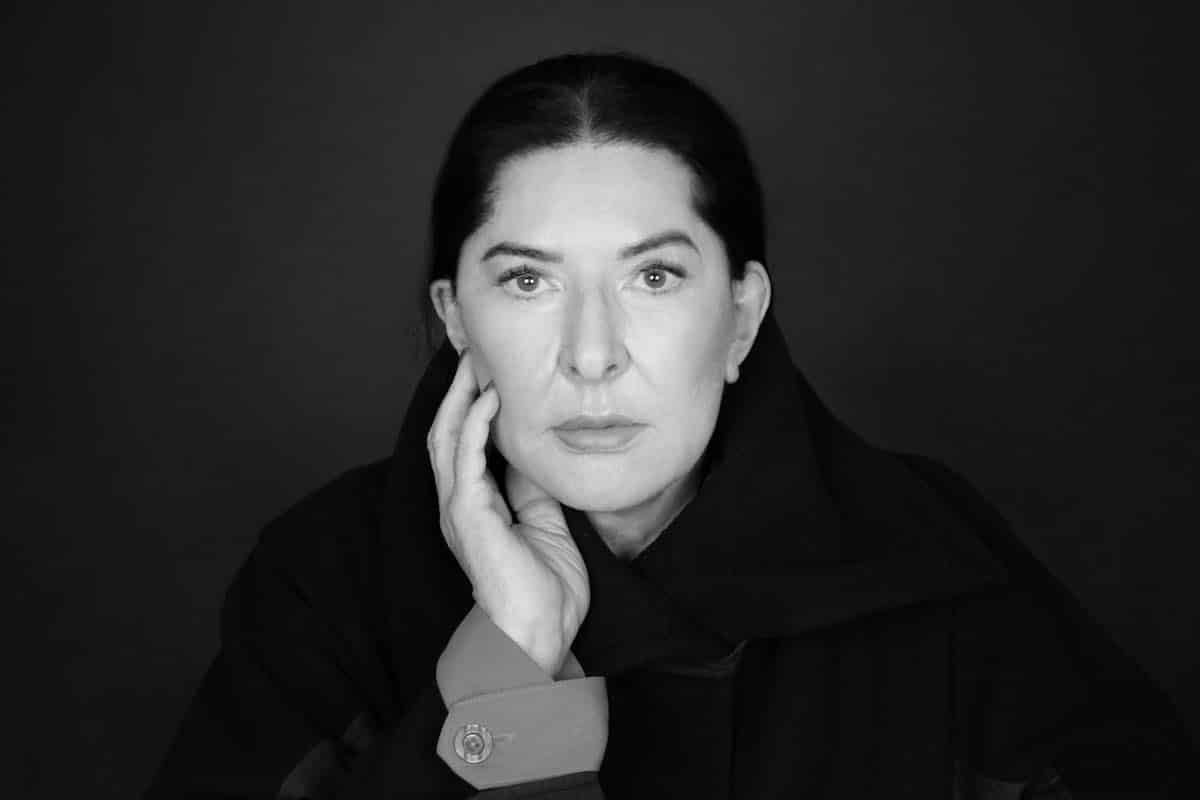
When Marina Abramović first visited the Venice Biennale as a fourteen-year-old girl, travelling by train from Belgrade with her mother, she stepped out of the station and wept. The city was, she has recalled, so incredibly beautiful that it was unlike anything she had ever seen. More than six decades later, she returns to Venice not as a visitor but as the first living woman artist to be honoured with a major exhibition at the Gallerie dell’Accademia, one of the most venerable institutions in the history of Western art. The symmetry is not lost on her, and it should not be lost on us.
The exhibition will coincide with the 61st Venice Biennale Arte. The exhibition marks Abramović’s eightieth birthday and represents a milestone of institutional recognition that, given the significance and influence of her practice over five decades, is overdue and genuinely welcome. She became the first woman to hold a solo show at the Royal Academy of Arts in London in 2023, and in 1997, she was the first woman to be awarded the Golden Lion at the Biennale itself.
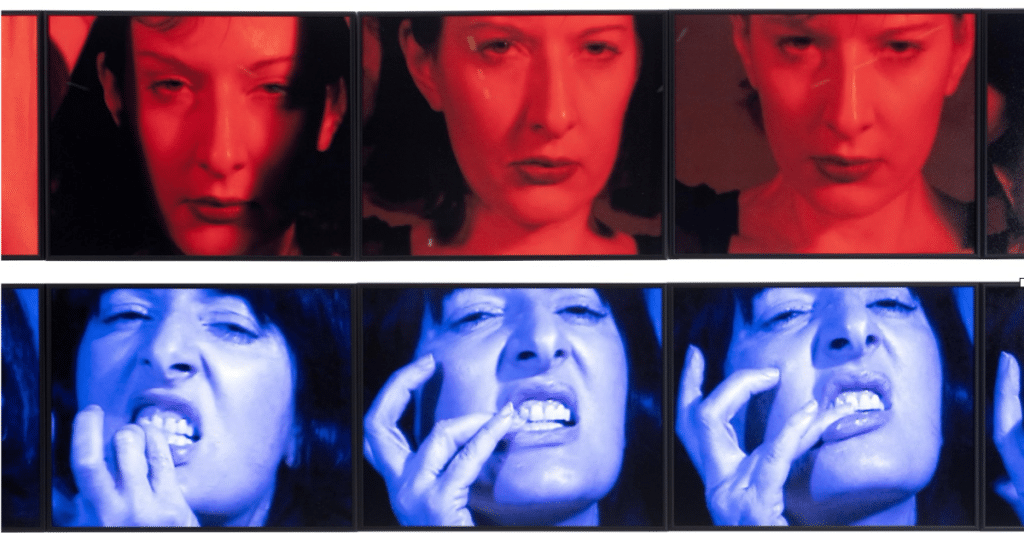
Marina Abramović, Red Period Blue Period, 1998. Courtesy: Marina Abramović Archives.
The Accademia exhibition adds another chapter to a record of firsts that reflects more on institutions’ slowness to recognise work that did not fit their established frameworks than on Abramović’s ambition. The exhibition was curated by Shai Baitel, Artistic Director of the Modern Art Museum in Shanghai, where an earlier iteration of Transforming Energy first debuted. The Venice presentation is substantially different
A temporary exhibition of the Accademia’s history will be displayed across both the permanent collection galleries and the dedicated temporary exhibition spaces. Abramović’s practice will unfold within the fabric of the institution’s Renaissance holdings rather than cordoning it off in a separate wing.
Those implications are most powerfully realised in the exhibition’s central pairing. Abramović’s Pietà (with Ulay) from 1983, a photograph of the artist cradling her former partner Ulay’s body across her lap in a deliberate echo of the devotional tradition, is placed in direct dialogue with Titian’s Pietà, the unfinished final masterpiece that the Renaissance painter left incomplete at his death and that Palma Giovane brought to completion. This year marks the 450th anniversary of Titian’s work, and the juxtaposition is precisely as charged as it sounds. Across five centuries, two artists working in entirely different registers address the same fundamental questions about grief, the body, suffering and transcendence. The conversation between them is not forced. It feels entirely necessary in the context Baitel has created.
The inclusion of the Ulay pairing deepens the work considerably. The two artists, who were partners in life as well as practice for more than a decade, undertook their final collaboration in 1988: the Great Wall Walk, in which each began at opposite ends of the Great Wall of China and walked toward the other for ninety days, meeting in the middle not to marry, as had originally been planned, but to end their relationship. The walk, represented in the exhibition alongside documentation of other historic performances, has become one of the defining gestures in the history of performance art. This durational act collapsed the personal and the artistic into a single irreversible event. Ulay passed away in 2020. His presence still resonates in the exhibition, through the Pietà photograph and the documentation of their shared performances, adding energy, a dimension that sits alongside its more participatory elements without overshadowing them.
Participation is central to the exhibition’s structure. Visitors are invited to engage with Abramović’s Transitory Objects, stone beds, and structures embedded with crystals, including quartz and amethyst, by lying, sitting, or standing upon them. The gesture belongs to Abramović’s longstanding interest in what she terms energy transmission, the idea that materials and bodies can enter into a relationship that produces genuine transformation in the person who submits to it. In Venice, a city whose history is inseparable from the movement of rare and precious materials across cultures and continents, and whose Byzantine and Renaissance artistic traditions are grounded in the metaphysical properties of gold, glass and mosaic, this language finds an unexpectedly sympathetic context.
Early performances, including Rhythm 0 from 1974, in which Abramović stood for six hours in a Naples gallery and invited visitors to use any of seventy-two objects placed on a table, among them a candle, a comb, a loaded gun and an axe, upon her body as they wished, are represented through projection and documentation. A re-enactment of Imponderabilia, in which Abramović and Ulay originally stood naked in a doorway forcing visitors to press past them, is also included. Together, these works establish the historical depth of a practice that has always placed the body, its vulnerability, its endurance, and its capacity for transformation at the absolute centre of its concerns.
Marina Abramović: Transforming Energy is at the Gallerie dell’Accademia, Venice, from 6 May to 19 October 2026.