
There is a particular pleasure in the British Museum’s Objects in Focus series, which takes a single work from the collection and asks what, through patient and rigorous inquiry, it can yield. The format suits certain objects better than others. It suits the Tudor Heart exceptionally well. Rachel King’s account of this extraordinary pendant is one of the finest entries in the series, a book that moves with scholarly confidence between the technical details of goldsmithing and the broad sweep of early Tudor political culture, making both feel equally urgent.
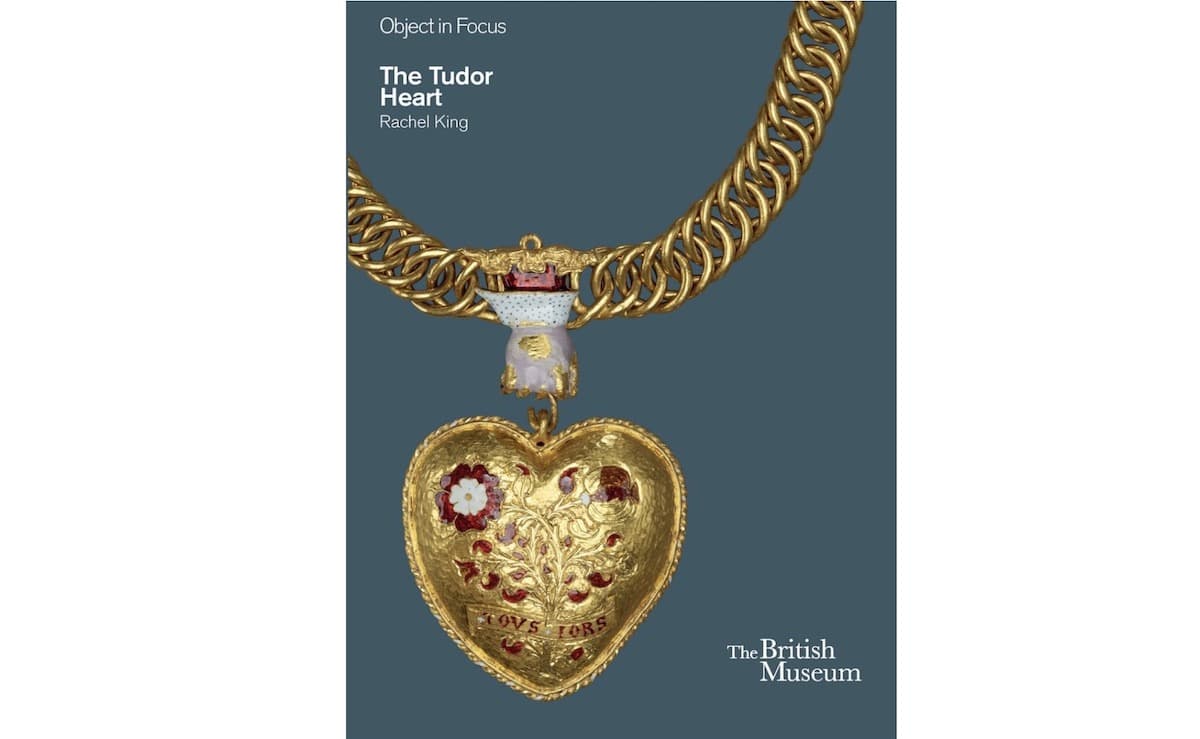
The object itself demands attention before any historical argument is made. The Tudor Heart is a heart-shaped pendant in enamelled gold, suspended from a chain by an enamelled clasp, the whole ensemble weighing more than 0.3 kilograms and comprising over three metres of gold wire. The chain is the oldest known example of its type to survive. The gold is largely 24 carat. The artistry is, by any standard, extraordinary, and King takes care to establish the piece’s full technical achievement before deploying it as historical evidence. This sequencing ensures the reader never loses sight of the object’s status as a masterwork in its own right.
The pendant’s association with Henry VIII and Katherine of Aragon has been established through a combination of physical analysis and archival research. Dating to the last years of the 1510s based on its enamelled motifs and supporting documentary sources, the object emerges from these pages as a witness to a specific and pivotal moment in English history, the early years of Henry’s reign, before the iconographic revolution that Hans Holbein the Younger would later bring to the expression of Tudor magnificence. The pendant predates Holbein’s arrival, and King uses that fact productively, situating it within a visual culture somewhat overshadowed by later Holbein portraits and one that the Tudor Heart helps recover in unusually material terms.
The book also tells the story of the pendant’s discovery, a sensational chance find that King narrates with appropriate drama before settling into the more sustained work of analysis. The tension between the object’s spectacular physical presence and the painstaking scholarly methods required to interpret it is one that King handles with considerable skill, moving between registers without losing the thread of her central argument.
King is Curator of Renaissance Europe and the Waddesdon Bequest at the British Museum, with specific responsibility for ceramics, glass, metalwork and related collections made under European influence between roughly 1500 and 1700. Her particular interest in English goldsmiths’ work, and especially enamelled pieces, developed through her curatorial involvement in the Treasure Process administered by the Portable Antiquities Scheme. This connection gives her a practical understanding of how objects like the Tudor Heart enter the public record.
The result is a book that achieves what the best object-centred scholarship always aims for but rarely manages so cleanly: it makes the gap between the physical thing and its historical meaning feel genuinely small. By the final pages, the Tudor Heart is no longer simply a remarkable survival from the early sixteenth century. It is a document, a statement of dynastic intent, a record of technical achievement, and an index of a court culture that, within a decade or two of the pendant’s making, was about to be transformed beyond recognition.
The British Museum Press publishes the Tudor Heart as part of the Objects in Focus series.
Read More
Buy This Book Here