
Joe Lewis was born in London’s East End. He made his fortune in currency trading, became the largest single shareholder at Christie’s briefly, quietly acquired one of the great American collections before it went to auction under its original owners’ name, and eventually retreated to the Bahamas, where he has lived for decades while continuing to buy art with the instincts of someone who understood markets long before he understood paintings. This June, he is bringing back to the city where he grew up a significant portion of what he and his daughter Vivienne have assembled over the past 30 years for a standalone sale at Sotheby’s, estimated at between £150 million and £200 million. It is the most valuable single-owner collection ever offered for sale in the United Kingdom.
The decision to sell in London is not incidental. For much of the past decade, and particularly since Brexit, the narrative surrounding the London auction market has been one of managed decline, a city losing ground to New York, Paris and Hong Kong, its summer sales season contracting to the point where Christie’s declined to hold modern and contemporary auctions in London at all during June 2024.
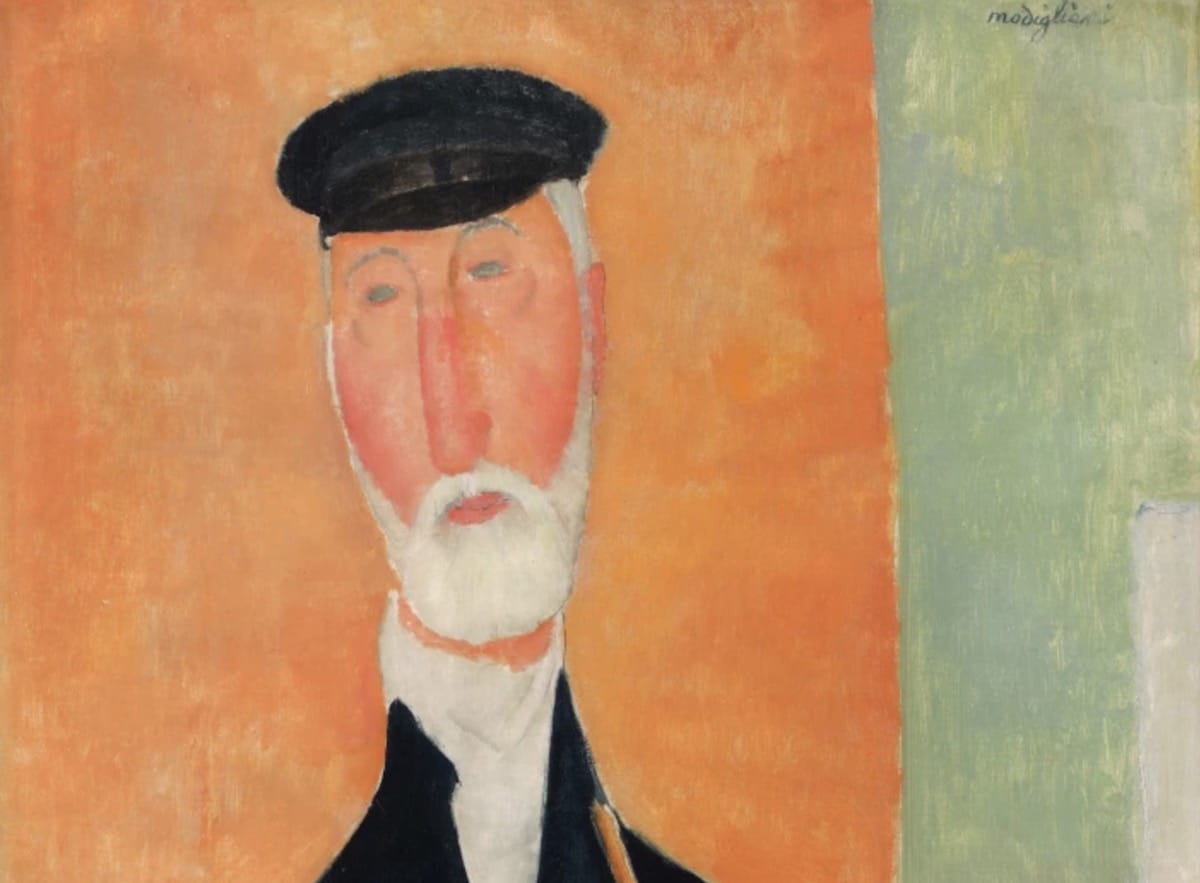
Amedeo Modigliani’s Homme à la pipe (Le notaire de Nice), painted 1918
The collection assembled by Lewis, mostly between the early 1990s and around 2015, is built around an abiding fascination with the human figure. The School of London painters, Francis Bacon and Lucian Freud above all, represent what Barker calls the core DNA of the collection, an affinity that Lewis has described in terms of his East End origins and the directness with which those artists confronted the human condition. A March sale at Sotheby’s, focused solely on Bacon, Freud and Leon Kossoff and realising £35.8 million with fees, served as a market test. The June sale extends the aperture considerably, bringing in Klimt, Schiele, Modigliani, Picasso, Caillebotte and Soutine alongside the School of London works, a global checklist of figurative painting’s most significant practitioners across the past century and a half.
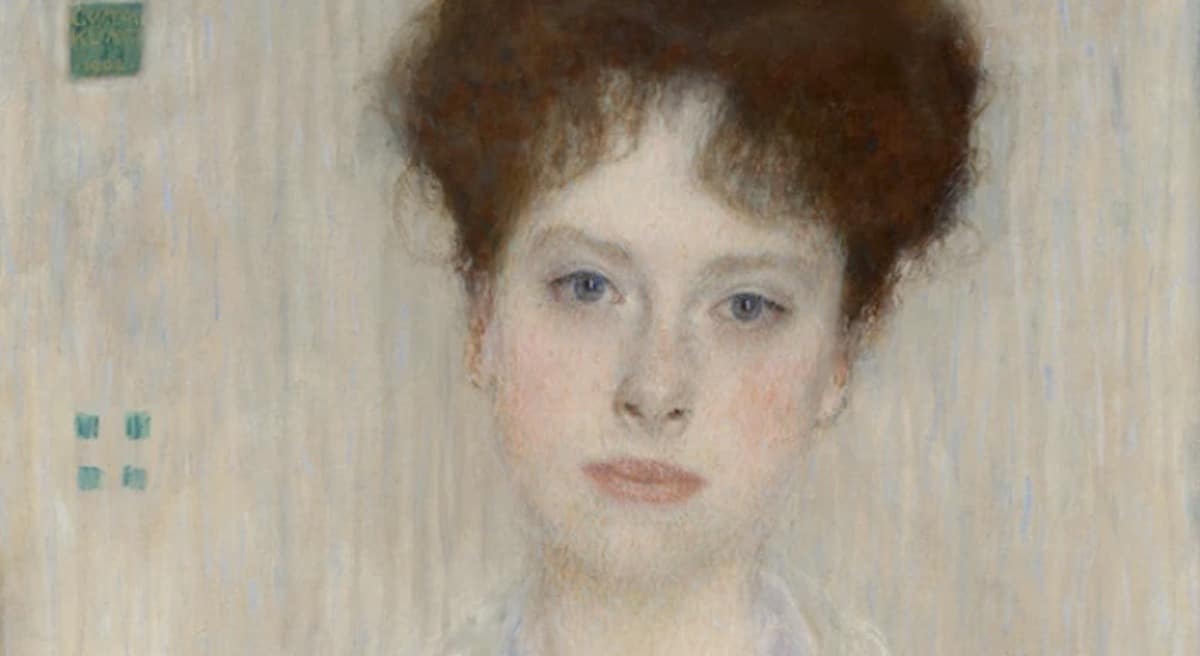
The highlights disclosed so far establish the quality of what is to come. Gustav Klimt’s 1902 society portrait Bildnis Gertrud Loew, a restituted work that Lewis purchased at Sotheby’s in 2015 for £24.8 million, carries an estimate of £20 million to £30 million. The comparison with Klimt’s portrait of Elisabeth Lederer, which sold at Sotheby’s New York in November for $236.4 million, contextualises both the estimate’s ambition and its relative restraint. Amedeo Modigliani’s Homme à la pipe (Le notaire de Nice), painted in 1918 during the final months of the artist’s life when illness had sent him south to recuperate and he began painting the locals he encountered, is estimated at £12 million to £18 million. Bacon’s Two Studies for Self-Portrait from 1977 carries an estimate of £8 million to £12 million. Lucian Freud’s Woman in a Grey Sweater, painted between 1987 and 1988, is estimated at £3 million to £4 million. A 1936 drawing of Dora Maar by Picasso is offered at £600,000-£800,000.
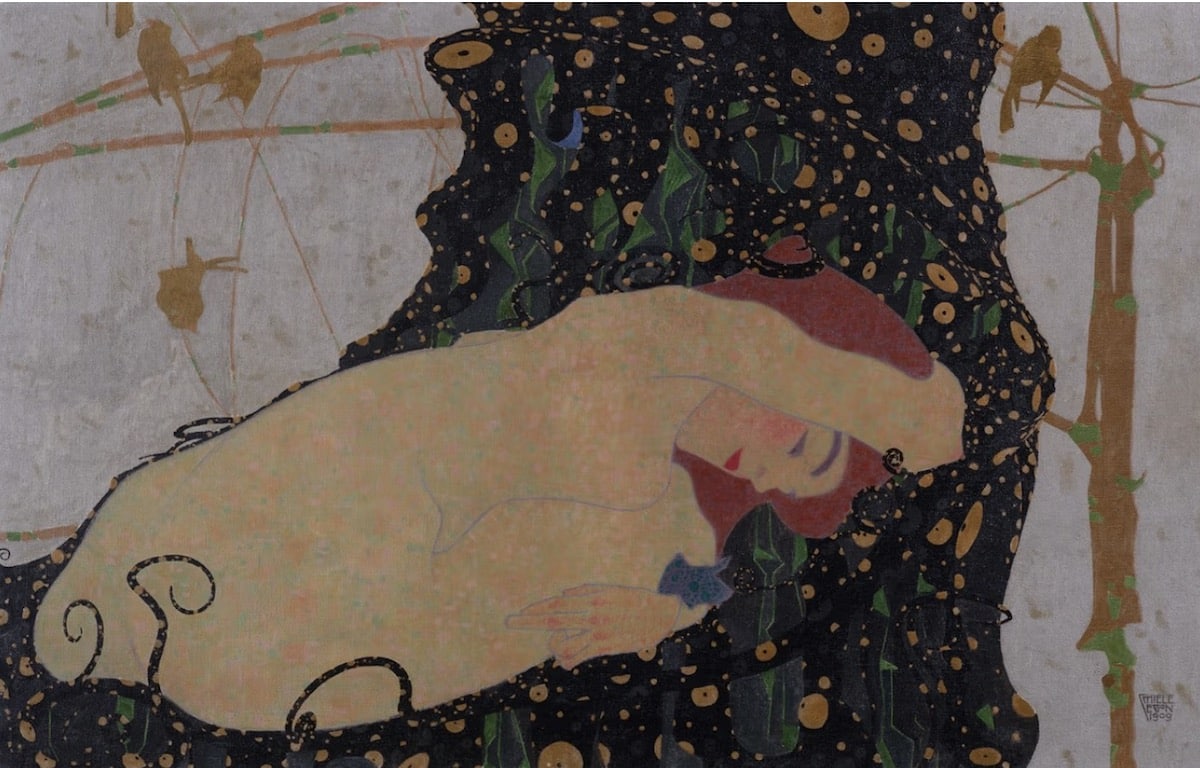
Egon Schiele’s Danaë, painted in 1909. Photo Courtesy Sotheby’s
The return of Egon Schiele’s Danaë, painted in 1909 when the artist was nineteen, is one of the sale’s more intriguing subplots. The work was withdrawn from a Sotheby’s New York sale in May 2017, where it had been estimated at $30 million to $40 million. It reappears now with a considerably reduced estimate of £12 million to £18 million, and the market will decide what that repositioning means.
Barker speaks about Lewis’s relationship to the works he has bought with evident admiration, noting that he loves to situate art at the moment of its creation and to understand the stories surrounding its making. The Caillebotte portrait of Paul Hugot, exhibited at the Musée d’Orsay’s 2024 retrospective and depicting the artist’s close friend and patron, prompts Barker to a more personal observation. “I read into the Caillebotte a little bit of Joe himself,” he has said, “the proud businessman, parading on his own way to work.”
Lewis, now 89 and valued by Forbes at approximately $7 billion, brings to this sale a biography inseparable from the recent history of the art market. His involvement in Christie’s ownership, his acquisition of the Victor and Sally Ganz collection before its public auction in 1997, and his long proximity to the market’s mechanisms have given him, as Barker puts it, a position that very few collectors ever reach. He was, notably, buying art before he became involved with the auction house, driven by instinct as much as by calculation, and willing, when necessary, to pay extraordinary sums for the works he wanted most.
The Lewises have chosen not to take a guarantee for the collection. This decision signals either supreme confidence in the works or a philosophical preference for letting the market speak without cushioning. A family spokesperson has framed the sale not as a conclusion but as a staging post, noting that the collection continues to buy actively, with Vivienne engaged in the global market on an ongoing basis, and that the family remains committed to the painters of today whose practices are shaped by the artists now heading to auction.
Top Photo: Detail Gustav Klimt Bildnis Gertrud Loew (Gertha Felsőványi) (Portrait of Gertrud Loew (Gertha Felsőványi) Courtesy Sotheby’s
A selection of works will be on view at Sotheby’s New York from 2 May, ahead of the London sale in late June