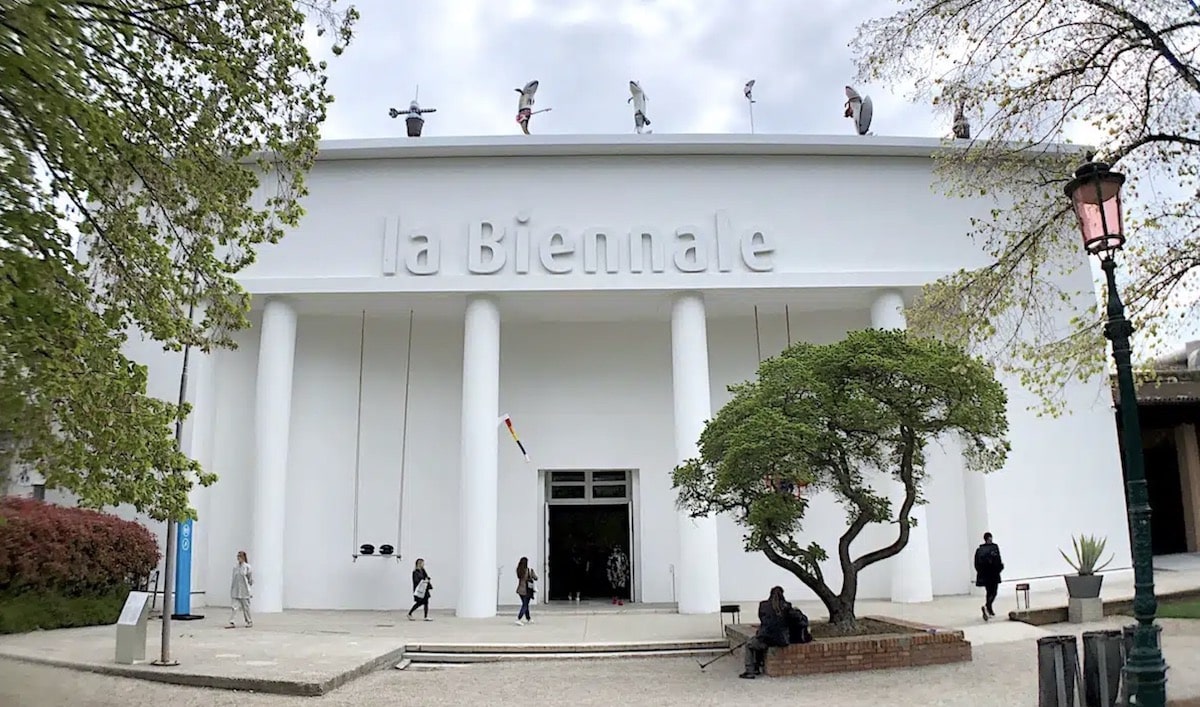
The 61st Venice Biennale has entered an open institutional crisis. The event’s international jury resigned collectively today, 30 April, eight days after publishing a statement announcing that it would not consider artists from countries whose leaders are currently charged with crimes against humanity by the International Criminal Court. The resignation was published on e-flux this morning in a short, unambiguous notice. The Biennale Foundation has confirmed receipt of the decision. This came a day after the Italian culture ministry sent inspectors to Venice to gather information about the decision to allow Russia to have a pavilion at the event.
The five-member jury, selected by the Biennale’s late Art Director Koyo Kouoh, comprised Solange Farkas as president, alongside Zoe Butt, Elvira Dyangani Ose, Marta Kuzma and Giovanna Zapperi. Their statement of 22 April had framed the decision to exclude Russia and Israel from consideration for awards as an expression of their commitment to the defence of human rights. At that point, the Biennale Foundation had responded by describing the jury’s position as a natural expression of the freedom and autonomy that the institution guarantees its juries. The jury’s resignation today suggests that the relationship between the two positions was less stable than that initial response implied.
The jury is responsible for awarding the Golden Lion for the best national pavilion exhibition and the Golden Lion for the best artist in the main exhibition, titled In Minor Keys. Those awards will now need to be reconsidered under entirely different circumstances, with less than a few days remaining before the Biennale opens to the public on 9 May.
The context in which the resignation arrives is one of accumulating institutional pressure from multiple directions simultaneously. Italian Culture Minister Alessandro Giuli had already announced that he would not attend the Biennale’s preview days or opening ceremony in protest at Russia’s participation, while separately pledging his support for Israeli pavilion artist Belu-Simion Fainaru and promising, according to the Israeli outlet Haaretz, that Fainaru’s work would be promoted and exhibited in Italy as part of a Ministry of Culture initiative. The contradictions embedded in that dual position, boycotting one national participant while actively championing another, have not gone unnoticed.
The situation surrounding the Russian Pavilion has itself reached a peculiar resolution. Following sustained criticism and the European Commission’s threat to withdraw funding from the Biennale entirely, it was confirmed that the Russian Pavilion would be physically accessible only during the preview period, from 5 to 8 May. It would then be closed to the general public for the entire six-month duration of the event. Screens installed over the pavilion’s windows will display multimedia documentation of the performances staged during those opening days. It is an arrangement that satisfies the letter of various obligations while satisfying almost nothing else.
The jury’s resignation echoes and amplifies the calls of the Art Not Genocide Alliance. That campaign has attracted thousands of signatories to an open letter addressed to the Foundation, as well as endorsements from dozens of national pavilion artists and curators, and from many of the artists participating in In Minor Keys. The Biennale Foundation has consistently maintained that it rejects any form of exclusion or censorship of culture and art, a position that is becoming increasingly difficult to uphold as the institutional fabric around it continues to unravel.
The jury’s resignation does not resolve any of the underlying questions. It makes them more urgent and more visible. An event whose late Art Director had assembled a jury of this calibre, whose exhibition title In Minor Keys suggested a particular attentiveness to marginalised voices and contested histories, and whose institutional response to the present crisis has been characterised above all by a desire to avoid choosing, now faces the final days before its opening without a functioning awards body and with its credibility under sustained attack from multiple constituencies simultaneously.
What happens next remains unclear. The Biennale Foundation has not indicated how it intends to proceed with the awards process, or whether it will seek to constitute a new jury in the days remaining before the opening ceremony. The questions that the jury’s resignation forces into the open, about the limits of cultural universalism, about the relationship between institutional neutrality and political complicity, and about what it means to hold a global art event in a world shaped by ongoing atrocities, will not be resolved by administrative decisions alone. They will be present in every pavilion, every press conference and every conversation in the Giardini when the Biennale opens its doors on 9 May.