
2026 marks 87 years since the start of WWII, or 13 years away from the centenary of its beginning. Yet scholarly investigations into professionals’ roles in the consequences of the National Socialist German Workers’ Party policies only really began in the 1990s. In part, this was due to a lack of access to primary documents and to some authors not being part of the profession they were writing about. Blewett, by contrast, is a restorer and has undertaken remarkable primary research over a wide geographical area to reveal the culpability and manipulation the profession underwent due to these Nazi policies. By necessity, to place her findings in context, she describes a great deal of those policies.
Before Hitler and the Party came to power, the restoration profession in Germany was keen to raise standards and professionalism. But with the policy of Volksgemeinschaft (People’s or National Community), Blewett’s research reveals standards were lowered to allow ‘the people’ a wider involvement in the profession, opening it to non-expert hands. As Blewett says, “No area of life under the Nazi regime, whether social or cultural, escaped some form of permeation by the concept of the Volksgemeinschaft.”
Wider involvement, of course, did not include the Jews. Hindenburg appointed Hitler as the Reich’s Chancellor on 30 January 1933, and by April, legislation was in place to eject Jews from their professional positions. Among those who lost their jobs at that time was Helmut Ruhemann, a Jew who had worked at the Kaiser-Friedrich-Museum (now the Bode Museum) in Berlin. Ruhemann is well known among British restorers as he eventually became a head conservator at London’s National Gallery. While at the Kaiser-Friedrich-Museum, he already had an international reputation. But this was of no consequence to the Nazis. The Jews were to be eradicated, and no Jewish restorers simply stepped into the vacancies left by Jewish ones.
To aid the racial policies to expunge Germany of its Jews also led to a program of so called restoration to extract ethnic data from Church books containing records of births, marriages and deaths. Some of these records went back to the 17th century and were very fragile. Information was extracted by photographing the books, and despite its so-called mission to restore these delicate objects, the procedures ran counter to the survival of the objects themselves – a key principle for professional restorers. To extract the data, unsuitable materials were used to make the texts more photographically legible, or to flatten them heavily so they could be photographed at all. The data would be used to pave the way to the “Final Solution”.
Blewett describes the work of restorers in Poland, Belgium and Holland, many of whom were employed by institutions but still undertook private work and dealt profitably in looted works. Among them was Jan Dik senior, a Dutch restorer, who tripped badly over the now-infamous Christ and the Woman taken in Adultery by the forger van Meegeren, recommending it as a Vermeer to Göring. Göring himself is known to have employed a range of restorers to care for his personal art collection, which was to go to the State once he attained the age of 60. He died aged 53.
In Paris, restoration was initially undertaken by the Einsatzstab Reichsleiter Rosenberg (ERR) on the art ‘acquired’ in its looting program. But not in the main depots where looted art was gathered. Restorers in private practice were used. Then, as the Occupiers realised the extent of the damage caused by moving the artworks, paintings were dropped, stepped on, and torn. Rather than restore pieces twice, they were moved for treatment to the well-equipped atelier at the Monastery at Buxheim in Bavaria, overseen by Dr Otto Klein. It is also a surprise to learn that looted art in the various Nazi depots had restorers in attendance, not just military personnel.
Some restorers undoubtedly had a high level of skills, but mammon led them to enrich themselves through dealing in the work they restored. They also served the party line in the creation of a false ‘true German art’ that was to the Führer’s liking. Pleasing the Führer led to rivalries among prominent party members keen to offer gifts to both Hitler and his unrealised Führermuseum in Linz. This museum was meant to showcase the apex of new German culture. Blewett describes the complexities of ‘authenticating’ a Raphael that was to be gifted to Hitler at the Doerner Institute. It was designated as not fake, overlooking the fact that it was a copy, not an original.
Blewett discusses and illustrates the journeys and fates of well-known works: The Isenheim Altarpiece by Matthias Grünewald and The Ghent Altarpiece by Hubert and Jan van Eyck.
Forced labour was also used notably in Möbel Aktion (Furniture project), directed by Colonel Kurt von Behr, director of the Dienststelle Westen, a sub-group of the ERR. The project took furniture from ‘abandoned’ Jewish apartments, redistributing it in the east and among those German citizens who were in need, as they had been bombed. Jews were enlisted to sort, repair and restore pieces. Working in these depots delayed their eventual deportation to the gas chambers. Sometimes they would discover the fate of a loved one by coming across their possessions while sorting through them.
Right at the start, Blewett chillingly points out that the enactment of the National Socialists’ policies was feasible not because of a single directive (from Hitler) but because of a much wider acceptance, rivalry, and implementation. Looting gave wider benefits not just for the party’s high-ups. To carry it out, there had to be transport, packing, sorting, documenting, and restoration. Thus, there was a willing and proactive workforce, not just that of forced labour.
The massive volume of works looted is hard to convey, and the muddle in the postwar years is no surprise. This allowed culpable people to conceal their past affiliations and evade the consequences. This is a detailed, well-researched work that deserves to be read in full, and its insights into human nature should be taken to heart.
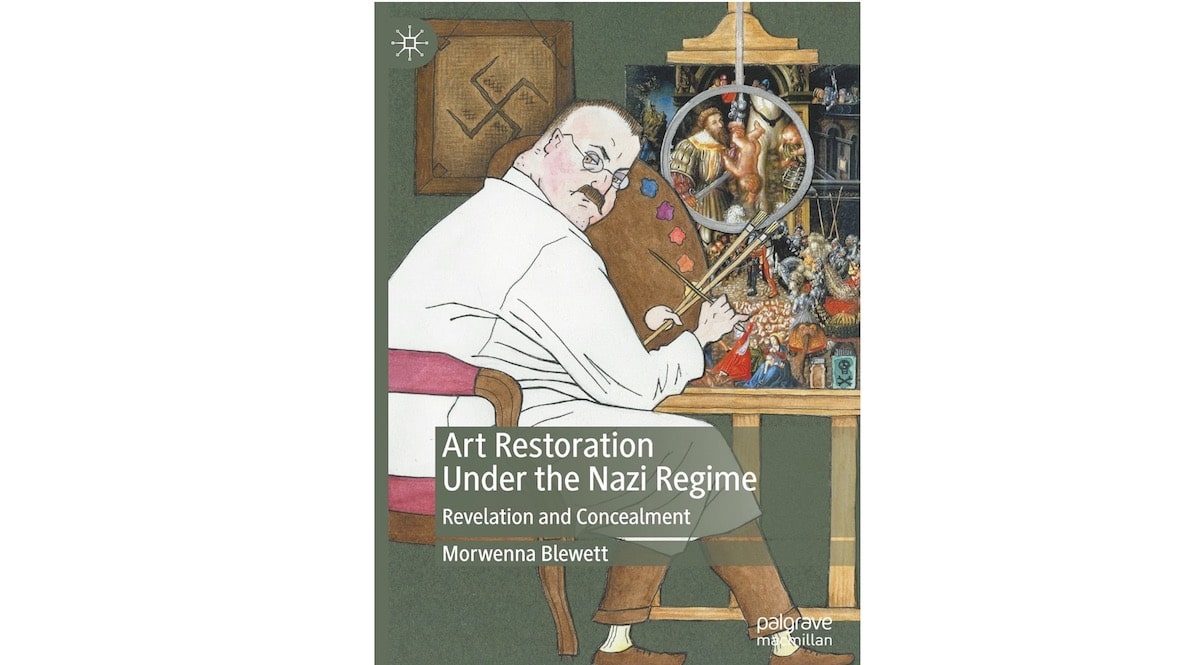
Morwenna Blewett, Art Restoration under the Nazi Regime; Revelation and Concealment, Palgrave Macmillan, 2026
Words: Dr Clare Finn © Artlyst 2026