
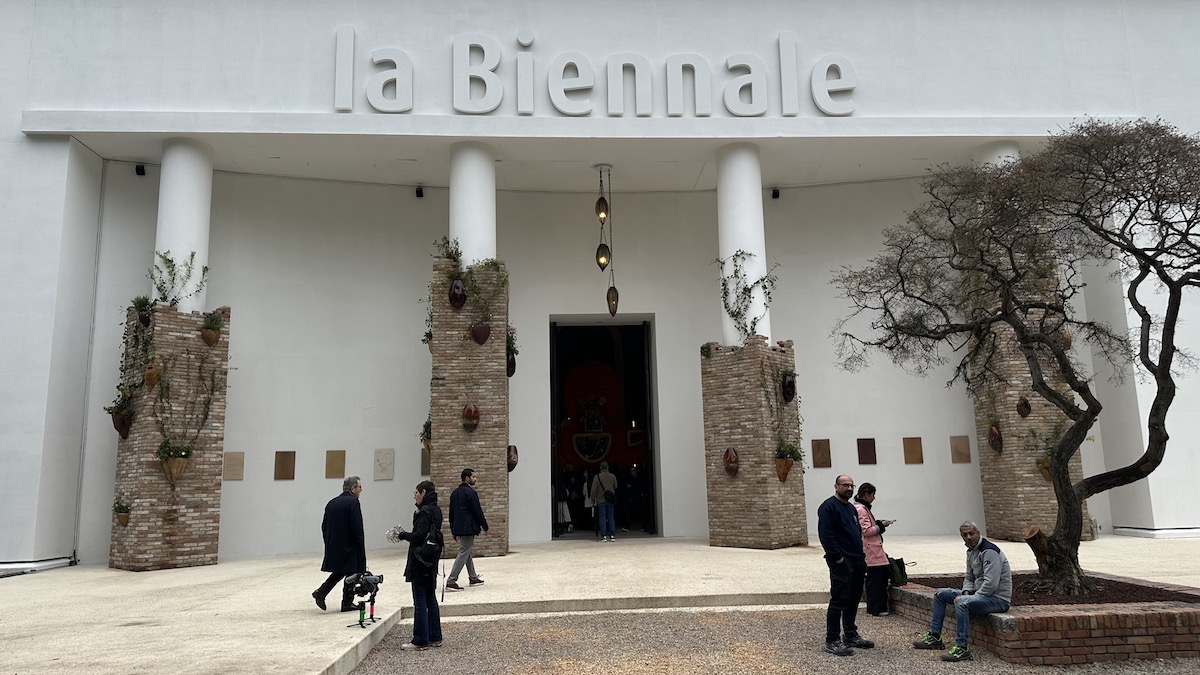
The 61st Venice Biennale is not an easy edition to summarise, and that was entirely the intention. Working within the conceptual framework that the late Koyo Kouoh developed before her death, In Minor Keys asks of its audience what most contemporary art events do not: patience, attentiveness, and a willingness to sit with ambiguity rather than reach for quick interpretation. The Arsenale and the Giardini have not been filled with the kind of declarative gestures that generate social media traction. Instead, there are quieter things happening here, works that ask you to slow down, to notice what you might otherwise walk past, to understand that a minor chord can carry as much weight as a major one and sometimes more.
The political turbulence surrounding this edition, the jury’s resignation, the protests, the Russian pavilion’s peculiar semi-presence, and the pavilion strike have, at various points, threatened to swallow the art entirely. It has not. What follows is an account of ten presentations that justify the trip, each one a different kind of answer to the question Kouoh was asking.
Ukraine: Security Guarantees
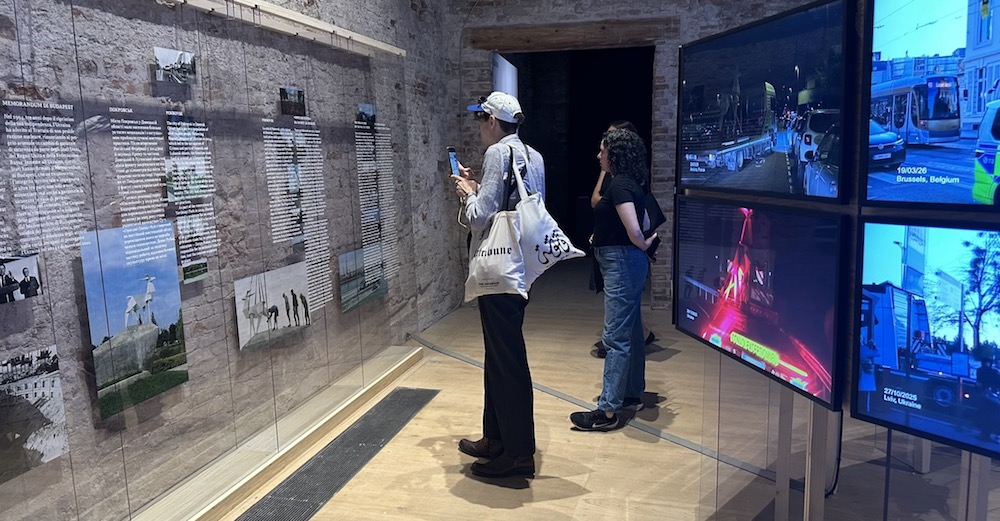
Ukraine’s pavilion puts the facts on the table and lets them speak. The curatorial premise takes the 1994 Budapest Memorandum as its starting point, the agreement under which Ukraine surrendered its nuclear arsenal in exchange for international guarantees of territorial integrity. Those guarantees are now worth examining in light of everything that has followed, and the exhibition, curated by Ksenia Malykh and Leonid Marushchak, does exactly that with the work of Zhanna Kadyrova at its centre.
The pavilion’s most arresting element is the concrete sculpture The Origami Deer, which originally stood in Pokrovsk in the Donetsk region, was evacuated by municipal workers as fighting moved closer in 2024, and now hangs suspended from a crane overlooking the Venetian waterfront. The journey from active war zone to the Giardini transforms the object into something more than art. Inside the Arsenale, archival material relating to the Memorandum sits alongside documentary footage of the sculpture’s removal, creating a conversation between diplomatic language and lived consequence that is difficult to walk away from quickly.
Ethiopia: Shapes of Silence
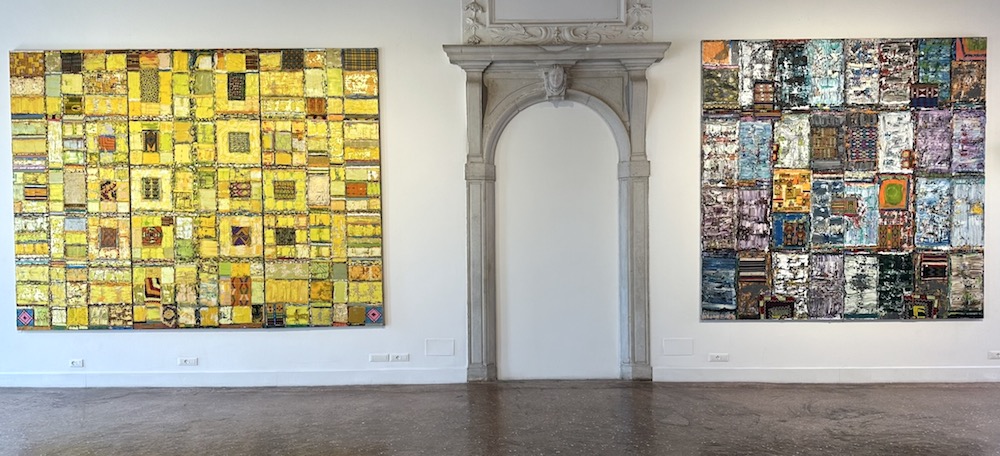
Ethiopia returns to the Biennale for its second time. The exhibition by Tegene Kunbi at Palazzo Bollani in Castello presents one of the most accomplished painters showing in Venice this year. Curated by Abebaw Ayalew, the exhibition treats silence not as absence but as a social and political condition, asking consistently who is permitted to speak and who has historically been expected to remain unheard.
Kunbi’s practice spans more than three decades and moves between painting, assemblage and textile-based installation. The monumental geometric compositions installed in the palazzo’s Renaissance interiors are layered with colour, pattern and material references that hold personal memory and broader cultural history in productive tension. The textiles are particularly affecting, hand-knitted garments and domestic fabrics woven into works that become archives of labour and inheritance. Golden Dawn, the exhibition’s focal work, has a luminous surface that takes on additional resonance against the surrounding architecture. Ethiopia’s presence at the Biennale is becoming something to watch.
New Zealand: Taharaki Skyside
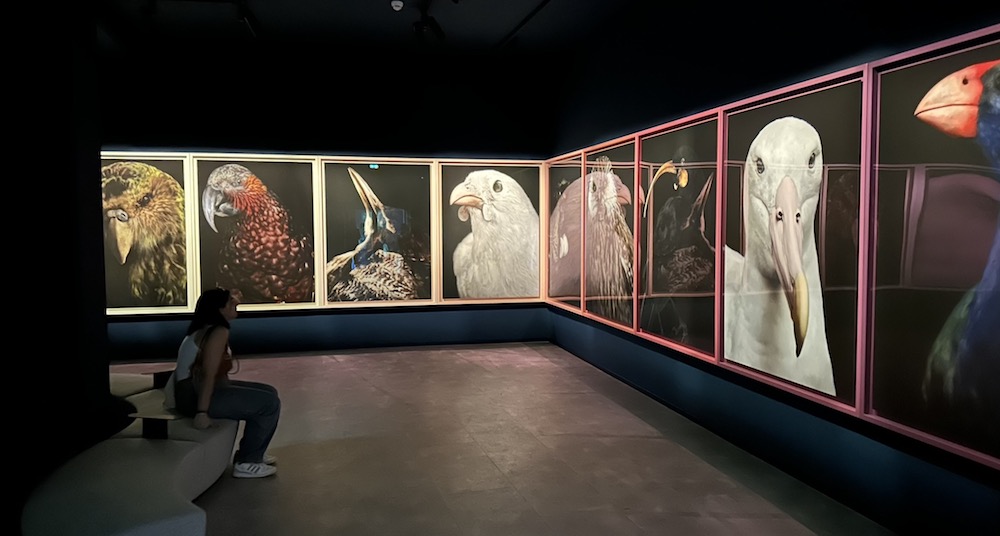
Fiona Pardington’s photographs of taxidermied native birds, installed in the cloisters of the Istituto Santa Maria della Pietà, are among the most affecting things at the Biennale this year. The seventeen large-scale portraits, co-curated by Felicity Milburn and Chloe Cull, show many from museum collections across Australasia, species that are critically endangered or entirely extinct, isolated against deep, void-like backdrops and meeting the viewer at eye level with uncanny directness.
Pardington, of Māori and Scottish descent, resists treating her subjects as scientific specimens. These birds are presented as taonga, as treasured ancestors, as spiritual messengers operating on the threshold between the physical and the metaphysical. Fragments of nineteenth-century landscape photography are visible within their gazes on close inspection, glimpses of habitats that no longer exist. The atmosphere Pardington and creative director Neil Pardington have created is one of impossible beauty and heavy ecological consciousness. It is among the most emotionally substantial rooms at this year’s Biennale.
Wales: Sownd
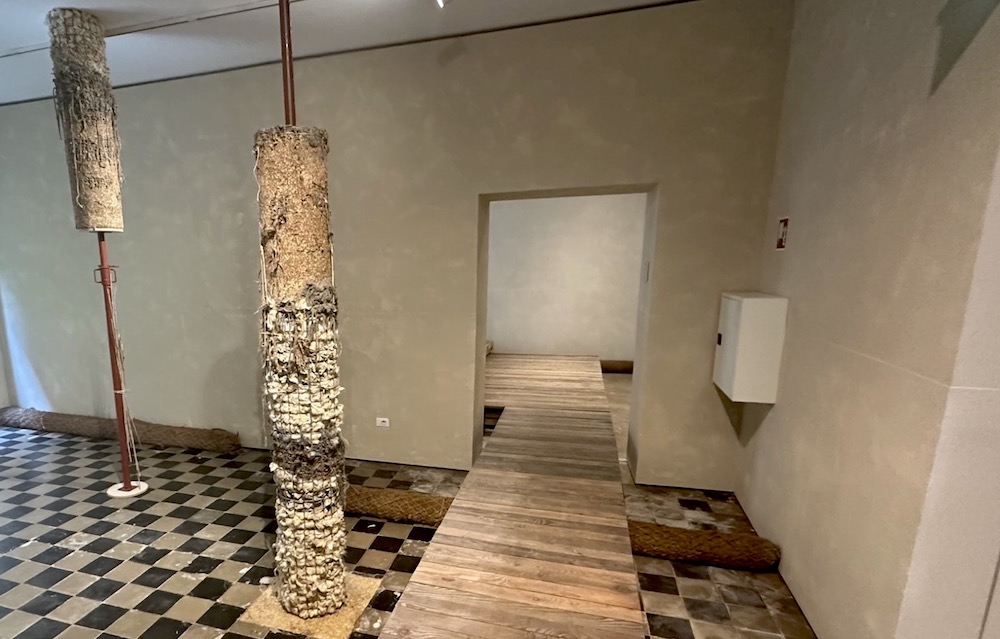
Wales returns to Venice after a seven-year absence with a presentation that resists the conventions of national showcase from the outset. The collaboration between artist Manon Awst and writer Dylan Huw, curated by Steffan Jones-Hughes and the teams from Oriel Davies and Oriel Myrddin, builds its three-room installation around a single Welsh word. Sownd means simultaneously structurally secure and physically trapped, and that semantic tension runs through everything that follows.
A wooden boardwalk structure guides and complicates movement through the space. Materials gathered from Welsh peatlands sit alongside organic specimens from the Venetian lagoon, damp transitional landscapes that preserve ecological histories while mirroring the vulnerabilities of minoritised languages. Huw’s text and sound weave through the tactile environment, transforming the rooms into something genuinely multi-sensory. The pavilion avoids regional nostalgia entirely, presenting itself instead as a living archive that raises serious questions about what survives, what gets buried, and what it means to maintain a language and a culture against the pressure of larger forces.
Canada: Entre chien et loup
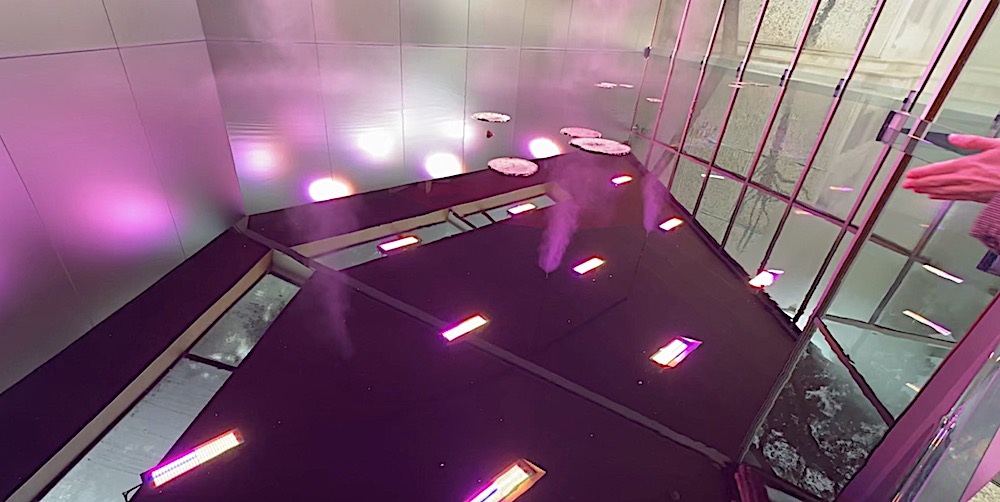
Abbas Akhavan’s transformation of the Canadian pavilion is the most immersive single environment at this year’s Biennale. The nautilus-shaped Giardini building has been reimagined as a Wardian case, the nineteenth-century glass terrarium used to transport exotic plants across colonial shipping routes. Inside, the temperature and humidity have been calibrated to replicate the Amazonian atmosphere. Warm mist filters through the space from concealed tubes. A third of the floor has become a pond, and enormous Victoria water lilies float across dark water, their leaves slowly unfolding over the six-month exhibition.
Curated by Kim Nguyen, the installation operates in the space between architecture and ecology, between the contained and the living. The plants are not passive decoration. They carry the history of colonial displacement in their very presence, exotic species trapped within a Western framework, and the installation makes that history felt without stating it explicitly. It is a work that rewards the time spent inside it, and the experience of the humidity, the light, and the slow movement of the lily pads is one of the more genuinely transporting things available in Venice this season.
Bvlgari Pavilion
The Bvlgari Pavilion debuted with a major installation by the Toronto-born, New York-based artist Lotus L. Kang. The presentation also marks the beginning of Bvlgari’s partnership with the Biennale, an alliance set to run through 2030 and signalling an increasingly ambitious engagement with contemporary art.
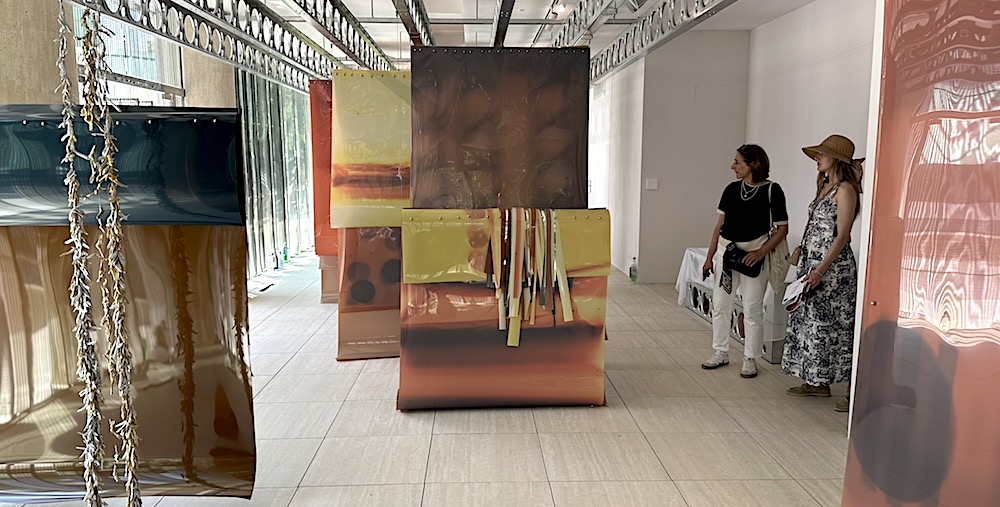
Kang’s practice has long explored the unstable territory between memory, identity and time. For Venice, she presents The Face of Desire is Loss, a work curated by Matthew Hyland that reflects on the fragility of perception and the ways experience is shaped by constant change. The installation centres on lengths of unfixed photographic film suspended throughout the space. Sensitive to light, moisture and atmospheric conditions, the material shifts subtly over time, responding to Venice’s distinctive environment.
Rather than existing as a fixed object, the work remains in a state of transformation. Colours deepen, fade and mutate, creating a dialogue between the artwork and its surroundings. The result is both intimate and elusive, inviting viewers to consider impermanence as a material condition rather than an abstract idea.
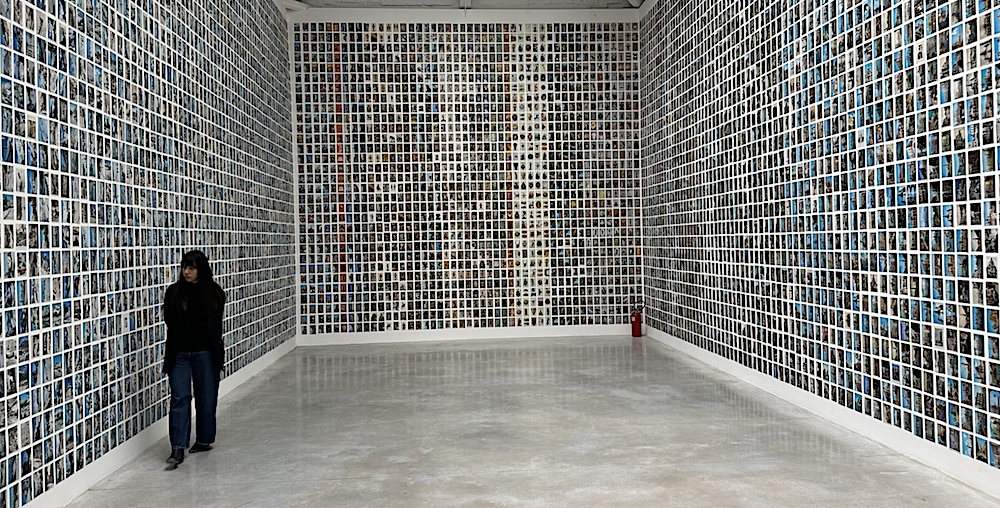
Spain: Los Restos
The Spanish pavilion has undergone extensive renovation, and its reopening provides the backdrop for one of the most formally inventive presentations in the Giardini. Oriol Vilanova’s installation, curated by Carles Guerra, floods the space with more than fifty thousand vintage postcards assembled over two decades from flea markets and second-hand shops across Europe. They cover the walls in a dense, shifting grid that, from a distance, reads as an undifferentiated mass of colour and, on closer inspection, resolves into a deeply unsettling archive of tourist imagery, colonial representation and weaponised cultural memory.
What appears initially as a nostalgic collection of printed ephemera gradually reveals itself as an excavation of how societies construct national propaganda and commodify their own histories. An unannounced performance, El fantasma de la libertad, extends the work into the surrounding Giardini, with figures moving through the landscape as temporary supports for the archival material. The pavilion functions as an anti-museum that aligns with Kouoh’s curatorial framework with unusual precision.
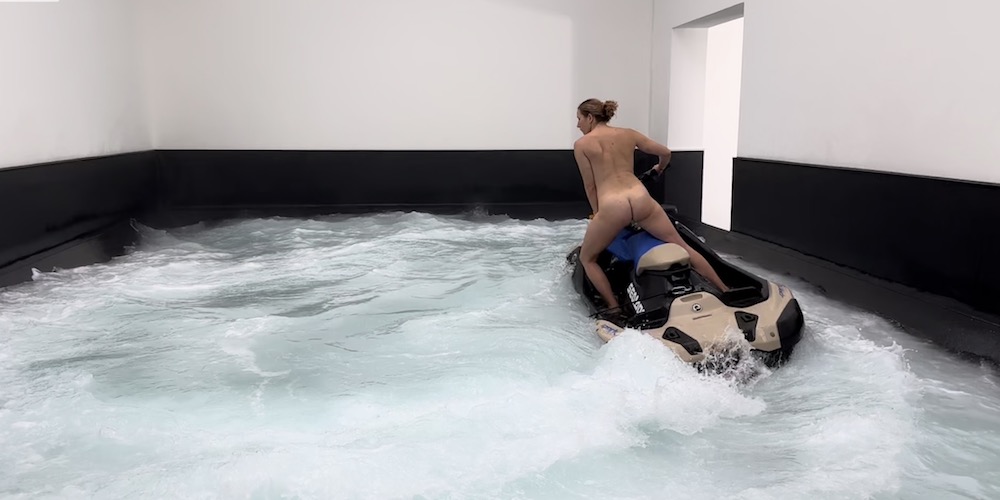
Austria: SEAWORLD VENICE
Florentina Holzinger’s transformation of Josef Hoffmann’s modernist architecture is the most visceral thing at the Biennale and the most likely to stay in the memory of anyone who enters it. The live installation, curated by Nora-Swantje Almes, converts the Austrian pavilion into something between a dystopian theme park and an industrial ecosystem, with performers navigating water-filled chambers, scaling structures, and occupying a tank sustained by the audience’s bodily fluids.
A bronze bell hung from a crane rings out hourly. A naked performer scales a rope beneath it, inverts, and swings to strike the iron, sending sound across the Giardini that is audible from some distance. Inside, the clean white cube has been entirely dissolved. Holzinger’s lineage runs through Viennese Actionism and feminist body art, and the work carries the weight of both traditions without being reducible to either. It is uncomfortable and very deliberately so, a presentation that refuses to let the audience remain passive witnesses. The pavilion was among those that joined the strike on the final preview day and remained closed. It is worth going back for.
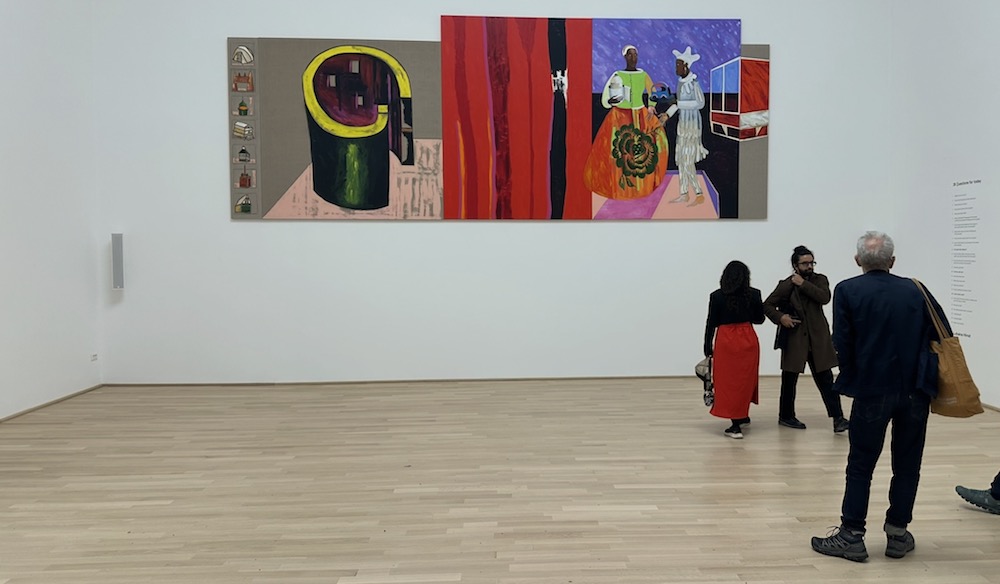
Great Britain: Predicting History, Testing Translation
Lubaina Himid’s occupation of the neoclassical British pavilion uses the architecture itself as a metaphor for Britain, exposing the tensions concealed beneath its imposing facade. The five monumental multi-panel paintings, curated by Ese Onojeruo, populate surreal theatrical settings with figures navigating displacement, migration and survival. Two architects in the opening room are engaged in a silent painted debate: one drafts structures for quick escape, the other builds permanent foundations for those who remain.
A collaborative soundscape developed with Magda Stawarska moves between pastoral acoustics and an unsettling insect drone, refusing the viewer any comfortable visual or auditory resting place. The text paintings ask confrontational questions about history, translation and the possibility of home. Himid’s work has always understood that meaning is made in the friction between what is said and what is withheld, and this pavilion enacts that understanding on a considerable scale. The British pavilion joined the strike but reopened the same day once additional staff were found.
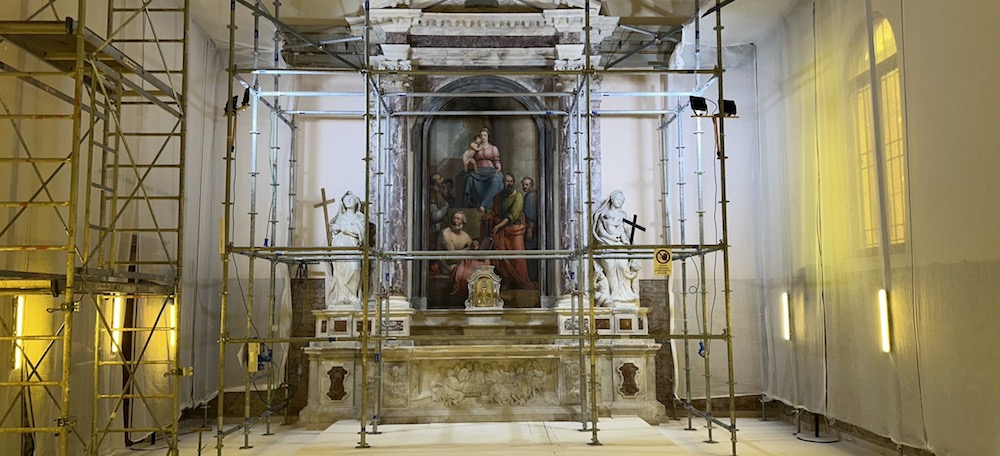
The Holy See: The Ear is the Eye of the Soul
Hans Ulrich Obrist and Ben Vickers have curated the Vatican’s contribution around an idea drawn from the twelfth-century mystic Hildegard of Bingen, and the result is one of the most genuinely meditative experiences the Biennale offers. Spread across two locations, a secluded monastic garden in Cannaregio and a complex in Castello, the pavilion places deep listening at the centre of its proposition.
In the Giardino Mistico dei Carmelitani Scalzi, visitors wear headphones to encounter a continuous sonic composition by Soundwalk Collective that incorporates the bioelectrical activity of garden plants alongside contributions from Patti Smith, Brian Eno, FKA twigs and Devonté Hynes, among others. At the Castello site, the final installation by the filmmaker Alexander Kluge, completed shortly before his death, anchors a living archive of historical artist books and recorded Benedictine chants. In an edition saturated with noise, both literal and political, the Holy See offers something rare: a space in which the act of listening is treated as both political and sacred.
These ten pavilions do not sum up what In Minor Keys has to offer, but they represent some of its most fully realised propositions. Kouoh’s vision, sustained through the work of artists and curators from across the globe, has produced an edition that rewards the kind of sustained engagement that Venice, at its best, makes possible.
The Venice Biennale continues until 22 November 2026
Words/Photos © P C Robinson Artlyst 2026