
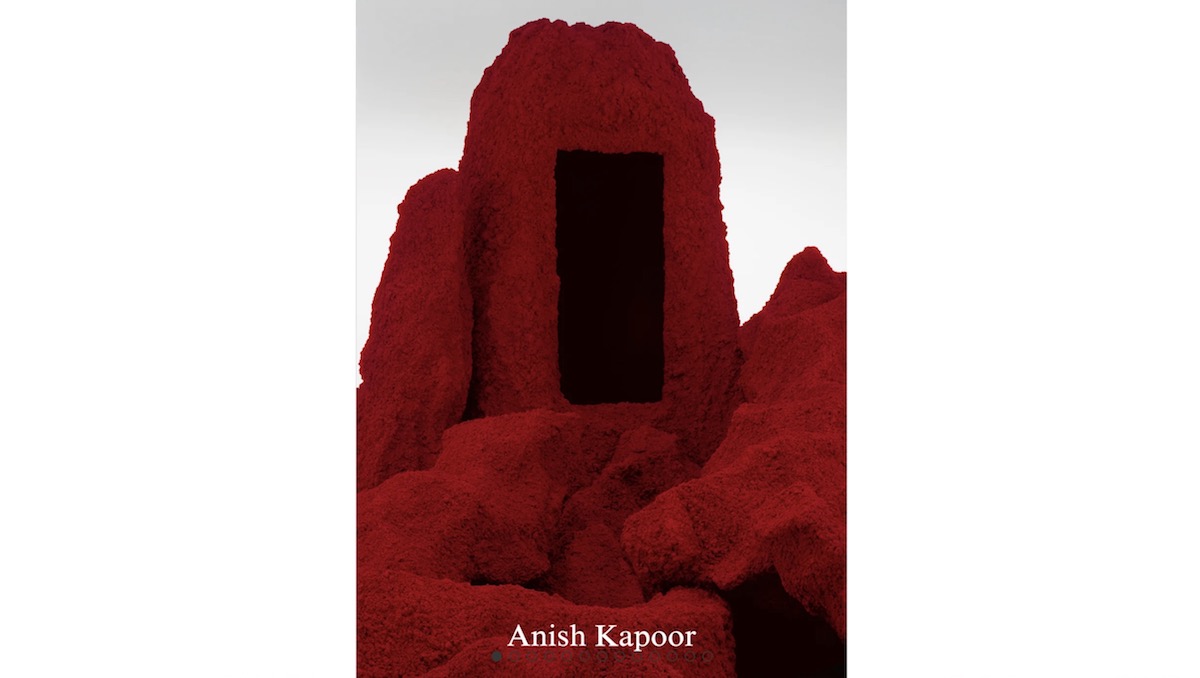
The catalogue for Anish Kapoor’s 2026 Hayward Gallery exhibition is a substantial object, as you would expect for a show that fills the entire building and marks both the artist’s return to the gallery where he staged his first major UK survey nearly thirty years ago and Ralph Rugoff’s final exhibition as Director after two decades in the role. The book earns its weight.
Three essays anchor the volume. Julia Kristeva, psychoanalyst and philosopher, contributes one. Art historians Nancy Spector and Sandhini Poddar provide the others. Alongside these is an extended interview with Rugoff, which turns out to be among the book’s more useful sections. Rugoff has spent twenty years thinking carefully about how exhibitions work as experiences rather than arguments, and his conversation with Kapoor covers the past five decades of the artist’s practice with the kind of relaxed precision that only comes from genuine familiarity. The interview reads well and gives the essays a useful context rather than competing with them.
Kristeva’s contribution approaches the work from the direction of abjection and the pre-symbolic territory she has occupied for decades, and which fits Kapoor’s visceral surfaces and apparent voids reasonably well. Whether it fits better than other frameworks is a question the essay does not quite resolve. Spector and Poddar take a more art-historical line, tracing the evolution of the work through recurring concerns: depth, reflection, pigment, the boundary between inside and outside, and the behaviour of surfaces that refuse to behave predictably.
The installation photographs are where the catalogue earns its place on the shelf. Kapoor’s work is notoriously difficult to reproduce, and the Vantablack pieces in particular, objects coated in the blackest known substance, exist in a genuinely different register when encountered in person than they do in print. The photographers have done what can be done. What comes across clearly enough is the exhibition’s spatial aggression: works pressing against walls and floors, descending from ceilings, voids opening in the gallery surfaces, and the large, red, monumental installations that appear to turn space inside out. The steel mirror sculptures, which warp, disorient, and fold the viewer’s own image back at them in distorted form, photograph better than the darker work, and several of the reproductions are genuinely good.
The show itself runs from 16 June to 18 October 2026 and is part of the Hayward’s 75th anniversary programme. Kapoor has been making large-scale public works for long enough that Sky Mirror and Cloud Gate in Chicago have become part of the furniture of international contemporary art, familiar to people who follow neither sculpture nor Kapoor specifically. The Hayward exhibition, according to both Rugoff’s account in the interview and the photographic evidence in the catalogue, returns to more interior, psychologically charged territory. The recent paintings and sculptures confronting what the gallery describes as the fragility of human existence are less well served by reproduction than the older work, which has the advantage of being more extensively documented.
At £35 on special exhibition price, the catalogue is positioned at the expensive end of what exhibition publications usually cost. It justifies the price for anyone with a sustained interest in the work. For the more casual visitor, it is a handsome record of a significant show in what is, by any account, a milestone year for the Hayward and for Rugoff’s tenure there.
Anish Kapoor Tue 16 June – Sun 18 October 2026
Read More
Buy This Book Here