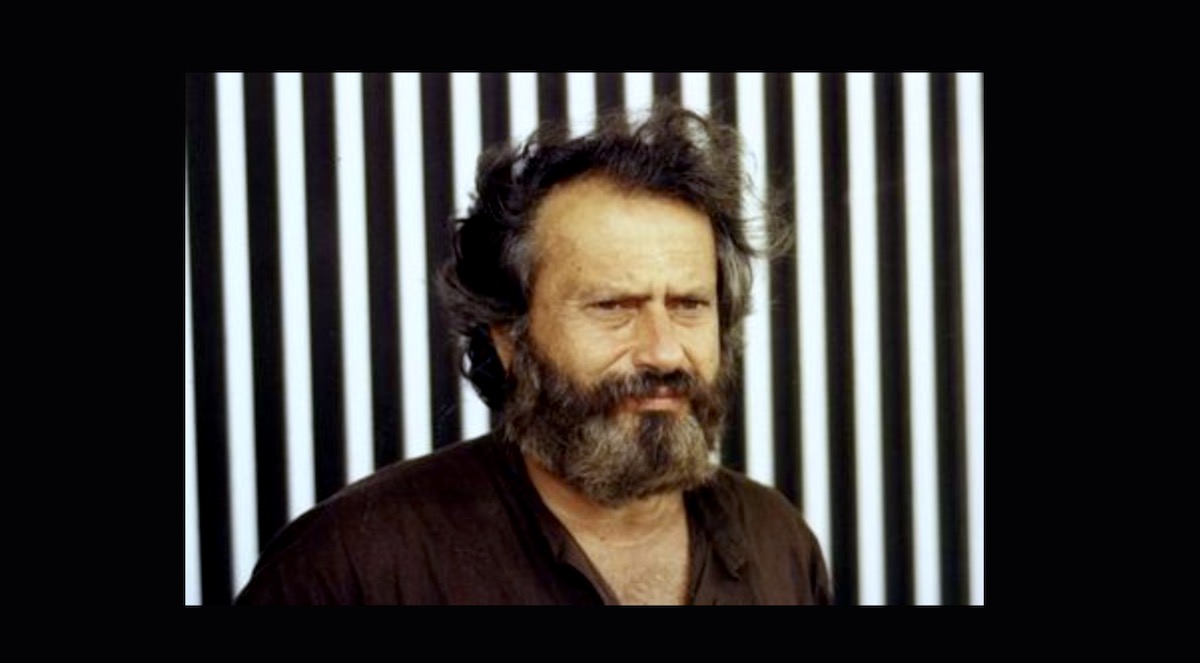
Yaacov Agam, who died at 98, was one of the founding fathers of Kinetic Art. His funeral took place with his body lying in state beforehand at the Agam Museum in Rishon LeZion, the city where he was born in 1928 and where, in his final years, he had returned to live.
He was born Yaacov Gibstein on 11 May 1928, the son of a Rabbi. The religious household shaped him in ways that never entirely left the work, however abstract it became. As a teenager, he was arrested by the British during the Black Sabbath raids of 1946 and held for several months at the Latrun detention camp. He went on to study at the Bezalel Academy of Arts and Design in Jerusalem under Mordecai Ardon, and later in Zurich with Johannes Itten, a Bauhaus figure. He moved to Paris in the early 1950s and would live there for decades.
In 1955, aged 27, he showed coloured wooden reliefs at Le Mouvement, a landmark exhibition in Paris that also included Marcel Duchamp, Jean Tinguely and Alexander Calder.
The work’s appearance changed depending on where the viewer stood. That quality, the image shifting as the body moves, became his signature and the basis of a practice he sustained for the rest of his long life. He was one of the founding figures of kinetic art, and one of the movement’s most formally consistent practitioners.
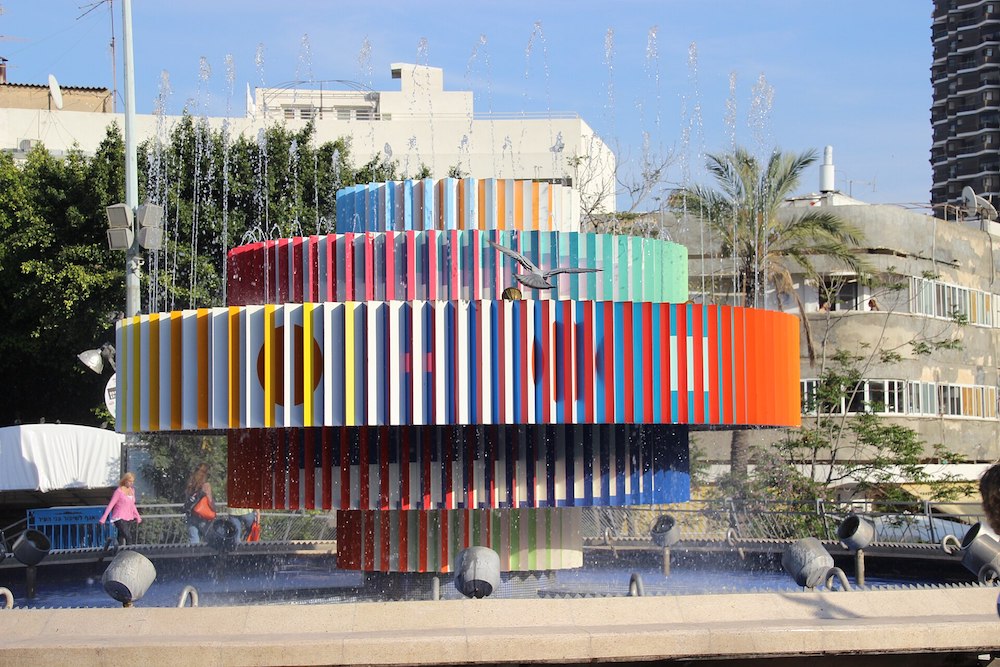
Yaacov Agam, painter and sculptor, known for works that changed with the viewer’s movement, helped shape kinetic art and created landmarks, including Tel Aviv’s famous ‘Fire and Water’ fountain
His conceptual framework was unusual. He drew on Kabbalistic metaphysics and Bauhaus discipline simultaneously, an unlikely combination but held together in the work with surprising coherence. He described his compositions as visual prayers. The language was not merely rhetorical. The idea that reality existed as a continuous process rather than a fixed state, becoming a simple being, ran through everything he made. “I aim to show the visible as a possibility in a state of perpetual becoming,” he said, in a formulation that served as something close to a manifesto across seven decades of work.
The Agamograph, his own display technique using Plexiglass to create images that shift with the viewer’s movement, became one of his most widely recognised inventions. His large-scale public commissions reached further. In Paris, he made works for the Élysée Palace and a musical fountain at La Défense. In Israel, his public presence was pervasive: Jacob’s Ladder at the International Convention Centre in Jerusalem, Eighteen Levels at the Israel Museum’s Billy Rose Art Garden, the colourful facade of the Dan Hotel in Tel Aviv, visible from the beach, works at hospitals, universities, and the Western Wall plaza.