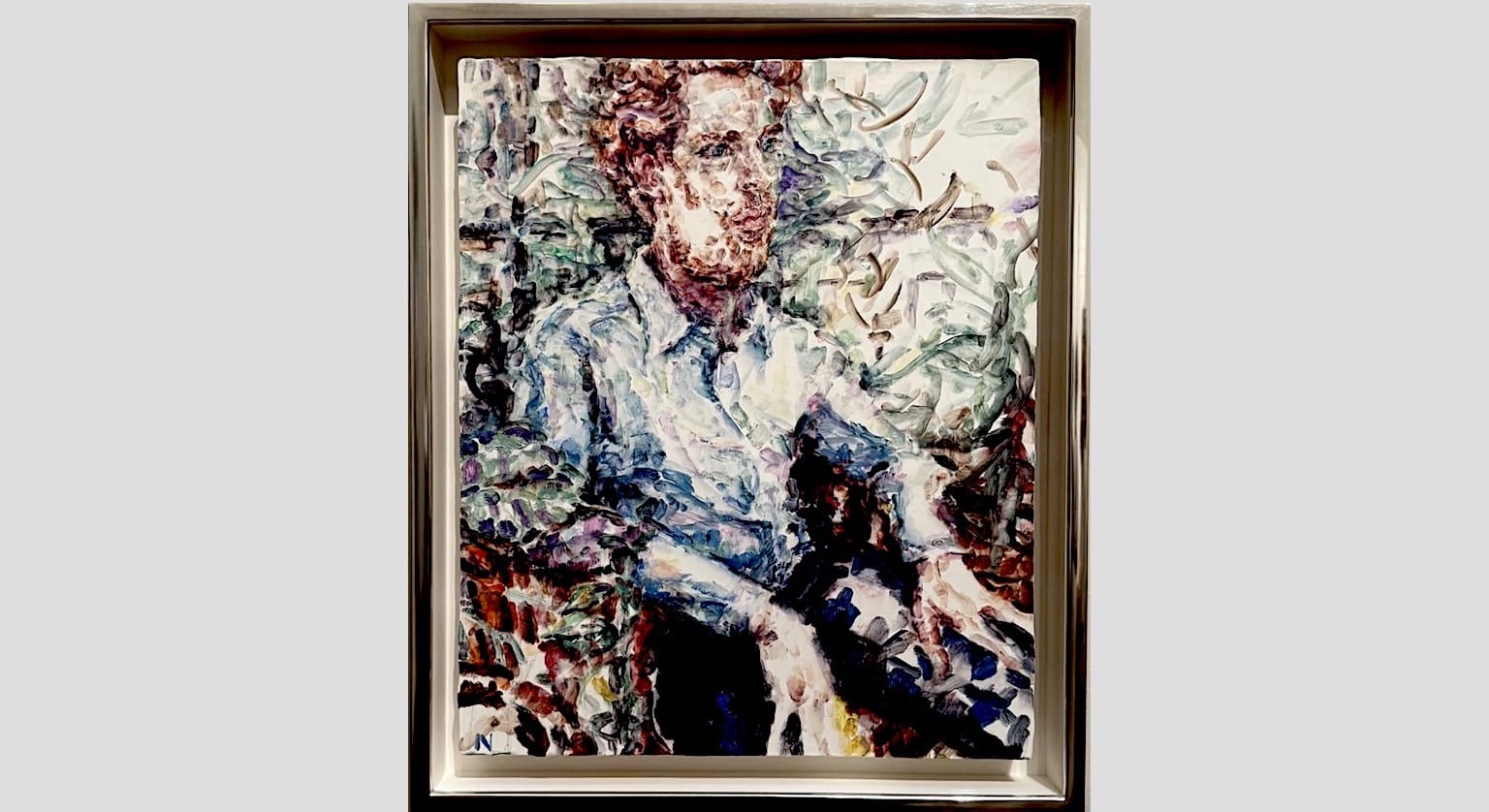
The National Portrait Gallery has unveiled a new portrait of its former Director, Nicholas Cullinan, painted by Elizabeth Peyton. It now hangs in Room 30, the latest addition to a tradition the gallery has maintained for generations: commissioning portraits of its own directors once their tenure ends. This one was donated by Peyton herself, which makes it the first of her paintings to enter the NPG’s permanent collection.
Cullinan led the National Portrait Gallery from 2015 to 2024, a period that included the most significant transformation of the building since its 1896 opening. The reopening in 2023 was widely praised. During his tenure, he also oversaw an international collaboration with the Getty to co-acquire Portrait of Mai by Sir Joshua Reynolds, painted around 1776, which became the largest acquisition in the gallery’s history and one of the largest the UK has ever made, comparable in scale to the Titian jointly acquired by the National Gallery and the National Galleries of Scotland in 2009. He left the NPG in 2024 to become Director of the British Museum.
The connection between Cullinan and Peyton goes back to 2019, when the NPG hosted her retrospective Aire and Angels, curated by Lucy Wood in close collaboration with the artist. The exhibition examined Peyton’s relationship to both historic and contemporary portraiture and was, by most accounts, one of the more significant shows of her career to date. The two grew close during that process, and the friendship has evidently continued.
Peyton’s portrait was made from life, with sittings split between Paris, where she is based, and London, where Cullinan lives. That kind of cross-channel sitting schedule is not unusual for Peyton, whose subjects over the years have ranged from artists, musicians, athletes, politicians, dancers, and royalty to luminous, gestural brushwork that has become her signature. Her paintings tend to carry an unusual warmth, an intimacy that doesn’t feel performed.
Cullinan described the experience of sitting for Peyton as an honour, noting that the donation marked the first of her works to enter the gallery’s permanent collection. Peyton, for her part, called the Aire and Angels exhibition a highlight of her career and said she hoped the portrait would carry Cullinan’s vitality and intelligence for a long time to come. Both statements have the slightly formal warmth of people who clearly like each other and are also aware they’re speaking for the historical record.
Peyton’s career has been substantial by any measure. She received a major retrospective, Live Forever, organised by the New Museum in New York in 2008, which travelled internationally. Solo exhibitions have followed at venues including the Hara Museum of Contemporary Art in Tokyo, the French Academy in Rome at the Villa Medici, UCCA in Beijing and Ryosokuin Temple in Kyoto. In 2023, she became one of two artists invited to serve as the first Hôtes du Louvre, marking the museum’s 230th anniversary, and was granted a studio within the Palais du Louvre itself, a kind of institutional recognition that very few living artists receive.
Before his time at the NPG, Cullinan worked as a curator at the Metropolitan Museum of Art and at Tate Modern, where he co-curated the 2014 Matisse cut-outs exhibition with Sir Nicholas Serota. That show became the most visited exhibition in Tate’s history and the first to draw more than half a million visitors. He holds a BA, MA and PhD in art history from the Courtauld Institute, and has held fellowships at the Guggenheim, the Morgan Library and the British School at Rome. He was made OBE for services to the arts in 2024.
The portrait now joins the NPG’s long lineage of director portraits, a tradition that links the institution’s own history to the practice it exists to celebrate.