The recurring female figures of Iraqi-born Hayv Kahraman serve as a semi-autobiographical tool to explore the trauma of displacement, gender-based oppression, and the pressures of assimilating into Western society. Her exhibition ‘What cannot be said will be wept’ draws on both her personal history as a Kurdish-Iraqi refugee and the loss of her home in the 2025 Los Angeles wildfires to consider the effects of systems that separate people from land, ancestry, ecology and embodied forms of knowledge.
PCK: The works in this show were made after your home was destroyed in the LA fires of 2025?
HK: Yes – and it was the second time I’ve been displaced, as in the early 90’s I left Iraq as a war refugee I was ten, then – and my daughter was ten when she looked out of the window and saw the fires. When the fires happened, I kept asking myself: why is this land trying to expel me? It was the first time I had bought a home, and I was ready to feel grounded following a very nomadic lifestyle. I had a sense of betrayal, and felt a deep mistrust and lack of safety. That made me think about what is it like to live in a world that is currently collapsing – not due just to the systemic violence directly caused by humans, but also the ecological violence. What could I contribute post-fire? I’ve come to realise becoming displaced as a refugee is one kind of rupture, but displacement can encompass more pernicious layers – not only a dissociation from everyone around me, but also from the natural world, like the tree I used to have in my yard that doesn’t exist any more: a disconnection from my environment, from the human and more-than-human and from a kind of knowing behind knowing.
I’ve been trying through these works to mend that, to make a reconnection.
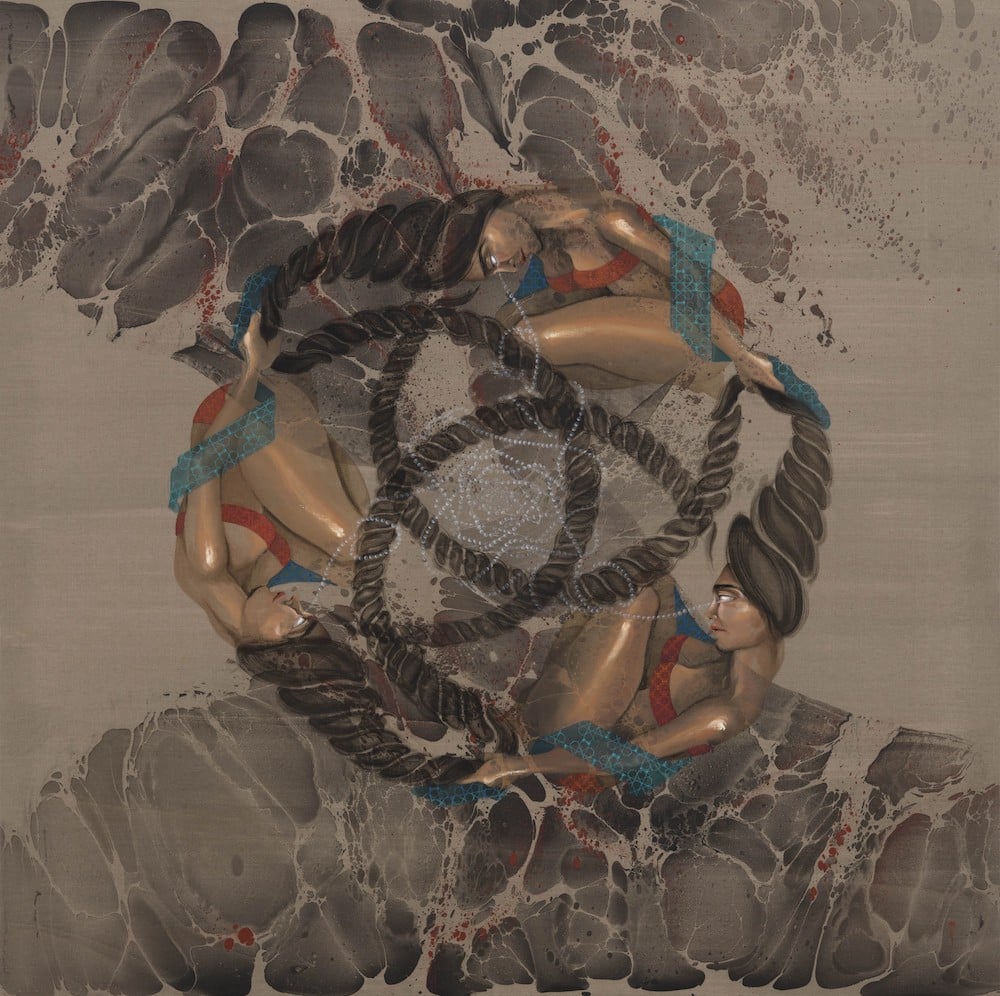 Hayv Kahraman: ‘Three Figures in Spiral’, 2026 – Oil and acrylic on linen, 198 x 198 cm
So are you seeking to return to a previous state of wholeness in ‘Three Figures in a Spiral’?
I’m not sure; I think modernity placed a spell on all of us in how we think about wholeness, as it’s not an end goal. Even thinking about goals feels very Eurocentric, so I think of these more as open-ended spirals. It’s not something with a beginning and an end; it follows a movement, and life happens in that movement. How do you regulate your nervous system in that kind of uncertainty? What I seek in these paintings is not resolution, but a kind of preparation, yielding me to sit with the undeterminable, to inhabit impermanence and to welcome an ancestral knowing that stretches across generations. A knowing that it is precisely our connection to the terrestrial and the celestial that holds us.
Did the fire affect the way you make work?
I was actually marbling – with black and red pigments only – in 2024, and was looking at images of fire, wondering how to paint it – it was already in my nervous system. But I am working in a different way since the fires, using intuition and dreaming, trying to access a different realm… After the fires I sank into a deep depression – for three weeks I could do nothing, but I somehow I got into the studio, and I picked up a brush and just painted on marbling I had already made – even though I’m not that kind of painter. I’m usually very systematic – months of research, sketches, colour studies, so I know exactly what I’m going to paint before I pick a brush up. But now I just started painting, and within half an hour I felt a door appeared in my mind and I opened it and walked through, and started to remember myself – this is who Hayv is! It’s better than any drug – because I tried drugs…
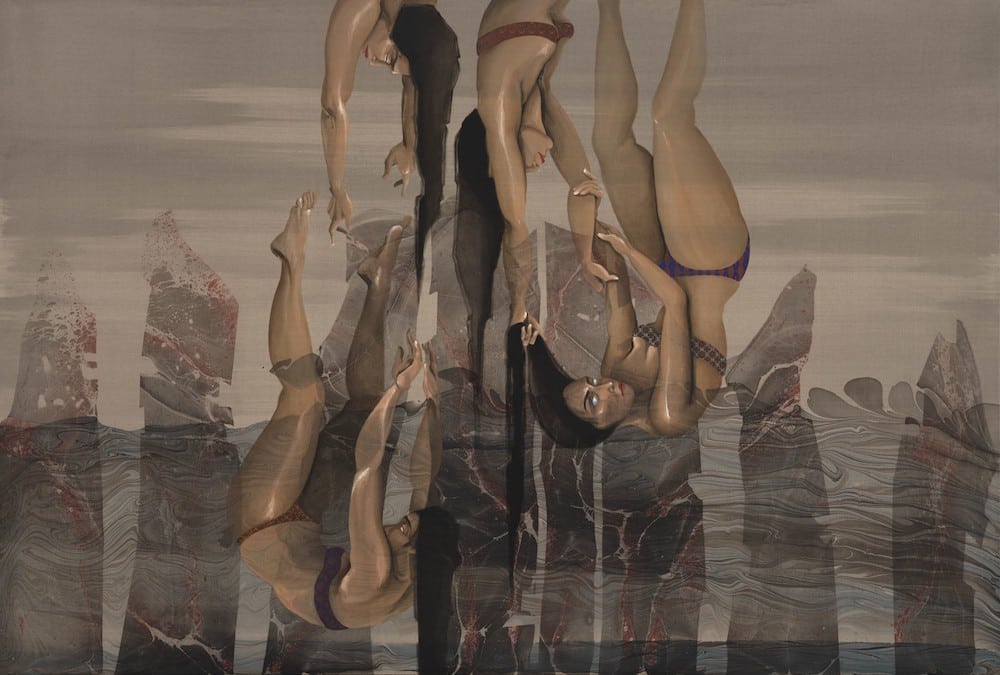 Hayv Kahraman> ‘Ancestral Tides’, 2026 – Oil and acrylic on linen, 198 x 292 cm
What started you on ‘Ancestral Tides’?
I’d never met my nephew – as he was from a part of the family that had fled elsewhere. He’s in the Canadian military, and was training. He needed a tandem jumper, and asked if I would do it. And I’m afraid of heights – if I sit on a bar stool I fear I might fall… But at the time I was reading the Sumerian myth from 4,000 BC about the goddess Inanna descending into the underworld. She has to shed something she carries or wears at each of seven gates, symbolically shedding her ego and identity, becoming fully exposed. So I thought: OK, I need to jump. So I jumped out of a plane! And it didn’t feel like I was descending; it felt like I was ascending, was being held up as I was moving down.
And what are the falling-yet-rising figures doing here?
They hold each other, as acrobats would, in mutual support. A contrast to the sense of dissociation from each other and from ecology.
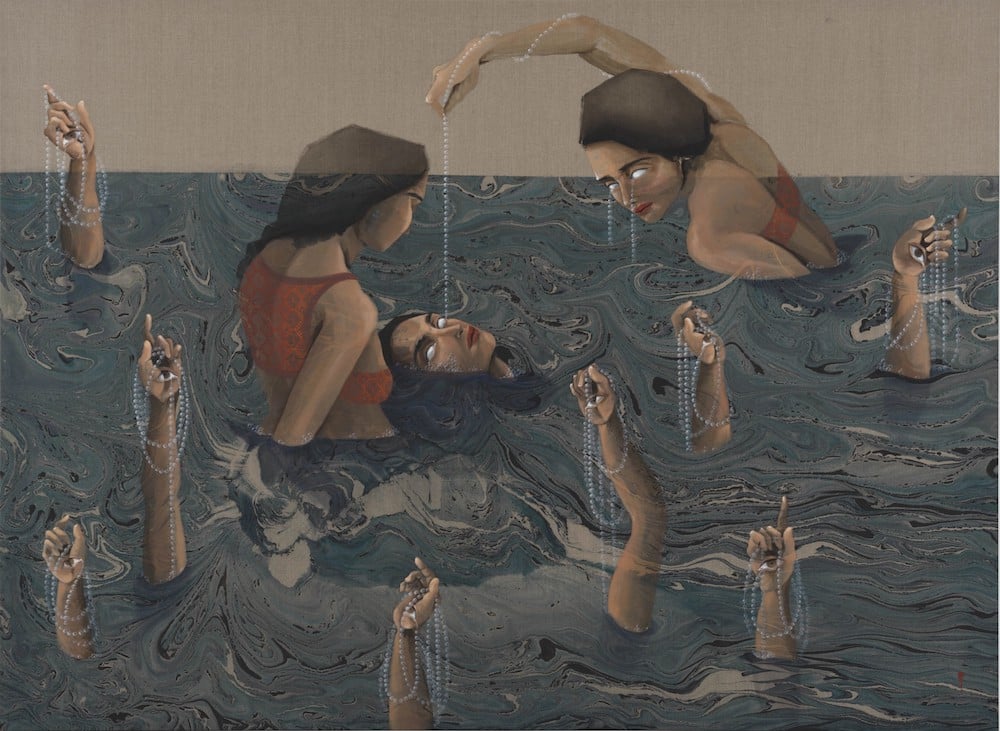 Hayv Kahraman: ‘Eyes in Waters, 2026 – Oil and acrylic on linen, 140 x 190 cm
Water seems significant?
It is. As I say in my statement about the show: ‘In a burning world, I turn to water: to seas, to rivers, to tears’. I have been researching Babylonian – Mesopotamian eras, and one of the stories is the creation of the universe through Tiamat, Goddess of the primordial salt sea and chaos and Nammu, Goddess of the cosmic ocean and primeval freshwater. Tiamat was the one who created the universe. She gives birth to gods, one of whom kills his mother, and out of her ribcage slit in half the world is created – one half becomes the celestial realm, the other half the terrestrial, and her tears create the Tigris and Euphrates.
The technique of marbling proves well matched to water. How is it done?
There used to be no backgrounds in my work, but now I marble as the first step, which is unpredictable – I don’t know what I’ll get except the horizon – I seal the top, then dip the whole thing into my marbling vat, and move the pigment with a stick. I don’t know what kind of line I’ll get, or quite what colours – it’s a whole ecology… Changes in studio conditions will change how it looks. As someone who was taught to be in control, it is unsettling not to be in control, but that’s about living with uncertainty.
Does the marbling also have a thematic significance?
The materiality of marbling, submerging the canvas in water, feels ceremonial and becomes a place where spirit might surface. A slow healing, enacted through immersion.
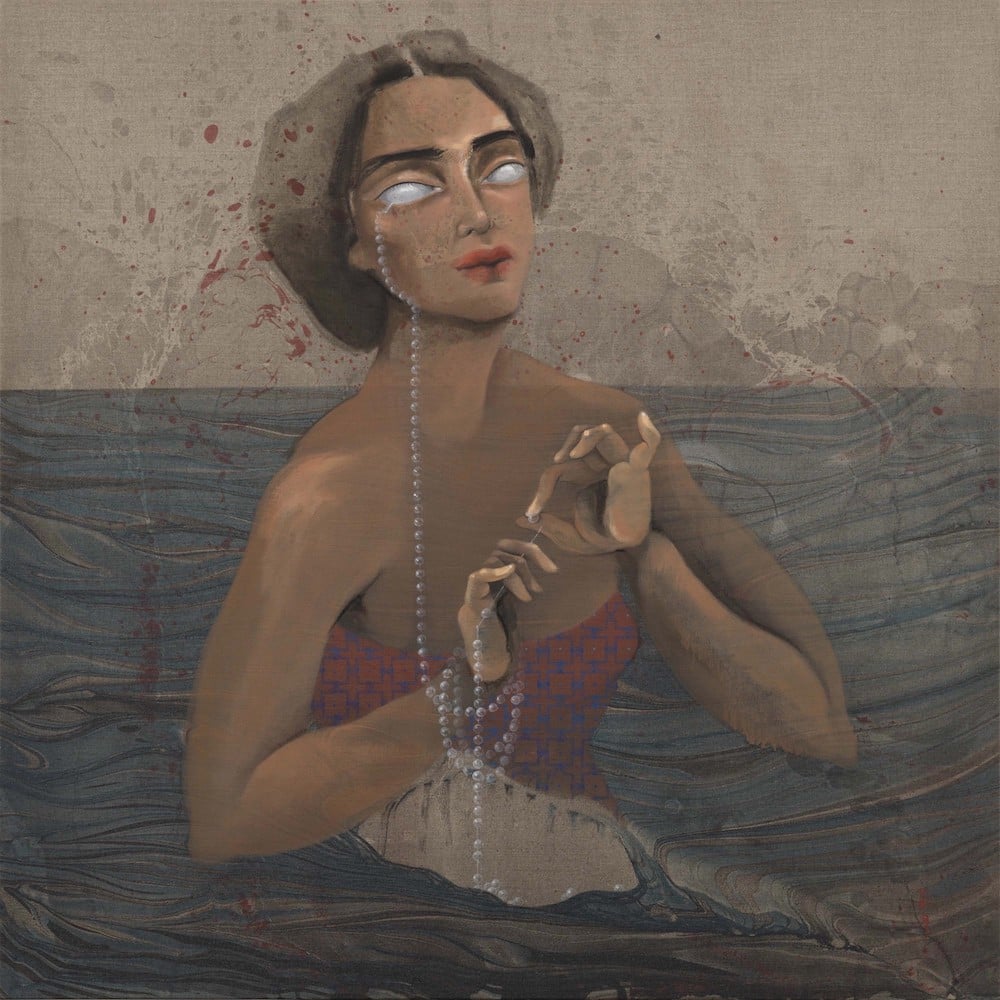 Hayv Kahraman: ‘Figure Threading Tear Beads’, 2026 – Oil and acrylic on linen, 89 x 89 cm
We also see a recurrence of beads or pearls positioned like tears?
If not for the war, I might have become a Sufi – my mother was due to marry a Sufi but chose not to when we fled to Sweden. And Sufism has the ritualistic practice with chants and movement and also the prayer beads: as you move through each bead the intention is to remember – to remember your connections to the world. I think of each bead as a moment in time, and the strand as deep time, the kind that is ancestral. There’s a sense of returning to something, not to a utopian ideal, but to a deeper sense of connection to something I feel was robbed from me. The eyes, the tears, the water stand for purification and movement. And there are connections: pearls belong in sea, and tears are salty…
Why do your figures have no irises?
That started years ago when I was researching the process of seeking asylum as an undocumented person. I have a cousin who works with incoming asylum seekers, and she was telling me a lot of these kids sandpaper or cut or apply acid to their fingers to circumvent bring traced via their fingerprints – there’s a centralised system which means if you are denied asylum in, say, Italy, you can’t get it in, for example, Denmark. That’s a very violent act of asserting agency. Now, they are scanning irises, so they can’t have irises. I was also thinking of right to opacity.
Some hold their eyes above them – as in ‘Eyes in Waters’, and they do have irises?
Yes, they feel more ritualistic and have irises as they are protected: you could close your hand. That’s about understanding the world in different ways – the ocular sense being Euro-American-centric. Here that translates into something more about accessing different worlds, or seeing the world in a different way…
Are you making a point through how the women have loose and flowing hair and reveal much of their bodies – contrary to what is traditionally accepted in the Middle East?
Maybe subconsciously, but not deliberately, no. I grew up in a very secular environment, so for me they are signifiers of femininity.
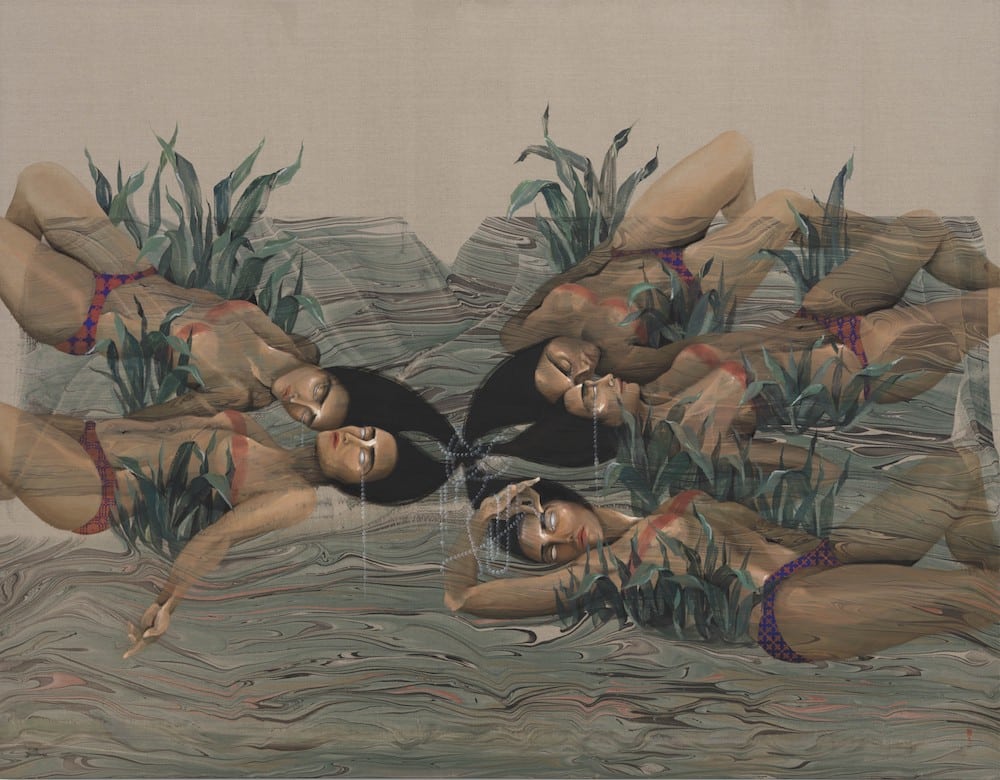 Hayv Kahraman: ‘Brittle Star’, 2026 – Oil and acrylic on linen, 180 x 231 cm
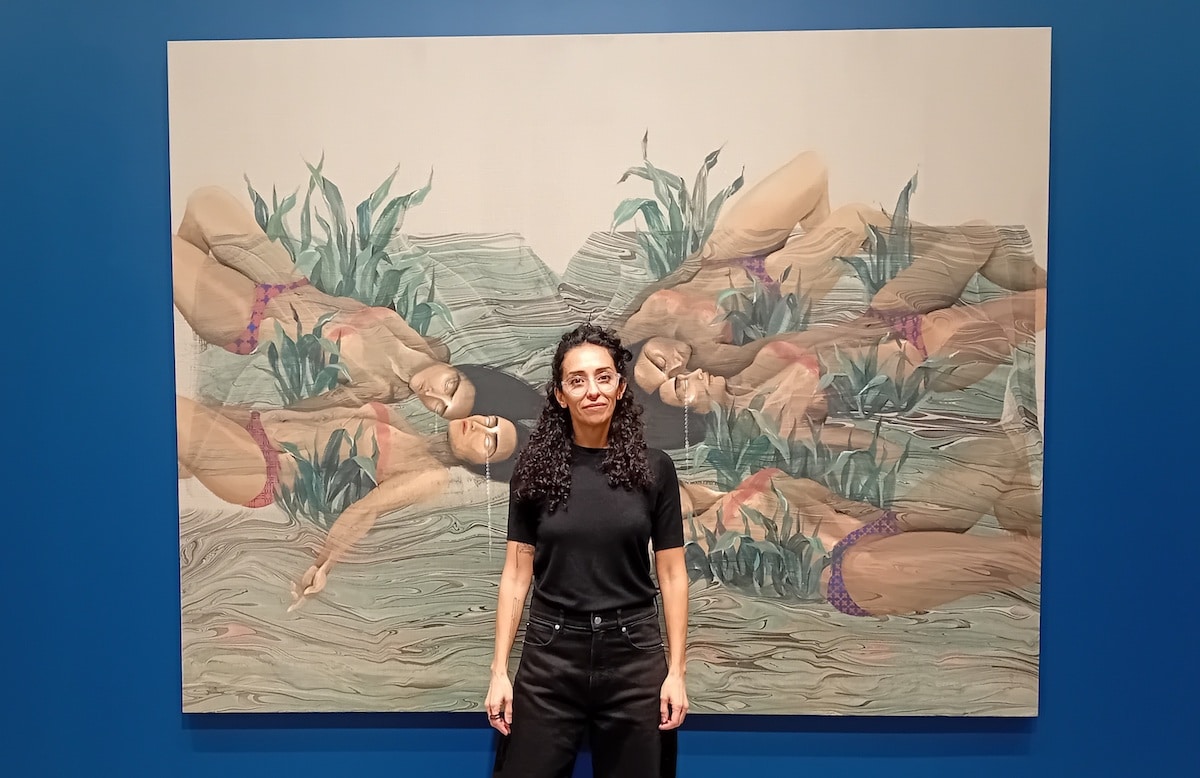
Why, in ‘Brittle Star’, do the five figures combine to form a star?
That comes from reading Karen Barad – she has the term ‘intra-action’ – not as in ‘interacting with you’, but a co-becoming with each other that changes the outcome. She uses the brittlestar, a type of starfish – it has no brain, and has the ability to detach a limb – as a means of shattering the notion of individualism. What is the brittlestar after such a separation? The brittlestar also has no eyes – but is made out of eyes, discs of calcite that sense their environment – a different way of sensing the world.
There’s a camaraderie between the women?
There’s always a sense of the collective that I try to go for. Another spell placed on us by capitalism/imperialism is that we are taught to think individualistically – I have my body, dissociated from the world. It’s been a lesson for me to approach the world in a more relational way: we’re sharing our microbes, we are interconnected. These works enact a remembering with the natural world, where entangled relationality is slowly taking shape.
Is Barad’s ‘Invertebrate Visions: Diffractions of the Brittlestar’ typical of your reading?
It has been yes, and I was also thinking of Thom van Dooren’s work, relating how widely the death of one species reverberates. I’ve always read theory and factual books, never novels. I only recently read my first novel: ‘There are rivers in the sky’ by Elif Shafak!
Hayv Kahraman: ‘What cannot be said will be wept’ runs to 29 August at Pilar Corrias, Conduit Street. Interview incorporates material from Hayv’s statements about the show and her answers to questions in a walk-through with Pilar Corrias, as well as answers to me.
Top Photo: Hayv Kahraman at Pilar Corrias with ‘Brittle Star’, 2026