
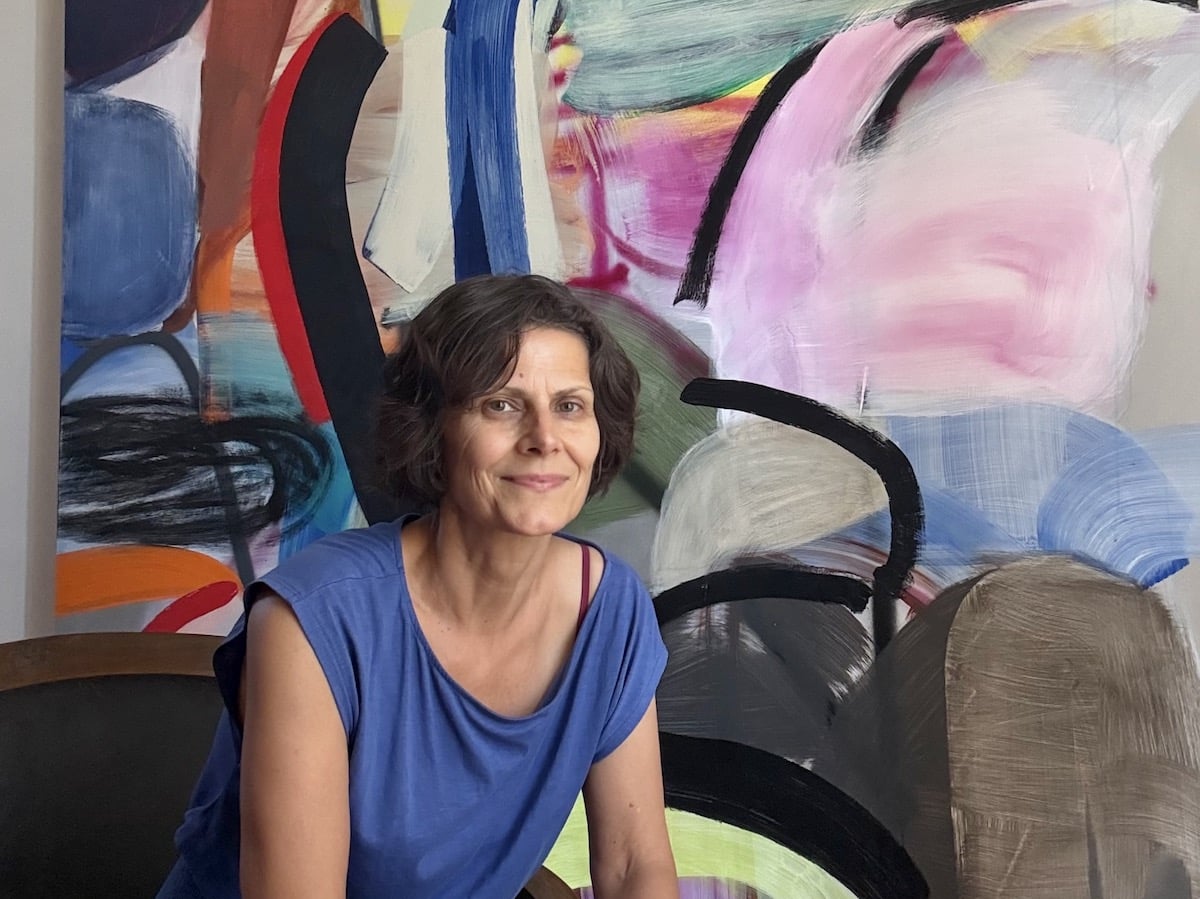
Late this Summer through Autumn, Swiss painter Liliane Tomasko becomes the focus of two major European museum exhibitions running concurrently, each approaching her practice from a different angle while together making the case for an artist whose international reputation has been building steadily for more than two decades. A survey at the Ludwig Museum in Koblenz charts twenty-five years of her development as a painter, while Les songes de la trame places her most recent work in conversation with one of the twentieth century’s most influential pieces of sacred architecture, Le Corbusier’s Couvent Sainte-Marie de La Tourette near Lyon.
The La Tourette exhibition opens on 16 September and runs until 18 November. The Koblenz survey, titled Bridge, opens on 30 August and continues until 1 November. Although distinct in scale and approach, the two shows illuminate each other in ways that make seeing both worthwhile if at all possible.
Le Corbusier completed the Dominican monastery at La Tourette between 1953 and 1960, and it remains one of his most uncompromising achievements. Built for contemplation rather than spectacle, its bare concrete forms, disciplined geometry and carefully controlled natural light create an environment that is austere but never cold. It is exactly the kind of space that is suitable for whatever art is placed within it, and Tomasko has responded with characteristic intelligence. Rather than competing with the architecture, her paintings enter into dialogue with it.
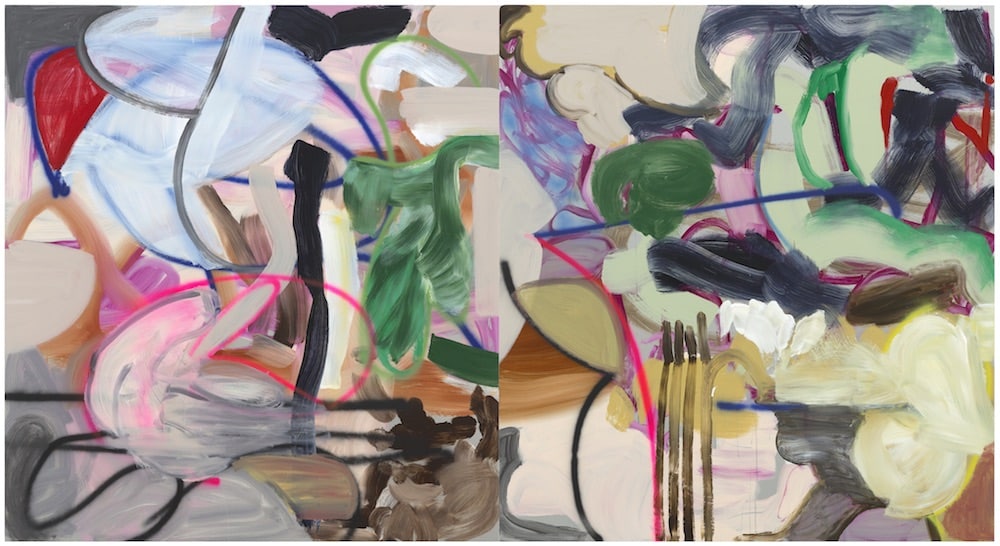
Liliane Tomasko: A tangle of shifts in a jungle of shapes, 2024 Acrylic and acrylic spray on aluminum
The exhibition brings together around thirty paintings and works on paper made between 2019 and 2026, installed through the monastery’s corridors and communal spaces. Le Corbusier’s building, for all its apparent severity, reveals unexpected richness on closer inspection. Brightly coloured service ducts run across concrete walls. Narrow vertical openings admit light that shifts throughout the day. Niches and textural variations break the surface in ways that reward sustained attention. These details, the kind that often escape a first look, are precisely the territory Tomasko has always inhabited as an artist.
Her starting point for the La Tourette works came from daily life within the monastery itself. She photographed napkins folded by the Dominican friars, then used those observations as the catalyst for paintings that bear almost no direct resemblance to their source while retaining a strong physical and psychological presence. The process is characteristic of how she works more broadly: familiar domestic objects, crumpled bed linen, folded fabric, tablecloths, are transformed through painting into something that sheds its physical origins and becomes primarily about memory, sensation and the unconscious. The recognisable dissolves, but the feeling of it lingers.
The works in the exhibition are arranged in groups of three, a structure that echoes the Christian symbolism of the Trinity while creating visual sequences that reward slow looking. Paintings function as variations on recurring themes, with subtle shifts in colour, movement and atmosphere becoming the primary subject. It is an installation strategy well matched to a building where repetition and ritual are part of the daily rhythm.
The Ludwig Museum survey in Koblenz offers another side to the story. Opening with early works from around 2000, including Bed I and Morning Creases, the exhibition traces the development of a painter who began with quietly observed domestic interiors, abandoned beds, empty rooms, crumpled sheets, and gradually moved through a process of abstraction that has accelerated over the past decade. Those early paintings carry the intimacy of Pierre Bonnard or Giorgio Morandi while already showing Tomasko’s fascination with absence and implied presence. Human beings are never quite there, but their traces are everywhere.
As the survey progresses, recognisable objects begin to dissolve. Works from around 2008 to 2010, including Soft Blue Stack and Under, reduce physical forms to layered fields of colour and texture. References to Colour Field painting surface, though Tomasko has always been more interested in material experience and psychological resonance than in formal reduction for its own sake. By the time of Linens from 2014, the folds observed in fabric have become the principal subject in their own right, evolving into intricate networks of lines that organise the entire picture surface.
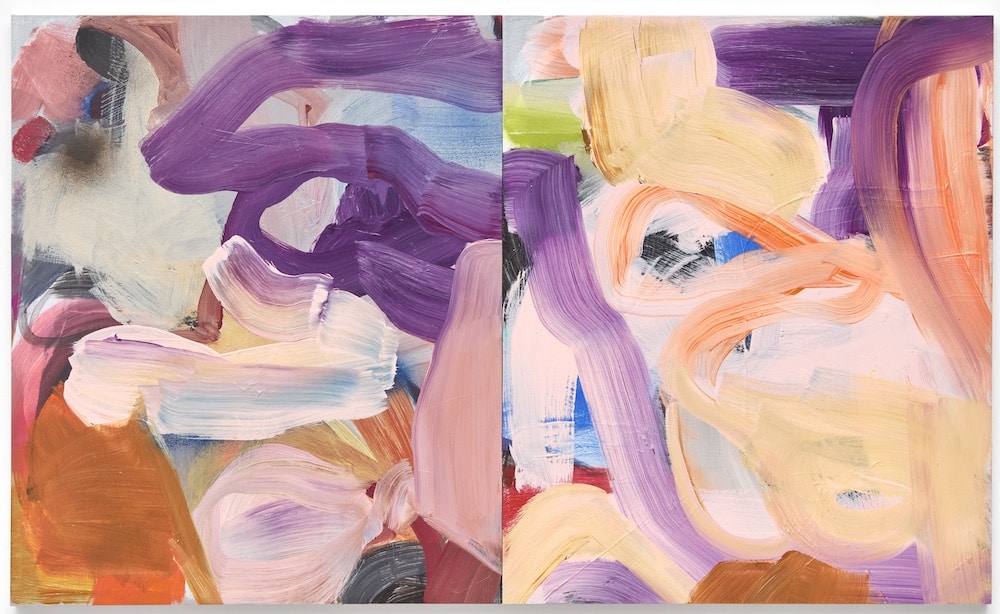
Liliane Tomasko: Shapeshifter (yesterday and tomorrrow, divided by the present), 2024 Acrylic and acrylic spray on aluminum
Her most recent Shapeshifter series, begun in 2024, extends these concerns into territory that resists fixed interpretation entirely. The paintings suggest landscapes, emotional states or memories without committing to any single reading. Looking at them is an active rather than a passive experience, something the artist seems to intend. The viewer’s own perception and associations become part of what the painting is.
Born in Zurich in 1967, Tomasko completed her Master’s degree at the Royal Academy Schools in London in 1998 and has since developed a body of work that draws on mythology, philosophy and art history while maintaining a strongly personal visual language. Giotto, Mondrian, Malevich, de Kooning and Picasso have all informed her thinking, but her paintings do not announce their influences. They occupy their own space, somewhere between dreams and waking consciousness, where perception keeps shifting, and nothing quite settles.
Her work is held in major collections including Albertina Modern in Vienna, Kunstmuseum Bern, Kunstsammlung Nordrhein-Westfalen, Lenbachhaus Munich, the Hugh Lane Gallery in Dublin and the Modern Art Museum of Fort Worth. In September 2025 she showed at Maison La Roche in Paris, another Le Corbusier building, which now serves as a prelude to the La Tourette exhibition.
Together, Bridge in Koblenz and Les songes de la trame at La Tourette make a strong case for an artist who has spent twenty-five years exploring what painting can do when it stays close to ordinary experience while refusing to be limited by it. – PCR 2026
All Photos: © Liliane Tomasko
Liliane Tomasko: Bridge, Ludwig Museum Koblenz, 30 August to 1 November 2026
Les songes de la trame, Couvent Sainte-Marie de La Tourette, 16 September to 18 November 2026