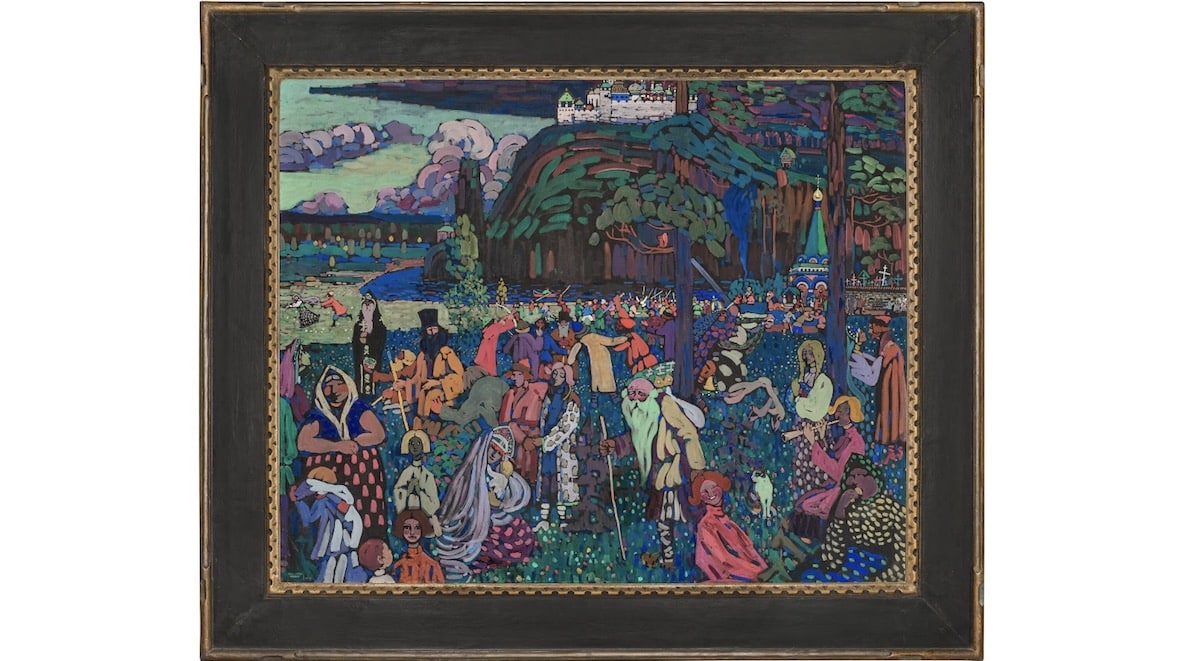
A Kandinsky painting recovered from decades of Nazi-era provenance problems is about to change hands for the first time in nearly a century, with its storied journey lending it remarkable historical significance. Christie’s confirmed it will offer “The Colourful Life” at its October evening sale in London. The 1907 tempera and gouache work, restituted to the heirs of its original Jewish owners just two years ago, is expected to fetch upwards of $30 million a figure that would place it among the artist’s most valuable works ever sold at auction.
The painting spent more than half a century hanging at Munich’s Lenbachhaus museum, on loan from Bayerische Landesbank. This Bavarian state bank acquired it in 1972 with seemingly little scrutiny of how it had come onto the market three decades earlier. That gap in the provenance record turned out to matter a great deal. The work had originally belonged to Emanuel Albert Lewenstein, a Dutch industrialist who ran a sewing machine factory, and his wife Hedwig Lewenstein Weyermann, both serious collectors of modern art in interwar Amsterdam. Lewenstein purchased the Kandinsky in 1927, and following his death, his widow is thought to have placed it with the Stedelijk Museum for safekeeping, a common practice among collectors anxious about the deteriorating political climate.
Neither Lewenstein nor his wife lived to see the German occupation of the Netherlands, but their descendants did, and were subjected to Nazi persecution in the years that followed. The painting itself was sold at auction in October 1940, several months after German forces invaded — a transaction whose full circumstances reflect a complex and troubling history of forced dispossession. Researchers have been unable to establish who consigned the work or under what pressure. What the German government’s advisory commission on Nazi-looted art did conclude, after review in 2023, was that the sale bore the hallmarks of forced dispossession, and that absent evidence proving otherwise, the loss should be treated as involuntary. Bayern LB accepted the recommendation and returned the painting to the Lewenstein family that same year, highlighting its cultural and historical significance.
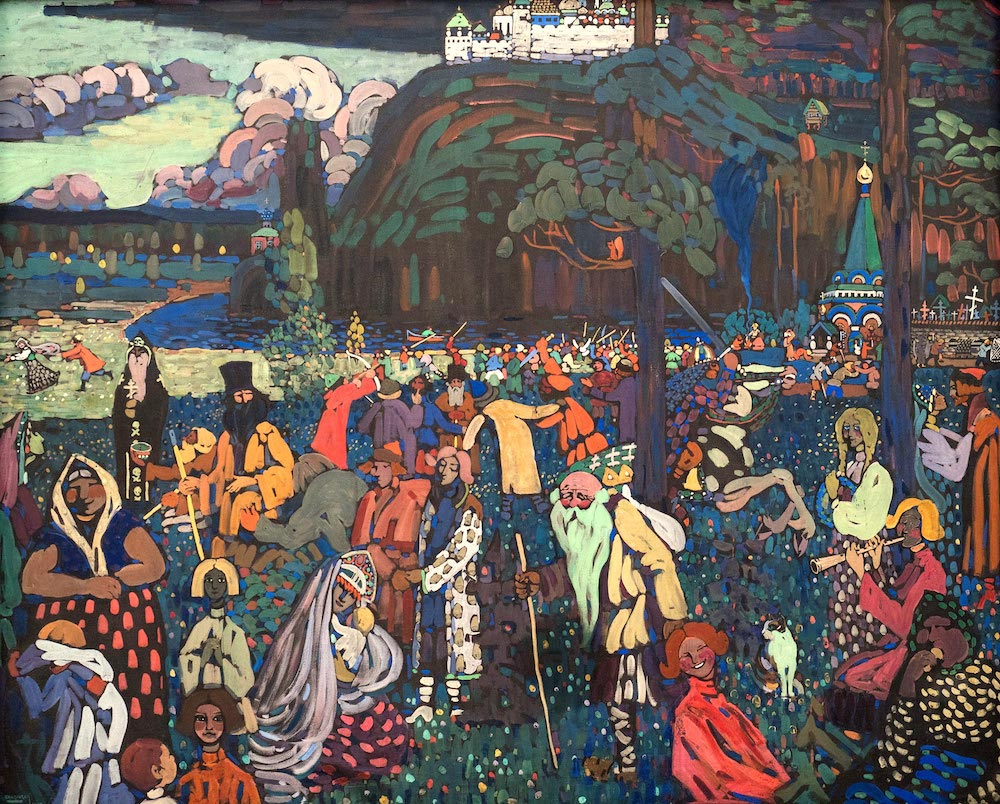
Kandinsky Colourful Life Das bunte Leben 1907 Tempera on canvas
It is not the only work the family has clawed back. A second Kandinsky from the same collection, the 1909 canvas “Painting With Houses,” was restituted following a protracted and often contentious dispute with the City of Amsterdam, while a third recovered piece, by the Dutch painter Jan Sluijters, rounds out what the heirs have managed to reclaim so far. Francesca Lewenstein Davis, one of the family’s heirs, described the process as a long campaign fought on behalf of more than just her own relatives. “Many years of fighting have gone by, not only for the restitution to my family but restitution to many Jewish families,” she said.
The recovery effort is far from finished. James Palmer, who founded Mondex Corporation and has built a career tracing looted art back to surviving heirs, estimates the Lewenstein family is still missing roughly 100 works from its original holdings. Much of what remains unaccounted for consists of drawings, prints, and works by artists whose names lack the market recognition of Kandinsky, making them considerably harder to track. “The task is difficult, because many of the artworks are by lesser-known artists and many are drawings or prints,” Palmer noted, adding that some pieces have already surfaced at past auctions and his team is now working to pin down their current whereabouts.
As for “The Colourful Life” itself, the painting captures a pivotal moment in Kandinsky’s development, made during an extended Parisian sojourn undertaken with Gabriele Münter, his former student, romantic partner, and a significant painter in her own right. At the time, it was the largest canvas he had attempted, and it shows him working through the collision between the experimental energy of the Paris avant-garde and the folkloric imagery of his Russian upbringing. The composition is dense with narrative incident: a crowd of costumed figures fills an invented landscape, one playing a wind instrument, another holding an infant, others shown fighting with swords, pleading, embracing, or caught mid-prayer.
Keith Gill, Christie’s vice chairman for 20th- and 21st-century art, called paintings from this specific window in Kandinsky’s career exceptionally scarce, noting that virtually every other surviving example from the period now sits permanently in museum collections. He framed the picture as a hinge point not just for the artist but for modern art more broadly. “It’s difficult to understate how important this period of time was in Paris in terms of the development of modern art,” Gill said, adding that the pace of change in how art was understood was shifting almost monthly, and that Paris was really the only place Kandinsky could have built his reputation at that moment.
Should the painting reach or exceed its Estimate, it will be close to the artist’s auction record, currently held by “Murnau With Church II,” another restituted work, which sold at Sotheby’s in 2023 for £37.2 million, roughly $45 million at the time. The pairing of two record-adjacent Kandinsky sales, both tied to restitution cases, underscores how significantly the market now factors provenance narratives into pricing for works with this kind of history.
Ahead of the October 14 sale, Christie’s will tour the painting through its exhibition spaces in Zurich, Paris, New York and Hong Kong throughout September, before it goes on view at the house’s London premises from October 8.