
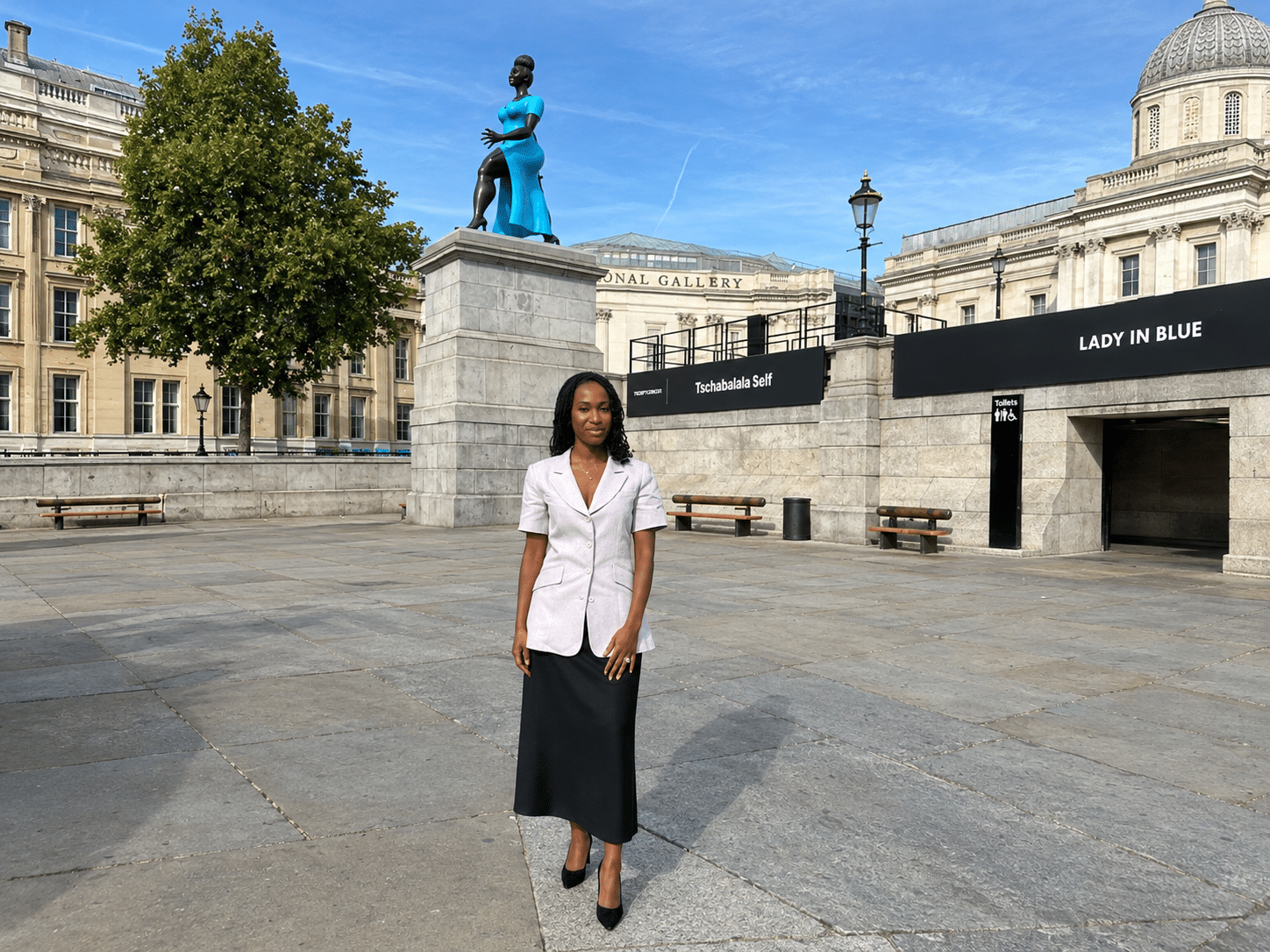
Trafalgar Square has a new occupant. Tschabalala Self’s Lady in Blue was unveiled today on London’s Fourth Plinth, becoming the sixteenth commission in a programme that has, over the years, become one of the more closely watched slots in public art anywhere in the world. She replaces Teresa Margolles’s Mil Veces un Instante, which held the position before her.
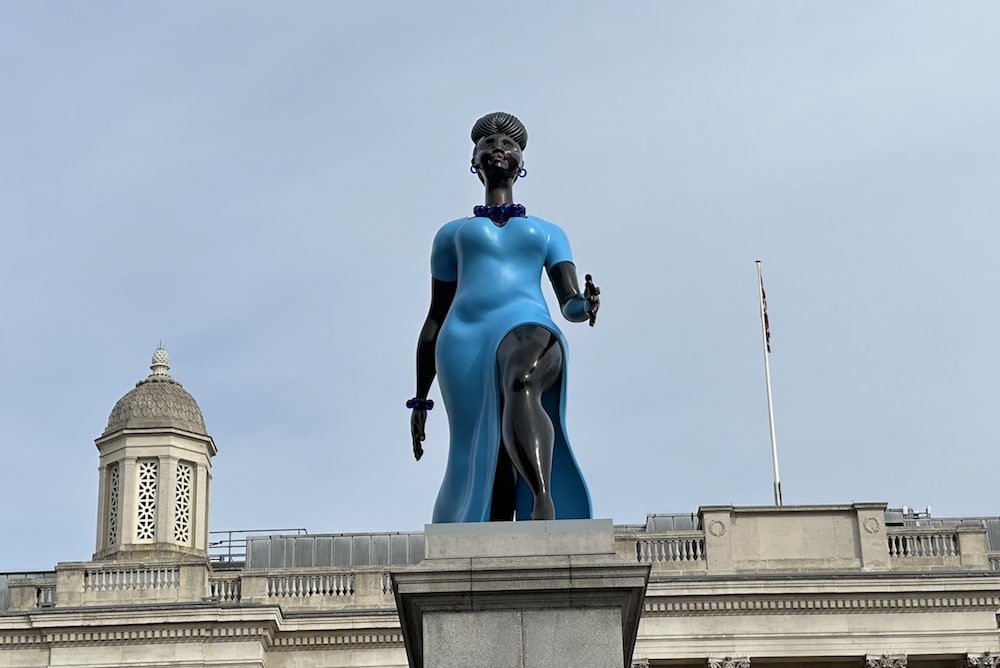
The figure herself is bronze, cast at monumental scale and painted a saturated blue, with jewellery finished to mimic the deep tone of lapis lazuli, the semiprecious stone that has been ground into pigment since antiquity. What she represents, according to Self, is deliberately unspectacular. Not a historical figure. Not someone being memorialised for a specific achievement. Just a woman, young and urban, striding through the square the way thousands of actual Londoners do every single day.
Self was announced as the winner of the commission in March 2024, alongside Andra Ursuţa, whose work will take the plinth in 2028. Both artists were selected independently by the Fourth Plinth Commissioning Group, chaired by Ekow Eshun. However, the public also had a say, weighing in on shortlisted proposals before the final decision was made.
Tschabalala Self Photo © Artlyst 2026
Speaking about the piece, Self described wanting to bring someone recognisable to the square rather than someone to be venerated. “She is neither an idol to venerate nor a historical figure to commemorate,” Self said. “She is an everyday person, much like the many who occupy the square each day. She is striding forward into our collective future with ambition, purpose and optimism.” London clearly means something specific to Self beyond the commission itself. She mentioned that her first institutional show and her first major gallery exhibition both took place in the city, calling it a place that has marked several milestones in her career, and describing Lady in Blue as a reflection of the sophistication she associates with London as a genuinely global metropolis.
Justine Simons, London’s Deputy Mayor for Culture and the Creative Industries, was similarly enthusiastic, calling the Fourth Plinth one of the most exciting public art commissions anywhere and noting that it places serious contemporary sculpture somewhere completely free and open, seen by millions who pass through Trafalgar Square each year without necessarily planning to look at art at all. She described the new work as monumental yet somehow still relatable, predicting that Londoners will take to it quickly.
Ekow Eshun, chairing the commissioning group, framed the piece in similar terms, saying Self had managed to take something ordinary, a woman simply moving through a city, and give it an outsized presence at the centre of London. He suggested the sculpture would open up conversation, giving audiences a direct way into engaging with an artist he called both remarkable and genuinely inspirational.
The unveiling lands at a busy moment for sculpture across the city. Lady in Blue becomes a centrepiece of London Sculpture Week, running from the 19th through the 27th of September, now in its fifth year and bringing together five separate initiatives: Frieze Sculpture, the Fourth Plinth itself, East Bank, Sculpture in the City and The Line, across various locations in the capital. It also follows closely on the heels of Black on the Square, a free one-day festival held in Trafalgar Square on September 5, which brought music, food and family-focused programming into the same space in celebration of Black culture and creativity.
For anyone wanting more context beyond the plinth itself, Bloomberg Connects offers a free digital platform with further material on both the new commission and London Sculpture Week more broadly. The Fourth Plinth programme continues to be funded by the Mayor of London, with additional support from Arts Council England and Bloomberg Philanthropies. This partnership has kept the slot running and consistently surprising for over two decades now.
Top Photo: P C Robinson © Artlyst 2026