
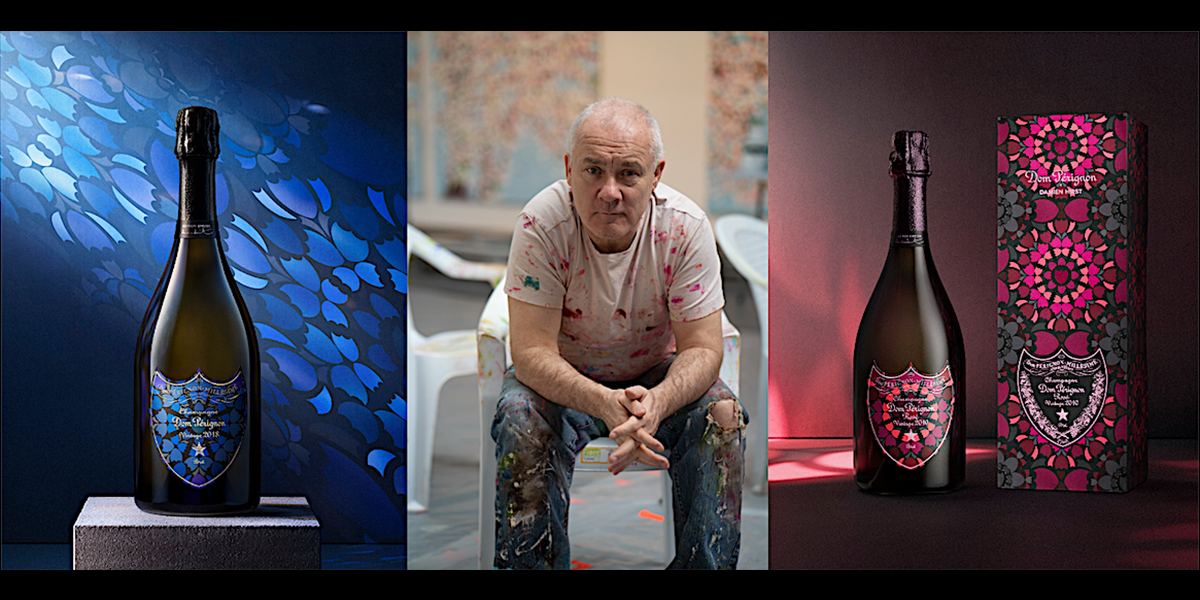
Dom Pérignon has joined up with Damien Hirst to design a limited-edition champagne label. This collaboration is on target as Tate Britain prepares to open its exhibition The 90s: Art and Fashion. Hirst, more than almost any other artist working in Britain, helped define what the nineties was all about and pairing him with a champagne house’s end-of-year release sits well.
There is a genuine appetite for revisiting that decade. Millennials and Gen Z are redefining nineties aesthetics from opposite directions, and for slightly different reasons. Younger audiences seem drawn to the pre-smartphone analogue era of vinyl and VCRs, a relief from the constant churn of contemporary digital life. Millennials, who actually lived through the decade the first time, are approaching it as nostalgia. They are only now able to reassess properly what makes the nineties feel new and alive.
Hirst himself needs little introduction. Born in Bristol in 1965 and now splitting his time between London and Gloucestershire, he remains one of the most commercially successful and critically discussed artists of his generation, a figure critics regularly credit with redefining what a contemporary artist could even be, somewhere between monumental creator, pop icon and deliberate provocateur. His work has spent decades circling the same handful of enormous themes: beauty, religion, science, life and death, approached from constantly shifting angles.
He first drew serious attention in 1988, while still a student at Goldsmiths, when he curated the group show Freeze, an exhibition that effectively launched the loose movement later labelled the Young British Artists. Since 1987 his work has been the subject of more than ninety solo exhibitions worldwide, including major shows at Tate Modern in 2012, the Rijksmuseum in 2008, the Fondation Cartier in 2021, and the Pinault Collection in Venice in 2017.
Besides his more notorious formaldehyde sculptures, Hirst has built an entire visual vocabulary around repetition, most visibly through his Spot Paintings, Spin Paintings and Kaleidoscope Paintings, works that multiply and refract across the canvas in patterns that feel simultaneously rigorous and slightly hypnotic. The kaleidoscope motif in particular has become something of a signature, an ongoing exploration of creation built on transformation, repetition, and, beneath both, a search for harmony hidden within apparent complexity.
That last idea is essentially what anchors the Dom Pérignon collaboration. Just as Hirst assembles fragments of organic matter into kaleidoscopic compositions that dissolve the boundary between stillness and motion, Dom Pérignon’s own process involves assembling grapes from a single vintage into something that reveals harmony out of unpredictability. The Maison and the artist, in other words, are working from strikingly similar premises, just in entirely different materials.
The resulting 2026 Limited Edition Dom Pérignon shield, through Hirst’s kaleidoscopic interpretation, breaks the emblem apart. It multiplies it across the label in shifting, layered configurations that seem to keep moving even though the label itself, obviously, does not. The shield never actually disappears within the pattern. It simply repeats, vibrating slightly with each iteration, serving as a visual metaphor for the tension Dom Pérignon has always sought to maintain between tradition and reinvention.
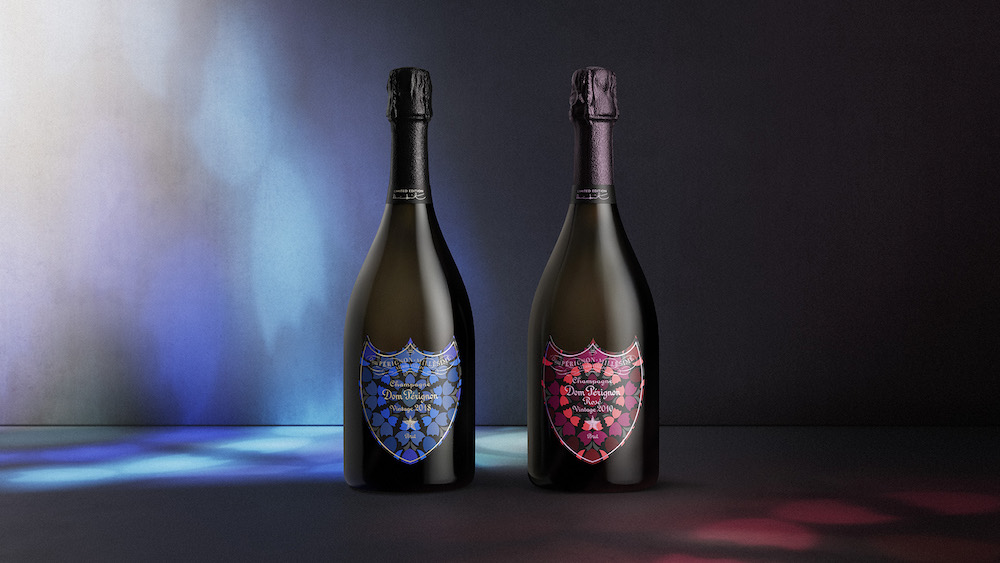
Dom Pérignon x Damien Hirst Limited Edition (1)_CREDIT ©ARTWORKS DAMIEN HIRST AND SCIENCE LTD. ALL RIGHTS RESERVED, DACS 2026
Hirst, for his part, has apparently responded to something specific in the Maison’s own philosophy, describing its savoir-faire as a living material that has always grown through experimentation rather than standing still, an approach that maps fairly neatly onto his own preoccupation with harmony, complexity, rigour and vitality existing all at once.
Two colour palettes, each tied to a specific vintage, are employed: a deep blue evokes infinity and a certain spiritual quality that wraps around the Vintage 2018, while a softer, warmer pink represents the Rosé Vintage 2010, built around the character of Pinot Noir. The two together are designed to feel complementary rather than competing, striking a balance between emotional warmth and more precise, almost geometric symmetry.
The vintages themselves could hardly be more different in character. The 2018 benefited from close to ideal weather throughout the growing season, generous sun and just enough water to meet the vine’s needs at every stage, ripening early enough by August that Chef de Cave Vincent Chaperon was able to push the wine toward greater minerality, sweetness, fruit and salinity, producing what the house describes as an added sense of tactile depth. The Rosé 2010 sits in a different register entirely, more interior and shadowed, with the Pinot Noir expressing itself through unusual density and assertiveness, continuing the Maison’s long-running pursuit of intensity in its rosé vintages.
Together the two bottles form what amounts to a highly collectable pairing, one solar and taut, the other more intimate, arriving at a moment when Hirst, most associated with nineties provocation and a champagne house built on decades of quiet reinvention, has, somewhat unexpectedly, found genuine common ground.