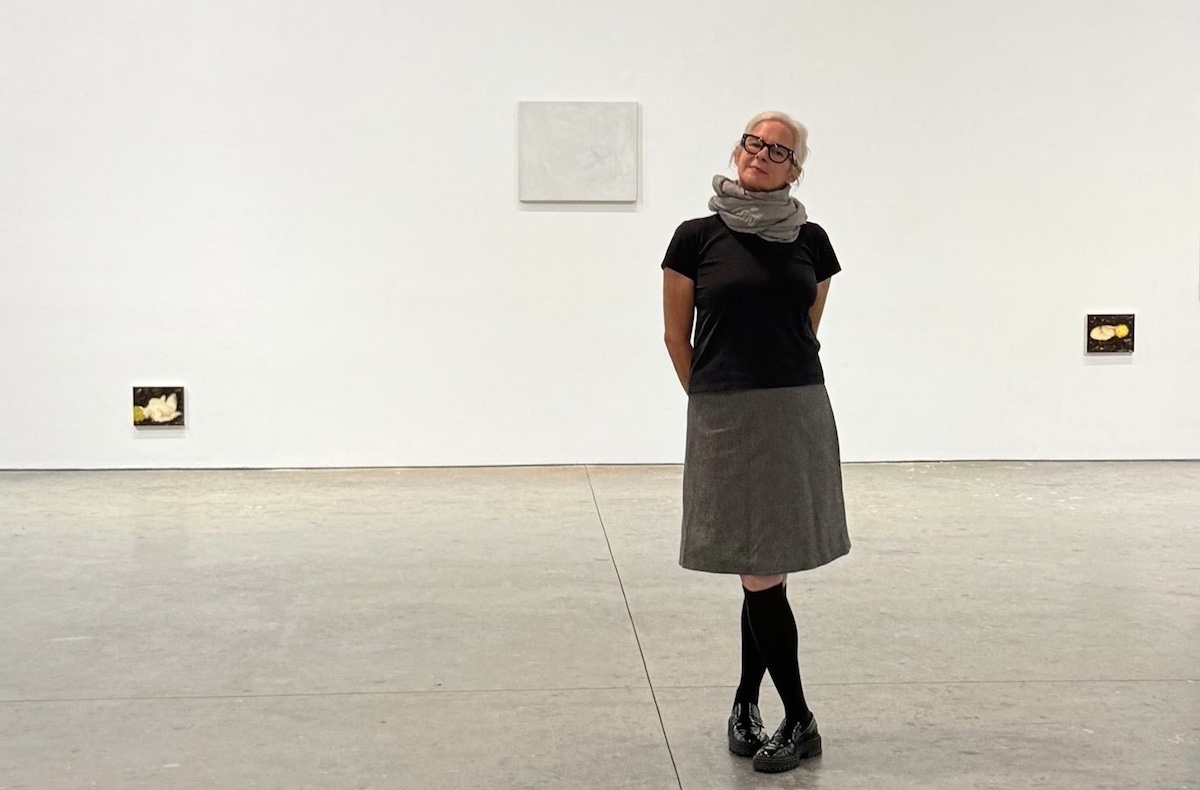
Rachel Howard returns to New York for the first time since 2019 with Harvest, a solo show of new paintings opening September 25 at 447 Space in Chelsea. It is not a cosy exhibition. The paintings move between the automated, geometric gaze of an unmanned Reaper drone and muddied infant figures that draw directly on Rubens’s Massacre of the Innocents, stripping away any historical romance in favour of something starker: the cold precision of surveillance technology set directly against actual human tragedy.
There is something almost inevitable about painting drone imagery, given how pre-packaged that imagery already is. Grainy, monochrome, geometric, oddly beautiful in its detached mechanical precision, footage from military sensors arrives already looking like art before anyone touches a brush. What Howard does, translating that machine vision into paint, is collapse two registers usually kept carefully apart, the sensor feed, indexical and bureaucratic and entirely disembodied, against the painted image, handmade and historically loaded and unavoidably human.
Citing Rubens is not a halfhearted choice either. Massacre of the Innocents remains one of art history’s defining images of state violence directed at people who have no way to see it coming and no way to fight back.
Bringing it into direct conversation with drone footage makes a fairly pointed argument that the basic structure of atrocity, power exercised against the powerless, has not actually changed across four centuries; only the instruments delivering it have. Howard’s muddied infants do not simply quote Rubens’s baroque drama. They degrade it, dirtying the classical composition until it feels considerably less like history painting and considerably more like something still happening.
From up high, a person stops being a person and becomes something closer to a coordinate, scale and individuality both stripped away in the same motion. The lower vantage points do the opposite. They give back what altitude takes: vulnerability, physical presence, the plain sense that there is an actual body down there rather than a point on a grid. The French philosopher Grégoire Chamayou has written about this at some length, arguing that the drone’s elevated, almost godlike view produces a kind of moral distance built into the optics themselves, well before any human being actually decides what to do with what they’re seeing.
Howard is not really arguing that warfare itself has changed. She seems more interested in how our permission to look at it has changed, how the apparatus of viewing has shifted the emotional cost of witnessing. The Reaper’s live feed and Rubens’s brushwork sit four hundred years apart, yet they circle the same uncomfortable question: what does it actually cost a viewer to witness atrocity secondhand, at a distance built in by the viewing technology itself? Harvest does not offer an answer to that question. It simply plays inside the discomfort of the collision, between past and present, between painted image and rendered feed, between victim and target.
447 Space, the Chelsea venue hosting the show, was founded by artists Sean Scully and Liliane Tomasko and lends the exhibition a setting with its own special pedigree in painting.
Rachel Howard trained at Goldsmiths, University of London, in Fine Art and Critical Theory, and her broader practice has long circled tensions between control and chaos, order and entropy, making and its opposite, unmaking. Religion, repetition, madness, surveillance and violence recur throughout her work, alongside what reads as genuine pleasure in her materials themselves. Her exhibition history is substantial, including Paintings of Violence at MASS MoCA in 2018 and 2019 and at MACRO Testaccio in Rome in 2016, Repetition is Truth, Via Dolorosa at Museo MADRE in Naples in 2011 and later at Newport Street Gallery in London in 2018, and At Sea at Hastings Contemporary in 2015. She has an upcoming pairing with Frank Auerbach at Pallant House and Print Room in 2026.
Her work sits in numerous institutional collections, including the Imperial War Museum, the Arts Council Collection, the Jerwood Collection, the Ackland Art Museum in North Carolina, Pallant House Gallery, and Pio Monte Della Misericordia in Naples, among others. Beyond her painting practice, Howard also founded and edits Doris Press, an independent publishing house, adding another dimension to a career that has consistently refused to look away from difficult material.
RACHEL HOWARD HARVEST 447 SPACE WEST 17 ST. NYC 25 SEPTEMBER – 6 NOVEMBER SELECTED WORKS