
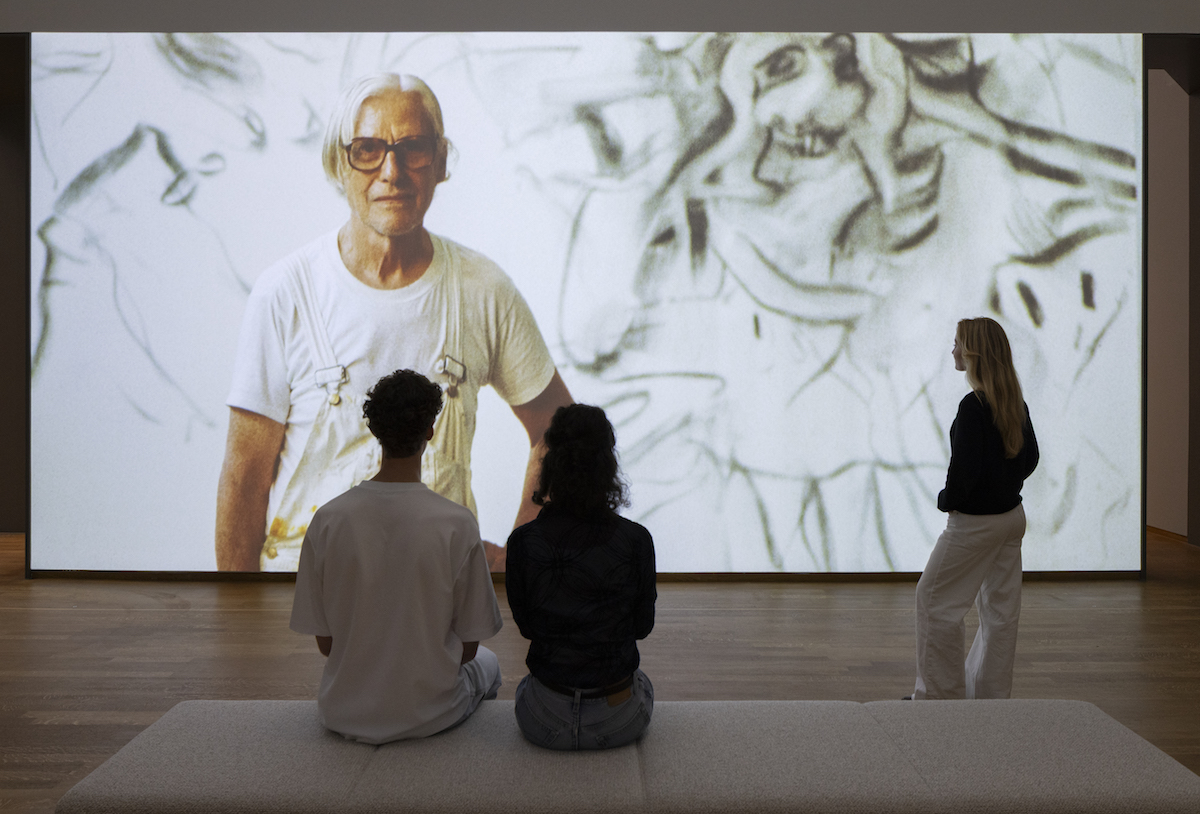
The Rijksmuseum in Amsterdam is marking the centenary of Willem de Kooning’s arrival in New York with an exhibition devoted to his work. De Kooning came to the city in 1926, having crossed the Atlantic aboard a cargo ship. More than 120 works are brought together, with works on paper taking centre stage; a selection of paintings and sculpture is woven throughout the display. For de Kooning, drawing was the ground from which everything else grew, and the selection bears that out across a career of some sixty-five years. The figure keeps returning. So does landscape. You see him sketching, trying things, revising, doing it all again, and now and then plainly surprising himself: quick pencil and charcoal studies sit beside sheets made with his eyes shut, and elsewhere the line between drawing and painting ceases to exist.
Much of the material is rarely seen in public. Reclining Nude (Juliet Browner) from the mid-1930s, Itinerant Chapel of 1951 and Woman in a Rowboat from the mid-sixties all come from private hands, which makes this a chance that may not repeat soon. Loans from public collections give the drawings some company: Abstraction from the Thyssen-Bornemisza in Madrid, Pink Angels from the Weisman Foundation, Woman from the Museum Ludwig, plus Excavation from Chicago and Clam Diggers of 1963. Chicago’s Art Institute is a development partner, alongside The Willem de Kooning Foundation in New York.
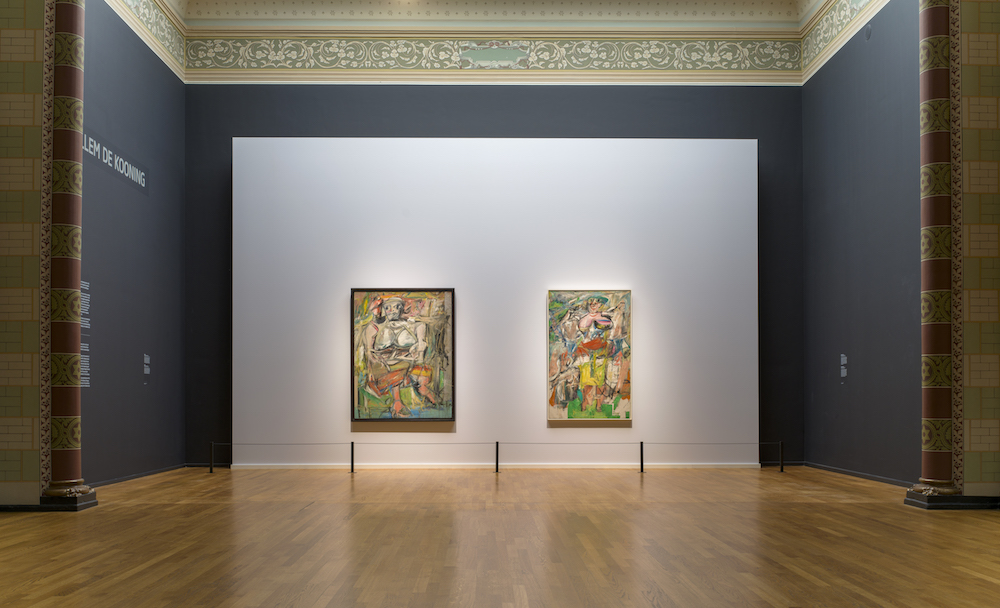
De Kooning’s Woman I and Woman and Bicycle hang for the duration, in the same long room as the Dutch masters
Born in Rotterdam in 1904, Willem de Kooning discovered drawing and painting early. As a teenager, he attended evening classes at the city’s Academy of Visual Arts and Technical Sciences, while also apprenticing at the decorative arts studio run by Jan and Jaap Gidding. The training gave him a practical grounding in design and craft, but his ambitions lay elsewhere.
At the age of 22, de Kooning hopped on a cargo ship bound for America. He arrived in New York with little more than his determination to become an artist. The early years were spent taking whatever work was available, from house painting and illustration to designing shop windows. Gradually, the commercial jobs fell away as he established himself as an independent artist.
By the late 1940s, de Kooning had found his place at the centre of the New York art scene. He became one of the defining figures of the New York School, alongside Jackson Pollock, Lee Krasner, Barnett Newman and Mark Rothko. His work helped shift the focus of international art towards New York and a new generation of American painters.
Over the following decades, de Kooning became one of the most influential artists of the postwar period. His name is closely linked to Abstract Expressionism, yet the label never quite contained what he was doing. He moved between figuration and abstraction, constantly changing his approach to line, colour and form. He resisted the idea that an artist should settle into a single style, and his career remained restless to the end. That refusal to stand still is central to understanding de Kooning. Even after achieving international recognition, he continued to test what painting could do, returning again and again to the possibilities of the drawn line.
Two books accompany the show. The catalogue, edited by the Art Institute of Chicago, carries fresh research on the drawings. The Rijksmuseum’s own volume is aimed at newcomers, and at anyone who wants to start again with him. By the late 1940s he was central to the New York School, next to Pollock, Krasner, Newman and Rothko. People call him an Abstract Expressionist. He never much liked being called anything.
Two books accompany the show. The catalogue, edited by the Art Institute of Chicago, carries fresh research on the drawings. The Rijksmuseum’s own volume is aimed at newcomers, and at anyone who wants to start again with him.
The Rijksmuseum in Amsterdam is marking 100 years of Willem de Kooning with an exhibition that opens on 9 October and runs until 17 January 2027