

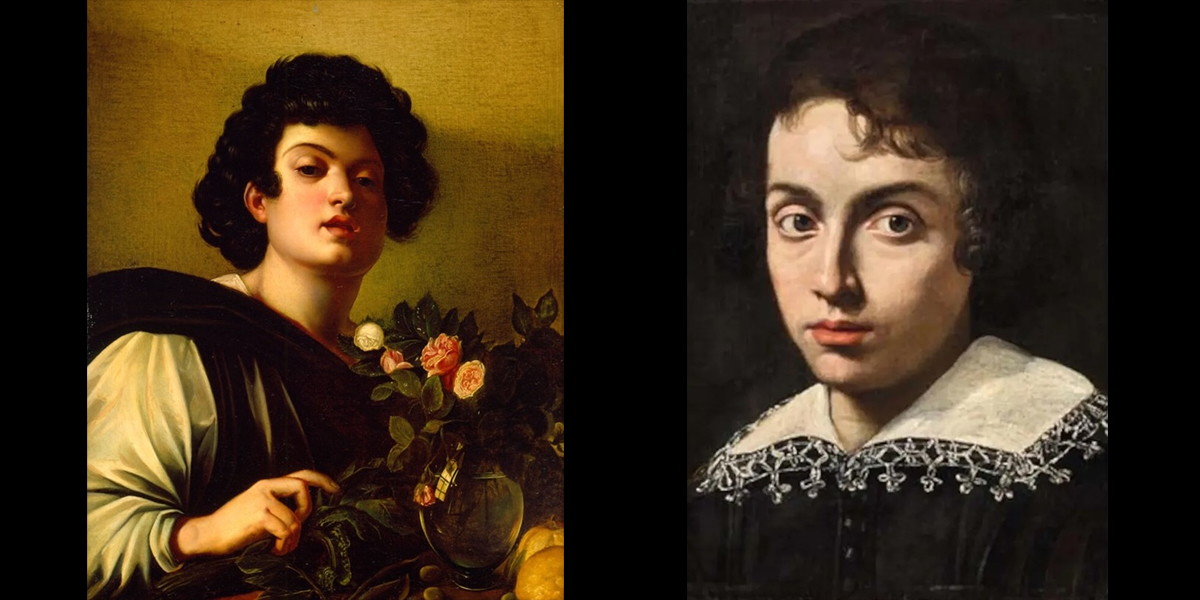
Two Italian researchers, working separately, each announced the discovery of a lost Caravaggio. Both paintings are thought to be early works.
The first claim came from the historian Gianni Papi. At a conference at the Pinacoteca Civica in Montepulciano on 7 November, he declared a dark portrait of a young man to be by the Baroque master. The canvas had been catalogued as Tuscan school, sixteenth century. It sold at the Dorotheum in Vienna in 2017 for €3,810, about $4,300. Papi has said nothing more for now. His findings will appear in the conference proceedings when they are published, according to the Italian outlet Finestre sull’Arte.
He has form. Last year he proposed what he called the earliest known Caravaggio, a modest picture of a boy peeling fruit, dated to 1592 or 1593, when the painter was around twenty.
The second announcement followed a day later. Maria Cristina Terzaghi, a professor at Roma Tre University and co-curator of last year’s Caravaggio exhibition at the Palazzo Barberini in Rome, told La Repubblica that she had traced Young Man with a Vase of Roses to a private collection in France. The composition was known only from copies and from a description by the painter Giovanni Baglione. The original had been missing for nearly two centuries.
Terzaghi says she found it some years ago, in the back room of a Paris gallery. It was covered in grime. She knew it at once. In her Sunday piece for the paper, she set out why she thinks it is the original and not one of the copies that have puzzled scholars for decades.
Her case rests on quality. She points to the boy’s extraordinary face, his moist eyes, the iridescent whites of his shirt and the marvellous still life. These, she says, leave no doubt. She now dates the picture to around 1596 or 1597.
There is also a link to another work. In the Barberini catalogue, she noted that the composition resembles The Boy Bitten by a Green Lizard, from 1593 or 1594, of which two versions are thought authentic. That boy recoils in shock. The young man with roses is calm, perhaps even sorrowful.
The paper trail helps. The painting once belonged to Cavalier d’Arpino, who worked in Caravaggio’s workshop around 1596. His collection was seized in 1607, in exchange for his freedom during a criminal trial for grievous bodily harm. Pope Paul V passed it to his nephew, Cardinal Scipione Borghese. It stayed in the Borghese collection until at least 1831 and was auctioned in Paris in 1909. How or why it left Italy for France is unknown.