Barcelona’s CCCB Takes On the Atom: Nuclear science didn’t arrive with the bomb. The CCCB in Barcelona wants that understood, so The Atomic Age starts much earlier, in the 1890s, when physicists began to find out that the atom wasn’t the end of the line. Matter turned out to be less solid than anyone had assumed. Artists noticed.
The exhibition has close to 250 works. Paintings, drawings, photographs, video, installations, and some documents that haven’t been published before. It started life at the Musée d’Art Moderne de Paris, curated by Julia Garimorth and Maria Stavrinaki, and Maria Ptqk has reworked it for the Barcelona audience.
Spain’s own nuclear story gets space, including the first power plants built under Franco and the current debate over whether the country should phase out nuclear power altogether. The show runs through three sections, though it doesn’t treat them as sealed rooms—the first deals with the atom itself. Once science showed that reality was shakier than it looked, painters had less reason to copy what they saw. Hilma af Klint sought invisible dimensions and tried to bridge science and mysticism. Loie Fuller read radioactivity as a new kind of energy and put it into her dancing. Pierre Huyghe has since filmed a performance that revives her. Sigmar Polke worked with uranium salts and photographic material, which is about as direct as it gets.
This part also covers how casually radioactive substances were sold—medicine, farming research, everyday products. Advertisements lent by the Musée Curie show the sales pitch. Then the Radium Girls, women who were poisoned by radium while working in American clock factories in the 1910s and 1920s. Aline Bovard photographed a comparable case in Switzerland.
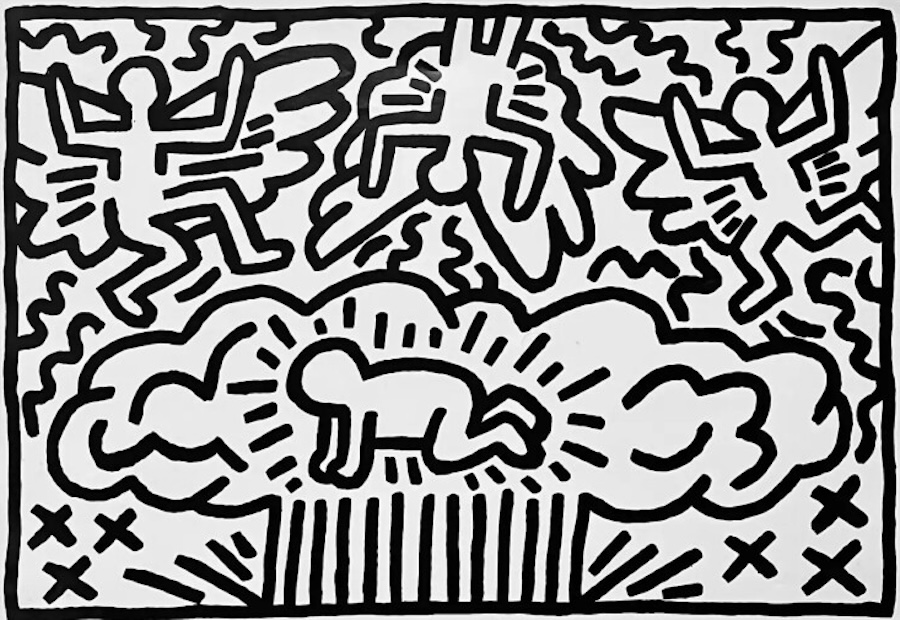
Image: Keith Haring, “Anti-Nuclear Rally”, 1982. Collection of the Estate of Keith Haring © Estate of Keith Haring
The bomb takes over the second section. August 1945, Hiroshima and Nagasaki, and after that art, science and politics were tangled together in a way they hadn’t been before. Western artists took the energy of the new physics as formal material, and the mushroom cloud, repeated through test after test, hardened into a cultural image. People got used to it. That’s part of the point being made here: the consequences were trivialised along the way. In Japan, the response ran differently. Art became a main route for dealing with the aftermath, and from the 1960s anti-art collectives went after the United States and its pact with Japanese militarism.
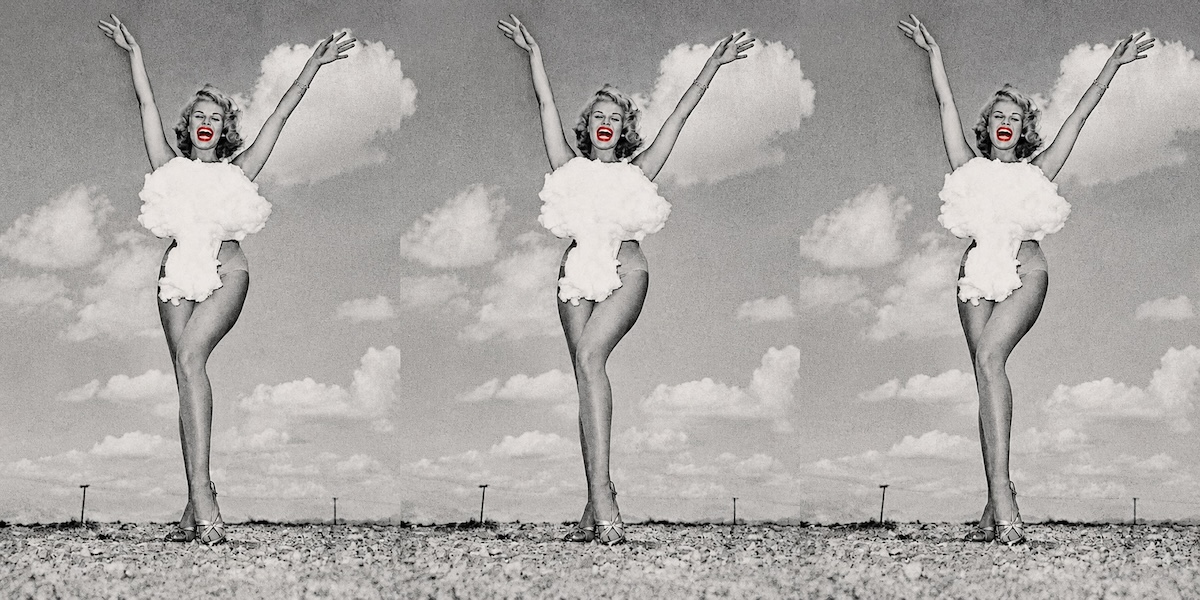
Expect photographs from the Manhattan Project and the aftermath in Japan, among them Yoshito Matsushige’s pictures taken on the day of the Hiroshima bombing, shown with drawings made by victims. Asger Jorn, Dalí, Roberto Matta, Piero Manzoni and Hessie answer in paint. Isidore Isou and Liliane Lijn use other media. Nevada test photographs show how the American government turned explosions into spectacle and propaganda, and Bruce Conner, Beatriz Caravaggio and Helga Fanderl contribute film work. Shelters and power plants close this part, through drawings by Claude Parent and Vladimir Yankilevsky and photographs by Javier Arboledas, Jürgen Nefzger and Manolo Laguillo.
Section three is where the mood shifts. By the 1960s, people were thinking about nuclear technology in ecological terms. It was a chain of mining, testing, reactors and waste. Chornobyl in 1986 and Fukushima in 2011 left a deep mark, denting the old story of the good atom that governments liked to tell. In Europe and in American counterculture, artists joined the anti-nuclear movement, often from feminist, ecological and anti-colonial positions, using posters, performance, graphic design and cinema.
The places matter here. Shinkolobwe, the source of the world’s richest uranium, inspires Roger Peet and Sammy Baloji. Elisabeth Leuvrey looks at the French nuclear tests in the Algerian Sahara. Fritz Goro’s autoradiographs document the effects of the Operation Crossroads tests on animals in the Marshall Islands. Sisters of Survival, Yayoi Kusama and Nancy Spero stand for the feminist and anti-militarist strand between the 1960s and the 1980s. At the same time, eighties protest posters by Antoni Tàpies, Eduardo Chillida and Keith Haring carry it forward.
Chornobyl is represented by original material from Viacheslav Fedorov, who ran the liquidators there. Natacha Nisic, Sabine Moritz and Kota Takeuchi respond to Fukushima. Jordi Bernadó, Fernando Cremades, Jessie Homer-French, Miriam Cahn and Cornelia Hesse-Honegger finish things off with work about living with radiation. Hesse-Honegger’s contribution will interest anyone who follows the science, since her subject is the effects of low doses on insects.
Other names in the exhibition: Yoko Ono, David Lynch, Peter Watkins, Enrico Baj, Antoni Tàpies again, Raymond Pettibon, Joan Rabascall, Marisa González, Susan Schuppli, Viktor Kossakovsky. A long list, certainly, and not every artist on it will get the same room.
The curators say the subject is still relevant. Waste still has to be stored somewhere, and the ecological crisis hasn’t eased. Tensions between states haven’t either. That’s their case for showing this now, and given the dates on the wall labels, it’s hard to argue with it.
The Atomic Age: CCCB — Centre de Cultura Contemporània de Barcelona Carrer de Montalegre, 5 08001 Barcelona Spain 26 November 2026 to 17 May 2027
Top Photo: Image: Jack Pepper (Las Vegas News Bureau). “Miss Atomic Bomb in the Las Vegas desert”, 1957 Courtesy of the archives of the Las Vegas Convention and Visitors Authority