After a Decade and £437 million, the London Museum opens its new home on Saturday 28 November. The building is the Victorian General Market at Smithfield, and getting it ready took ten years. The permanent galleries are free.
Funding was provided by the museum, the City of London Corporation and the Mayor, Sadiq Khan, and by Bloomberg Philanthropies, Goldsmiths’ Foundation, the Linbury Trust and National Lottery Heritage Fund. The lead architects on the project were Stanton Williams, Asif Khan Studio, and Julian Harrap; the conservation architects and cost £437 million.
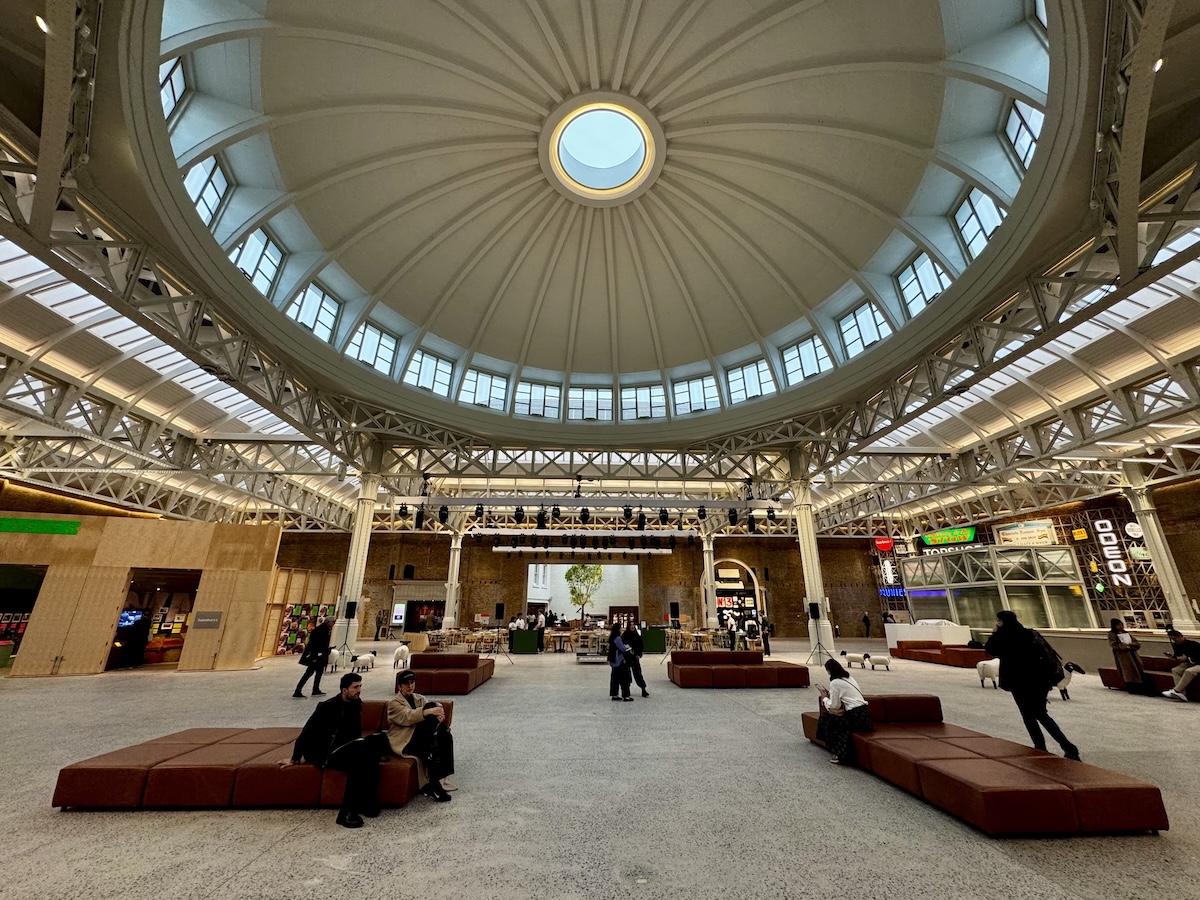
The original market opened in 1886 and was designed by Horace Jones (designer of Tower Bridge); it continued trading until the 1990s, after which it became derelict. So this major restoration and adaptation returns the market to general use after over 30 years. Over 70 different trades have been involved, with more than 40 new apprentices employed since early 2023 in a wide range of skills. They include all three remaining heritage coppersmiths in Britain, as well as stonemasons and blacksmiths from Wales. The aim is for the whole building to achieve BREEAM Outstanding, a standard achieved by fewer than 1% of buildings worldwide.
There are three principal areas of the museum: Real Time, Our Time, and Past Time. Real Time occupies a series of arcaded streets. Various aspects of the current state of the City and its inhabitants will be displayed on screens, including the total number of pubs and bees, as well as Londoners’ general feelings and music preferences. Broken pottery fragments and old clay smoking pipes appear on the surface of the original street. Piranhas, one of Banksy’s animals, in a sentry box, dates from 2024. In a small clock tower is one of the final bells made at the Whitechapel Foundry, used to signal the museum’s daily opening.
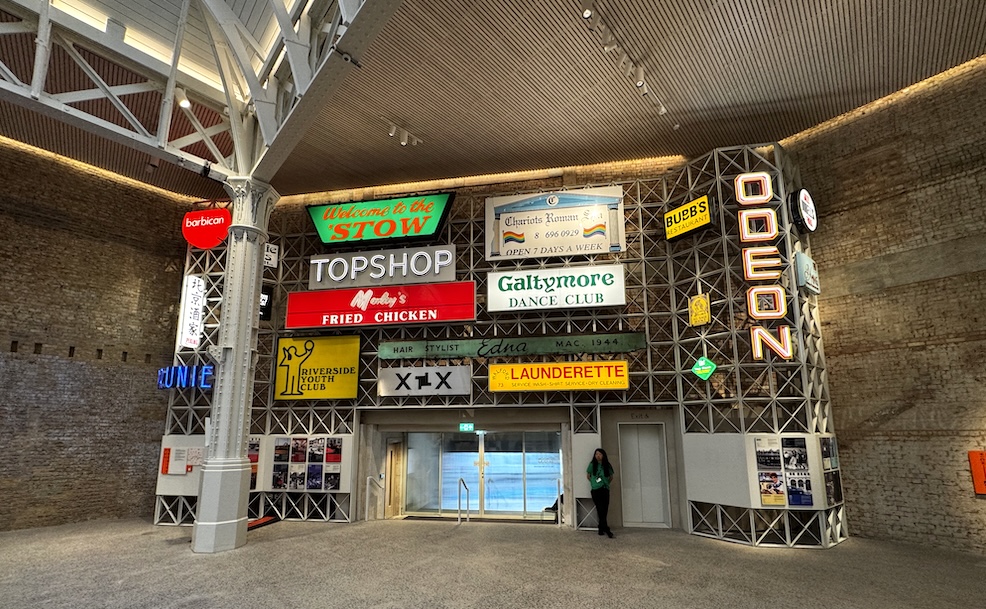
Illuminated Signs, Our Time, London Museum
Our Time occupies most of Linbury Hall, formerly the main area used for trading, light and spacious. Many of the facilities for visitors are here: a cafe, a restaurant, and a shop, plus a flexible showspace particularly suited to children and school groups. 13 installations explore various ways people come together. As well as the State Coach, used for the Lord Mayor’s procession since 1757, there will be the main switching equipment from Buckingham Palace, since 1970 and never previously displayed; and Syd’s Coffee Stall, which has been selling and giving away hot drinks in the East End for about 100 years (currently provided by Rare Tea). Places to hang out, 20 examples, include Galtymore Dance Club, Fabric, Topshop, and Morley’s Chicken Shop, Sydenham, one of the originals. Children and teenagers feature prominently, being the subject of a wide-ranging collection, the first undertaken by the museum, targeting Generation Alpha. Various sounds, including buses and Big Ben, have been combined into compositions by Scanner, and a variety of scenes of groups of people, street festivals, and demonstrations appear in the film The London Crowd by John Ogunmuyiwa.
A wide range of events and displays will take place at different times of day. Between November 2026 and August 2027, the theme will be food, under the title London Tastes, devised by Guest Editors Ruby Tandoh and Jonathan Nunn of Vittles, with sponsorship from Sainsbury’s. All kinds of markets will be represented, together with other specialities such as pie and mash and all sorts of chicken shops across the breadth of the modern greater London, from Enfield to Southall and Walworth. From December, there will be late evenings on Friday and Saturday featuring Morley’s and DJs. London Reprezent will be providing monthly House Parties from February 2027, and a Dinner Club will also be held monthly. Storytelling for all ages by N. Sethia will begin in November in the Showspace; regular events by Punchdrunk Enrichment will begin in January 2027.
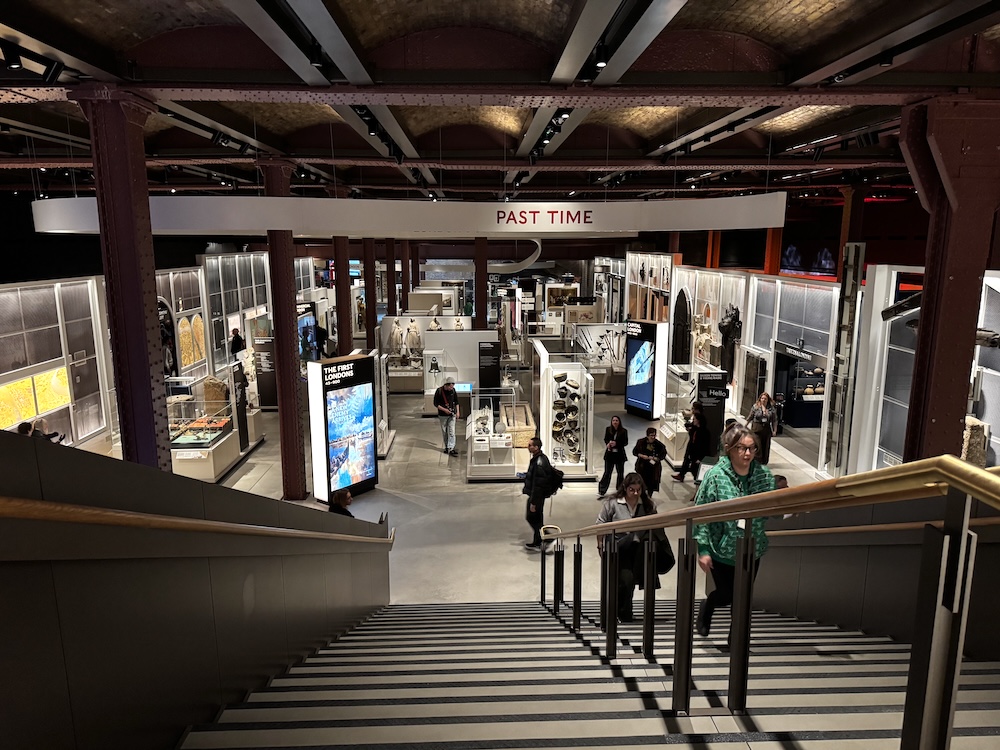
Past Time, London Museum Smithfield
The main display of the collection, Past Time, is below the main floor level, spanning about 2,000 years from early settlements on the banks of the river to modern world-city London. It is sequenced both chronologically and thematically. Important collections include examples of 16th-17th-century gold and silverwork from the Cheapside Hoard and an offcut of Fatberg from Whitechapel. Both the Bowes Cup, probably brought to the banqueting hall for Elizabeth I’s coronation in 1559, and a length of painted Roman wall, uncovered in 2007, are being displayed for the first time, the latter following some 400 hours of conservation. Exhibits previously displayed, such as the trunks worn by T. Daley when he won gold in 2012, a plate from Pepys’s dinner service and the original Selfridges lift, will be back. Other objects include inscriptions on Roman tiles and other materials from the Bloomberg collection; a bone inscribed with runes from Lundenwic; a vest probably belonging to Charles I when he was beheaded; brick and other material from buildings destroyed in the Great Fire, and Bills of Mortality. The East India Company and other items, including Equiano’s life and mementoes, illustrate aspects of Empire. Objects relating to the 2012 Olympics and Paralympics, including the torch, costume and a painting of M. Farah, bring it up to date.
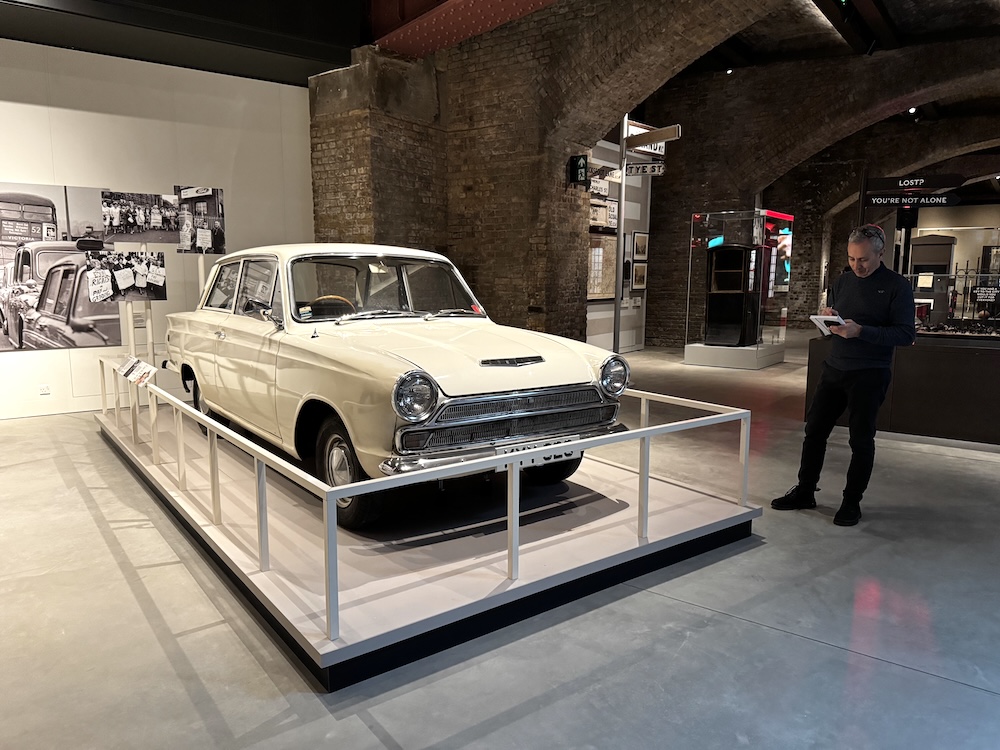
Ford Cortina 1965. Launched by the Ford Motor Company in 1962, the Mark 1 Cortina became the great success story of London manufacturing in the 1960s, when more than one million were produced. It could reach speeds of 95 mph and was reliable, inexpensive and robust.
This version was made in June 1965 and includes an air flow dash, one of the first heating and cooling systems of the time.
It was owned by a doctor living in the Barbican, east London.
Demonstrations and various forms of protest are well represented, for example the extensive Votes for Women collection, one medal from which was worn by E. Pankhurst after a hunger strike, and several portraits of members of the Sons of Africa by Ajamu X. A wide selection of items relate to music, from P. Simonon’s broken bass guitar (London Calling) to a Dickens chair, costumes worn by Kitty Lord, tablas played by K. Bhamra and the Dying Swan ballet dress of A. Pavlova. Various opportunities for participation include ‘visiting’ a Roman tradesman, experiencing the progress of the Great Fire depicted over many walls, and tracing animals around the gallery. There is even an enormous window where travellers on the Thameslink can be observed.
A further area of about 800 sq m comprising several vaults, uncovered during investigations in 2019, will be available from spring 2027, initially for an exhibition about Londinium. Further areas will be made available as the Poultry Market from 2028, comprising show space for special exhibitions, educational facilities, and stores.
Several catering facilities have been designed by Green and Fortune and Robin Gill, including a daytime restaurant (Clerk’s House), a bar (Bartholomew’s, featuring some signature Mr Lyan drinks), Temperance Cocoa Rooms (no alcohol), and The Roost (from early 2027). Artists represented in the museum shop include Nicole Chui, Supermundane, Lizzie King, and B. Ganjei, maker of a clock with an appropriate exhortation.
It is estimated that more than 100,000 individuals have contributed in some way to the museum’s creation, according to its Director, S. Ament. The Mayor regards it as one of the largest-scale cultural developments in Europe, and C. Hayward (City of London Corporation) anticipates visitor numbers of around 2 million per annum.
The London Museum Smithfield, Free, open daily from 10 am – 6 pm, Sunday to Thursday.
Reflecting the capital’s 24-hour spirit, the doors will stay open late every Friday and Saturday, from 10am – 11pm.
Visit Here
Photos: Sara Faith ©Artlyst 2026