
On December 8th, Sotheby’s is staging the first auction dedicated solely to Claude and François-Xavier Lalanne, the French duo whose imaginative animal sculptures have shifted from the periphery of design to commanding centre stage. Over 30 pieces from various private collections will go under the hammer under the banner Les Lalanne: Beyond Imagination. The auction house is projecting revenues around $25 million.
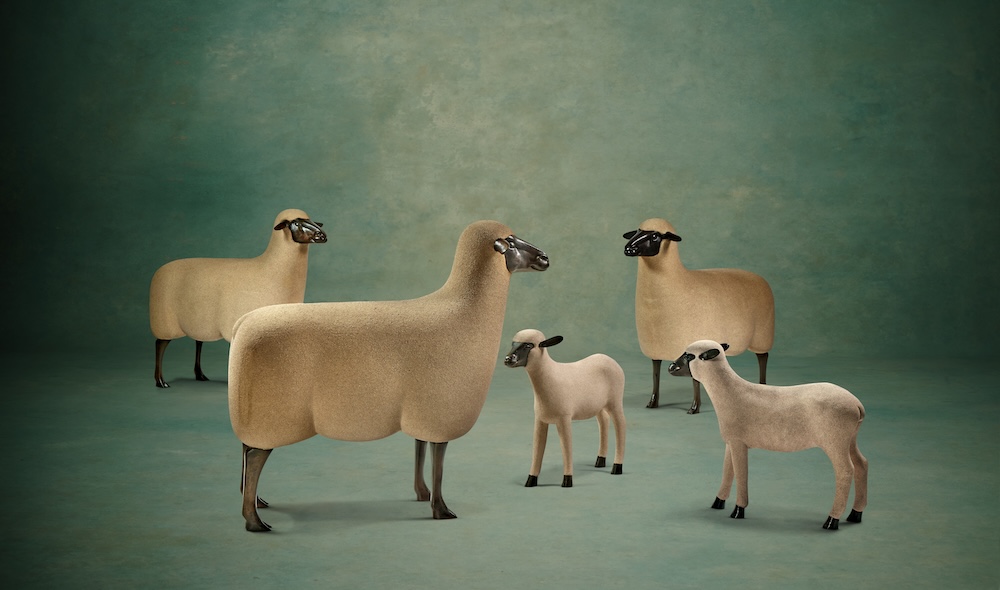
The market has been heating up steadily throughout the year. Back in April, one of François-Xavier’s woolly sheep sold for $2.3 million. During the summer months, a quartet of his frog fountains was valued at $3.5 million but ultimately fetched nearly $6.3 million. Then came the bombshell: a pair of bronze mirrors decorated with flowers, crafted by Claude, sold for $33.5 million earlier in 2026—a record for any design collectable. This eclipsed the $31.4 million that François-Xavier’s hippopotamus bar had commanded.
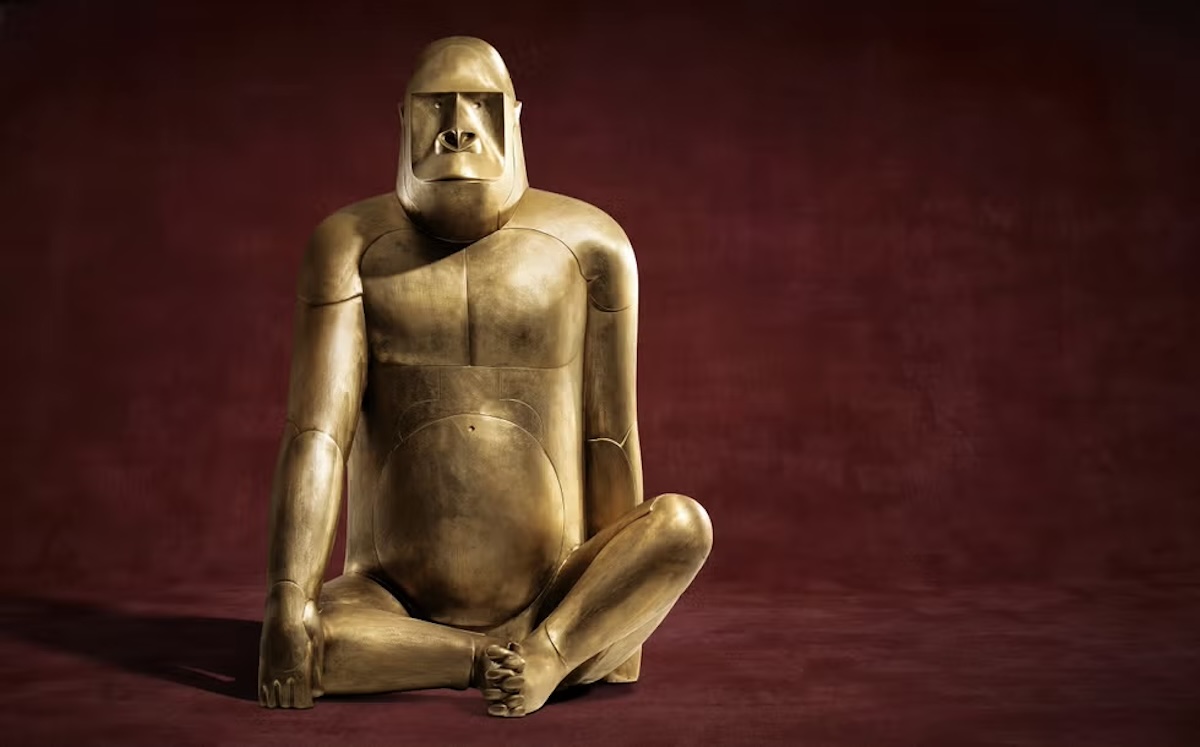
The star of the December auction is his gold-patinated bronze Gorille de Sûreté I, with estimates ranging from $8 million to $12 million. A white marble owl titled La Dame Blanche is estimated between $4 million and $6 million. Five sheep sculptures will be auctioned off, including two lambs estimated at $300,000 to $500,000 apiece.
A pair of bronze monkeys, Singes Attentifs I and II, feature a deep green patina with an almost jade-like shimmer. Each carries an estimate of $800,000 to $1.2 million. Two matching crocodile consoles, priced at $700,000 to $1 million, reference the crocodile chairs Claude produced after receiving a specimen from the Paris Zoo. A pair of Claude’s Bambiloba settees are estimated at $400,000 to $600,000 each.
According to Jodi Pollack, Sotheby’s chairman of twentieth-century design and major collections for the Americas, the couple has become a global sensation. Their influence, she contends, has fundamentally altered how collectors across generations approach design. A sheep can serve as seating. A crocodile can function as a console. Both belong in serious collections alongside masterworks without any hesitation.
That distinction really matters. Years ago, animal-shaped furniture might have been dismissed as whimsical. Now a Lalanne sheep sits naturally in rooms with important paintings, and collectors bid accordingly.
From December 2nd through the 7th, visitors can view the entire collection at the Breuer building, Sotheby’s latest Manhattan home. The auction commences at 11 am on the 8th. For the event, Sotheby’s tapped Milan-based artist Gaia Alari to design the catalogue. The result reads almost like a storybook. Pollack explains that the narrative unfolds on the page and continues throughout the Breuer, where visitors journey through an enchanted winter garden and encounter the sculptures. The vision, she notes, is to perceive ordinary things as Claude and François-Xavier did—discovering the magic within the everyday.
An unconventional partnership for the postwar era, the two artists met in Paris in 1952 and wed in 1967. When abstraction dominated with its austere sensibility and detachment from real life, they chose a different path: nature. Their creations blended poetry, surrealism and utility. You could sit on them, bathe in them or drink from them.
François-Xavier, born in 1927 and died in 2008, started as a painter trained at the Académie Julian. He also worked as a museum guard at the Louvre, where ancient Egyptian and Assyrian animal sculptures profoundly shaped his artistic vision. His studio neighbour, Constantin Brâncuși, encouraged him to pursue sculpture. He embraced this direction, transforming creatures into functional objects. His wool-draped sheep became seating. A life-size rhinoceros transformed into a desk. His hippopotamus concealed a bathtub and bar. His forms were spare and witty.
Claude, who lived from 1925 to 2019, studied architecture and decorative design. Her sensibility was more delicate and naturalistic. She worked directly with plants and animals, perfecting electroplating and bronze casting methods to preserve intricate botanical features in metal. She created across jewellery, furniture and sculpture. Chairs with cabbage-shaped legs, benches modelled after ginkgo leaves and mirror frames tangled with branches all emerged from her studio. The fashion world also recognised her talent—she notably created body sculptures for Yves Saint Laurent.
They maintained a shared residence in Ury, a village near Paris, and exhibited as a pair from their debut show in 1964, called Zoophites. However, they maintained separate workspaces and created independently. Each maintained their own distinctive aesthetic. What unified them was deep respect for nature, a sharp sense of humour, and an unwavering commitment to craftsmanship.
Their pieces now occupy major museums internationally. At auction, their work consistently shatters records and has subtly dismantled the boundary between high art and decorative design. The December sale will reveal how far collectors are willing to push their enthusiasm.
For those unable to attend, the works will be on display for just one week before the sale. It’s a brief window of recognition, long overdue.