Lisson is presenting a solo exhibition of new sculptures by Tony Cragg. The exhibition brings together a selection of animated and gestural configurations which, as Cragg himself describes, “are like drawings in space”, communing with one another while still maintaining a hard-edged materiality. Cragg’s focus is on the expressive use of materials rather than direct representation, harnessing the possibilities of movement, mass, and molecular arrangement that are inherent in all matter. I met the artist at Lisson Gallery to discuss this new body of work; at 76, he shows no sign of slowing down…
PCK: Tell us about the use of material here – you have focused on manufacturing sculpture from patinated bronze, reflective stainless steel and Corten steel:
TC: It’s what I’ve been working with – all the works in this presentation result from what I’ve been thinking and doing in the last three years, since my last show with Lisson Gallery. And that’s the idea behind this exhibition: to continue my discourse with the public here in the UK.
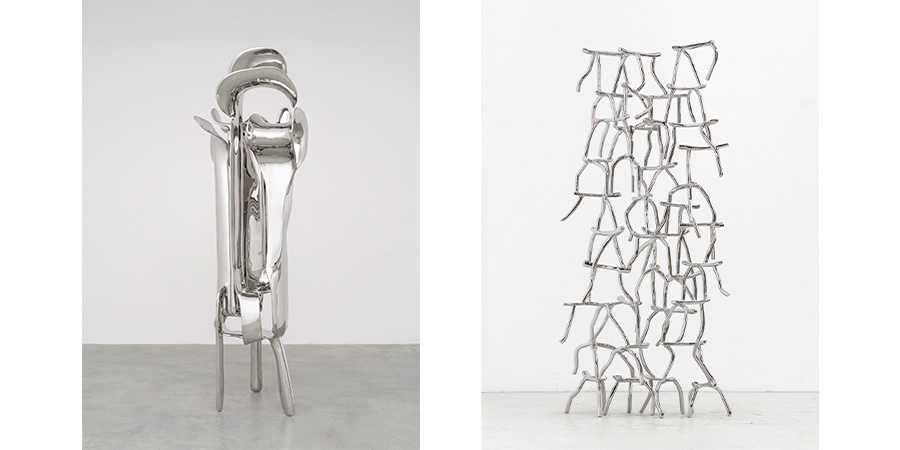
Tony Cragg: Incident, 2023 – Stainless steel, 185 x 84 x 87 cm and Incident, 2025 – Stainless steel, 230 x 73 x 71 cm
The ‘Incident’ series are made from steel. Can you tell us about that process?
I work with polyurethane, a soft yet firm material that can be carved very accurately. It’s like drawing in space, in three dimensions. There’s no plan, I just get on with it. I love drawing for its own sake, but these are not based on preparatory drawings. From that polyurethane form, we make a scaled-up mould and then cast it traditionally. I use technology in the manufacturing, not the design – computers are involved in the scanning to create a digital mould. Steel has historically been an industrially-formatted sculptural material, and it looks very constructed, somehow – as with Vladimir Tatlin, Eduardo Chillida, Mark di Suvero, Anthony Caro – but I wanted these to be fluid, to look more natural than industrial. Steel is a strong material – that’s what it means, ‘strong’. So what’s holding it up can be very thin, so thin it would break were it bronze. I am making the most of steel’s material properties. And you can do things with it that you can’t if you just stack things up – you can have poise, balance, a kind of internal dynamic.
They can appear like water?
Yes, stainless steel especially suggests a sense of water because it denies itself, and you can see the surroundings rather than the material.
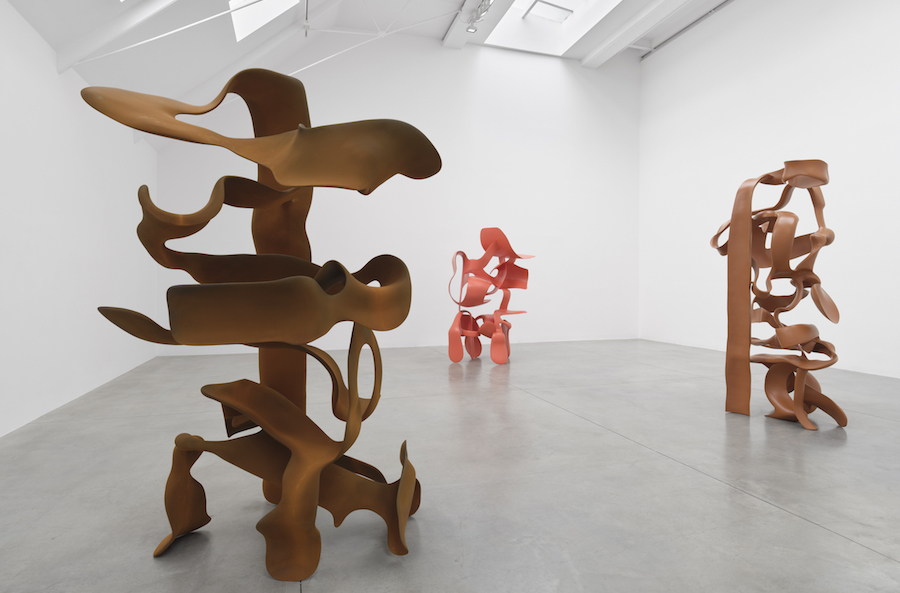
Tony Cragg: Installation view with Path, 2025, at front – Path, 2025 – Corten steel, 236 x 151 x 106 cm
All the works are vertically inclined, as if creating groups of figures?
They are vertical, so one could imagine that they have a figurative quality. For me, they are much more to do with the landscape, but everyone sees what they fancy! ‘Path’ is like a track up a mountain, also a course of events. I start very irrationally, not knowing what I’m doing, then build it up. Just as history is building itself up all the time, but you don’t get to a point of recognising what it is until you call it history.
The ‘Stand’ works are a contrast with ‘Path’ and the ‘Incident’ series?
They are more solid volumes, and that works for me in this size. They have at least three legs, as do all three series, as that is the minimum you need for stability – even when we stand, we are actually on at least three points across the instep and heel. They become pretty static, but have more volume than ‘Paths’ and ‘Incidents’, which are more dynamic. The ‘Stands’ did come, like the paths, from wanting to extend into space like a drawing, but where ‘Path’ really is like a drawing, here the edges turn into flat surfaces. Out of one thing come two directions.
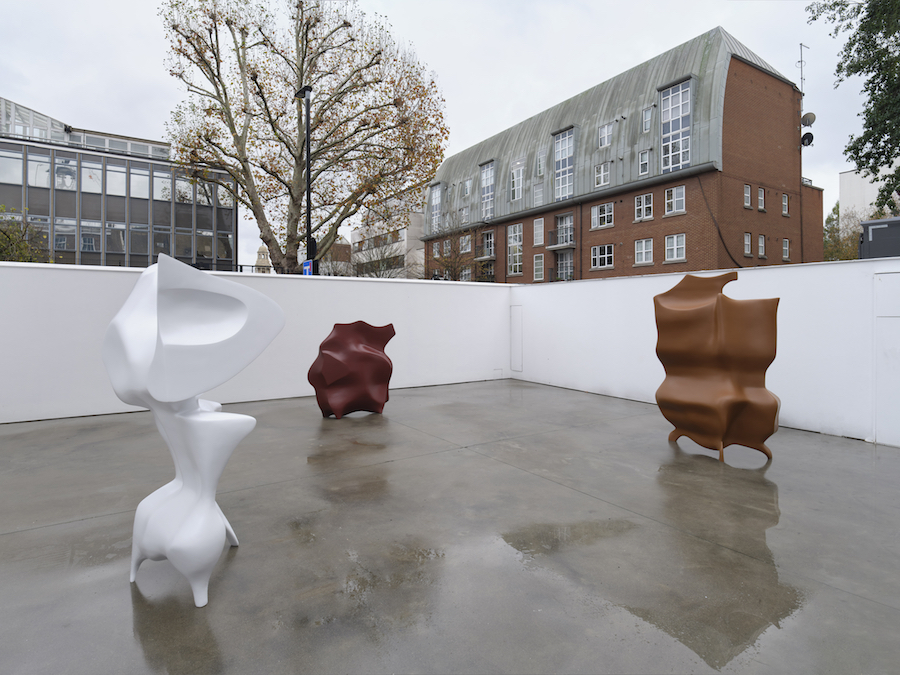
Tony Cragg: Installation view with ‘Stand’ works
The ‘Stand’ works are of painted bronze. How did you decide the finish on these?
When I made the first one, they put on the undercoat, and I thought, ‘It looks perfect in white!’ So I kept that, though it isn’t actually the undercoat you see now. There are smaller versions in steel and rust, and I kept the others in the identical spectra of browns and greys – oxidised metallic or mineral colours.
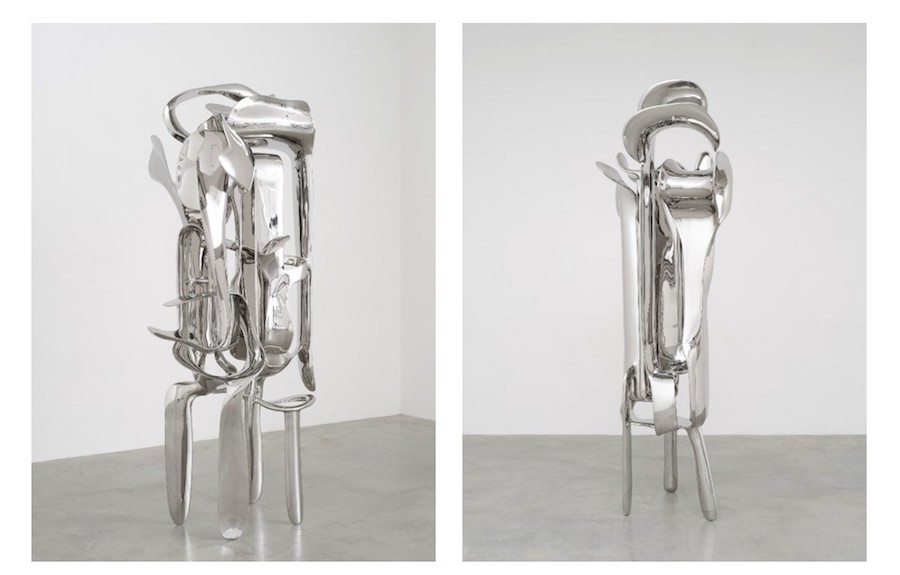
Tony Cragg: REM, 2025 plus detail – Stainless steel, 220 x 52 x 99 cm
Can you tell me about ‘REM’ and the meaning behind this work?
Yes, ‘REM’ is about the unease of that time when you’re trying to sleep. The work is based on an African headrest that I’ve got, close to the tree branch from which it’s carved, and somehow using the three-legged combination again. The headrest looks very animal-like. They are brilliantly made things, very sculptural, with minimalist structural functionality. But the headrest is just a starting form, there is no literal casting – everyone is different. Being a terrible sleeper, this sort of pattern seems to vibrate in my head.
You have pursued sculpture very consistently for half a century – what is it that has drawn you to this medium for this time?
I love sculpture, and not just my own. I’ve been making sculpture for 55 years, and that’s what I’m obsessed with in a way. For me, there is just sculpture. I like to spend as much time as I can in the studio.
And you never seem to run out of ideas?
The materials drive me. Good ideas do often not result in good art. Or even, rarely do. My recent book, titled ‘A Line of Thought’ – for which Jon Wood wrote the text – looks at my work from the very beginning. We wanted to produce a book that, rather than aiming to record all the work, reflects the line that goes through it. People think there are breaks, but in my mind, I know exactly how and why each thing leads to another, even if the continuity still surprises me.
Tony Cragg is at Lisson Gallery from 19 Nov 2025 – 31 Jan 2026. He also has an exhibition titled ‘Line of Thought’ at the artist-founded Skulpturenpark Waldfrieden, Wuppertal, Germany, to Jan 1 2026.
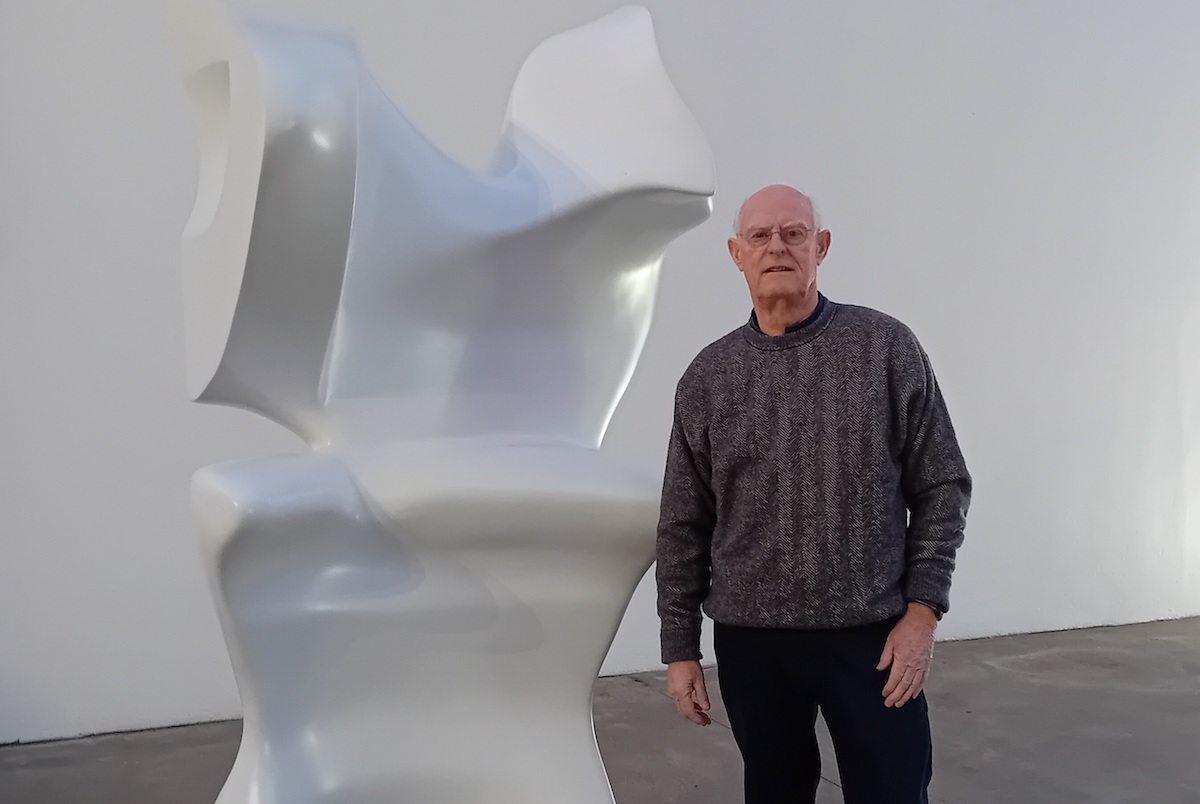
Top Photo: Tony Cragg with Stand, 2025 – Bronze, 220 x 75 x 127 cm
Images provided by Lisson Gallery; portrait Tony Cragg © Paul Carey-Kent first published Artlyst 2025
Read More
Visit