There’s something different about staging a show in rural Somerset that leans into the simplest of children’s games. CLOSE has taken Rock Paper Scissors as both title and provocation — a reminder that creativity often begins with nothing more than instinct, a bit of friction, and whatever materials you can get your hands on. The exhibition gathers eleven artists whose practices orbit around touch, choice, and the stubborn magic of raw matter. It sounds straightforward; it isn’t. The simplicity is the hook, not the whole story.
This exhibition fits neatly into CLOSE’s ongoing rhythm. Since Freeny Yianni founded the gallery in 2019, the programme has championed material experimentation and long-form engagement, steering contemporary art away from the hyperactive churn. Rock Paper Scissors carries that ethos forward, reminding you how much meaning can reside in a handful of elemental things.
The premise borrows from the schoolyard, yes, but CLOSE treats that triangle of moves — cut, cover, crush — as more like a philosophical loop. Each artist pushes at that idea of decision-making through things: stone, wood, feathers, clay, textiles, and fragments pulled from just about anywhere. The works are stripped back, often unguarded, and they carry that rare sense of materials speaking first and artists responding second. It’s a show that’s more about negotiation than spectacle — the slow, sometimes awkward dance between what we imagine and what reality allows.
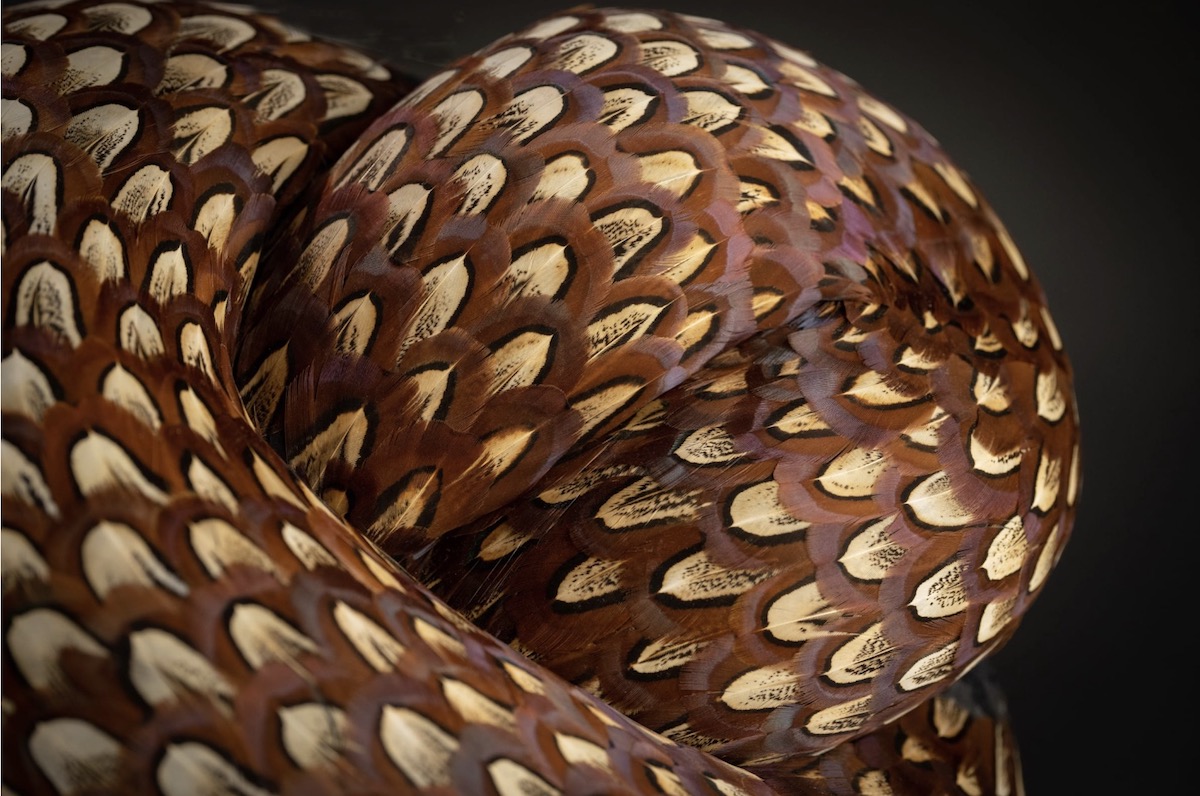
Across the galleries, the language is tactile. You see it immediately in the feathered forms of Kate McGwire, whose sculptures sit somewhere between creature and relic. They’re muscular without being brutish, and they feel like they’ve grown rather than been assembled — even though every feather has been collected, cleaned, and wrangled into place by hand. Feathers, normally signifiers of delicacy or flight, become dense, almost confrontational surfaces. They resist you a little, which is half the pleasure.
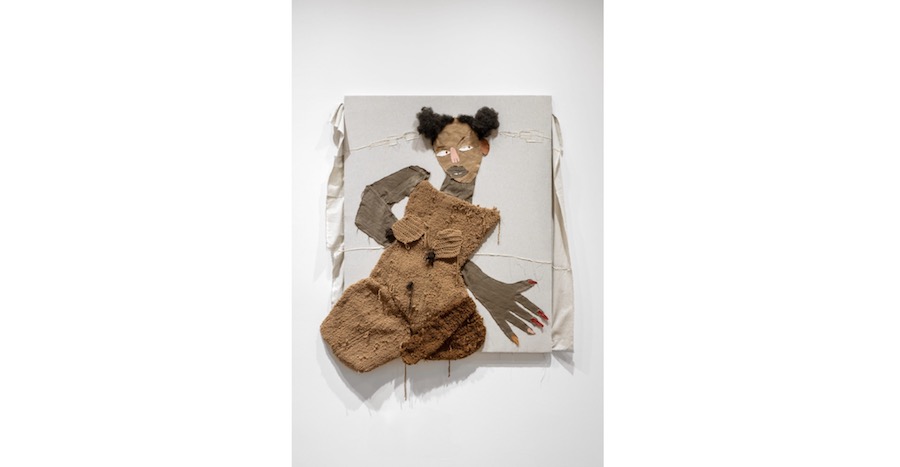
Nearby, Anya Paintsil delivers two new textile works. She pulls together denim, leather, wool — tough materials that don’t soften easily — and turns them into something simultaneously tender and fierce. Her blend of Welsh craft traditions and techniques rooted in West African textiles gives the pieces a deep sense of lived history. They feel inhabited, as if the fibres themselves remember previous lives. Paintsil’s work always hits on the politics of labour and legacy, but here it also folds into the show’s theme of playful decisiveness: how a piece of fabric becomes more than fabric once a hand intervenes.
The Somerset setting gives everything an extra beat of silence, enough to notice slight shifts in tone. Darren Appiagyei approaches wood with the patience of someone delicately balancing works carved from locally sourced materials. His pieces – some almost impossibly airy, others weighty as anchors – test the line between solidity and fragility. You have to lean in to see how far he’s pushed each form without snapping its logic.
Susanna Bauer works on an opposite scale but with equal intensity: tiny leaves repaired and embellished with crochet so delicate it feels like a secret language. Her work almost disappears if you glance too quickly — which, in an age of constant scrolling, is precisely the point.
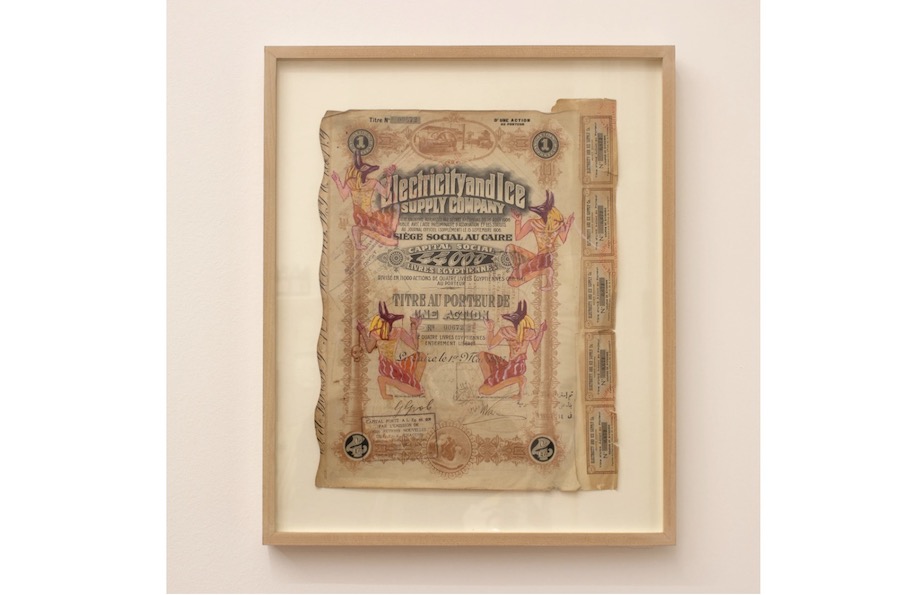
Threaded through all this are artists who expand the material repertoire outward. Hew Locke OBE RA, long known for his layered, idiosyncratic investigations of power and empire, brings a different register of symbolism into the room. Peter Randall-Page’s stone and clay forms anchor the show in the geological, the ancient, the patiently evolved.
Nicholas Lees refines porcelain into near-weightless gradients, so thin they seem to be made of light rather than matter. Dean Coates treats ceramics as a geological event — glazes reacting, surfaces erupting, colours blooming under heat. Amy Stephens bends photography, geology and sculptural form into objects that feel halfway between architectural fragment and landscape memory. Alice Freeman rounds out the group with works shaped by both British and Italian contexts, a practice sharpened by excavation — literal and metaphorical.
It’s a rich spread, yet the show stays coherent because the material logic holds tight: transformation, vulnerability, resilience, and that persistent tug between control and surrender. Just like the playground game, every gesture dominates something and gives way to something else.
CLOSE’s Somerset site — quiet lanes, soft light, that slightly stretched-out feeling of time — amplifies these tensions beautifully. The galleries don’t compete with the work; they give it breathing room. And that’s part of CLOSE’s whole ethos. Since Freeny Yianni founded the gallery in 2019, it has operated with a curator-led attentiveness that’s increasingly rare. It isn’t a space chasing headlines or quick-turn programming. It’s built on long-form thinking, residencies, and conversations that unfold slowly. Even the satellite project space in Marylebone feels shaped by that same rhythm, though filtered through an urban lens.
This exhibition marks another of CLOSE’s quietly ambitious expansions: CLOSE Collections, a new shop offering artworks, editions, and objects that extend the spirit of the show. It’s not merch; it’s more like an open invitation to keep the conversation going at home—a way to continue the game in miniature.
What becomes clear as you walk through Rock Paper Scissors is that the title isn’t a cute framing device. It’s a proposition: creativity begins with the simplest moves, but simplicity is deceptive. Stone beats scissors, scissors cut paper, paper covers stone — but only for a moment. Every choice sets off another. Every material has its own stubbornness. Every attempt at dominance is already slipping into surrender.
CLOSE has staged a show about that slippery space — the space where play becomes process, and process becomes something quietly profound. If you’re willing to slow down long enough, the work meets you halfway.
Artlyst Chats to gallerist Freeny Yianni, who founded the gallery in 2019
AL: CLOSE leans into a slower, rural rhythm. How does that environment actively shape the kind of work you choose to show — and the way artists produce during residencies?
In Somerset, time stretches differently. The days feel longer, the air is quieter, and that quietness has a way of revealing what’s essential. We gravitate toward work that derives from Nature and is contemplative, and that asks for contemplation rather than quick consumption. The landscape encourages artists to shed the pressure of constant output; instead, the work can surface at its own pace. The environment doesn’t just hold the job, it co-authors it.
AL: You work across both a Somerset site and a Marylebone project space. What tensions or opportunities arise from operating in two such contrasting contexts, and how do you curate between them?
Somerset is our foundation, our root. Marylebone offers a glimpse of our work in the West Country and, again, a place to gather and communicate our ideas about the visual arts, our communities, and visitors. Travelling our incredibly successful show After Nature, curated by Ben Tuffnell, from Somerset to Proposition in Bethnal Green has immediately allowed so many collectors, artists and friends to see the show, and to view this exhibition in an Urban Environment. That contrast is a productive tension. In London, we’re part of a faster conversation; ideas circulate quickly, works are encountered in passing, and the proximity to other institutions keeps us alert. We still managed to achieve a sense of warmth and connection. Somebody said it was because the work comprised artists working in natural materials. Maybe that’s true. Somerset, by contrast, allows for durational thinking, for grounding a project before it enters a more activated urban frame.
Curating between Somerset and London becomes a translation. Some works ask to begin in Somerset, where they can unfurl without interruption, and then travel to London as distilled propositions. Others originate in the city and later expand in scale or sensibility when placed against the open horizon. The nurture and rigour we apply to our work do not differ; we are constant in that respect.
AL: Your programme champions long-form exhibitions and deeper engagement. In a hyper-accelerated art world, what does sustaining that depth actually require — from you, from artists, and from audiences?
Depth is not a given; it’s a commitment. For us, it means structuring time differently, allowing exhibitions to unfold over months, not weeks, and giving artists the space to stay with a question long enough for it to begin to shift shape. It requires resisting the churn of constant novelty and trusting that slow attention yields richer understanding.
For artists, it means embracing process over product, letting research meander, and allowing works to evolve in response to place and duration. For audiences, they experience shows at the Clise of museum quality. We take chances and trust in the artist’s practice, which is key. It asks for return visits, for lingering, for the willingness to sit with something that doesn’t resolve immediately.
In a world that moves too fast, sustaining depth is an act of care for the work, for the people who make it, and for those who come seeking something that can only be found by slowing down.
Top Photo: TORQUE (detail) 2025, Kate MccGwire
Rock Paper Scissors: Close SOMERSET – 29 NOV 2025 – 17 JAN 2026
Read More
Visit