Tate Britain is presenting the first comprehensive survey of Hurvin Anderson, giving the British painter the much-needed retrospective. They’re exhibiting altogether around 80 works — the whole spectrum, from early student pieces right through to a room of fresh paintings that haven’t even had time to dry.
Anderson’s world is threaded with saturated colours, drifting between the Midlands and the Caribbean like a mind that never fully commits to one location. He’s always talked about that sensation of “being in one place but thinking about another,” and these interiors, landscapes, and half-remembered spaces all carry that faint echo. With his instinctive grasp of light, geometry and the odd melancholy of British landscape traditions, the show plants him firmly among the most significant painters working today.
Anderson grew up in Birmingham — the first in his Jamaican family to be born in the UK — and those twin geographies shaped him more than any academic training could. A residency in Trinidad added its own sharp edge. His paintings of places from his childhood often feel uncanny, like they’re slipping in and out of their own timelines. Tate leans into that dislocation, looping the display back on itself. Family photos, teenage sketches, portraits of relatives: these open the story. There’s Bev (1995), his sister doubled as both girl and adult, and Hollywood Boulevard (1997), a moment with his father, recast through memory. Anderson is a natural at collapsing past and present, building imagined support systems from the fragments that remain.
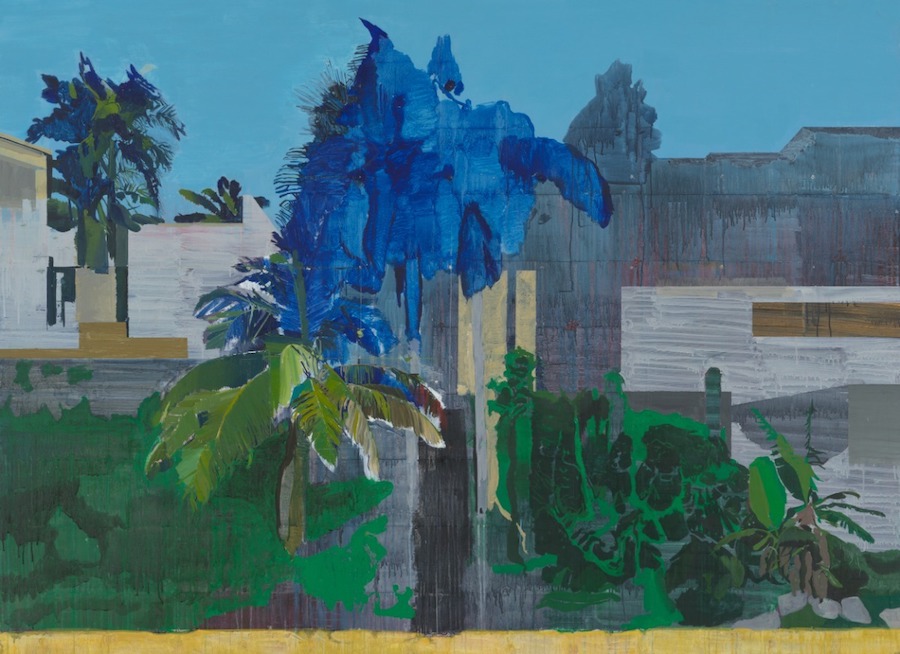
One of the exhibition’s structural hinges comes from his Ball Watching series (1997–2003) — four works that capture a Birmingham park scene but transport it elsewhere, the way memory does when it wants to protect or rearrange something. The original photograph of friends watching a football game becomes a tropical mirage, one location sliding over another. Memory’s unreliability, identity’s tug-of-war: it’s all baked in. Tate is also screening Handsworth Songs outside the show, a deft move that places Anderson’s youth against the hummed tension of 1970s and 80s Birmingham.
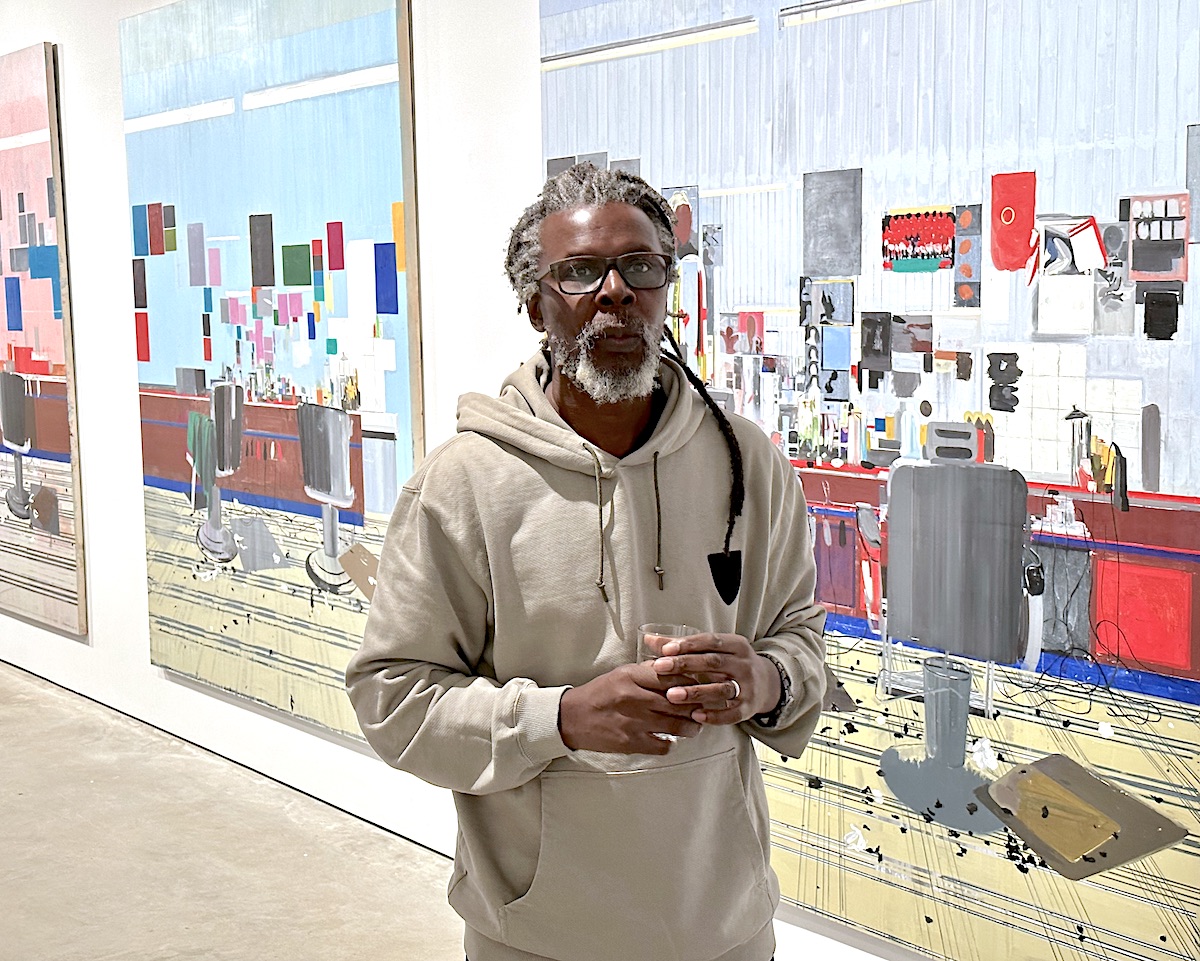
Public spaces — or at least the idea of them — have long been Anderson’s material. The barbershop recurs especially across his career. It’s not nostalgia; it’s history. Caribbean arrivals in the ’50s and ’60s carved out barbershops in their homes, and those rooms became makeshift hubs of work, conversation, and survival. Tate is showing early pieces like Jersey (2008) alongside newer works such as Skiffle and Shear Cut (both 2023), mapping how this space has shifted in his imagination over nearly two decades. From the companion Peter’s series, they’re showing Peter’s Sitters II (2009), an anonymous figure in a chair who feels both grounded and withheld.
One of the major centrepieces, though, is the UK debut of Passenger Opportunity (2024–25). It’s enormous — 24 panels — pulled partly from murals Carl Abrahams painted for Norman Manley International Airport back in 1985. Anderson reworks that imagery into a drifting, complicated chronicle of post-war emigration from Jamaica to Britain. It’s both homage and revision, a kind of historical recalibration that keeps picking at the uneasy ties between the two nations.
His 2002 trip to Trinidad left another mark. Anderson has often said the place made him feel like both an insider and an outsider, and his Welcome series makes that feeling literal. A bar glimpsed through a red security grille becomes emblematic — the viewer is fenced out, physically and emotionally. Country Club: Chicken Wire (2008) pushes the idea further, with the hexagonal mesh becoming a ghost of segregation. Tate is also showing seven of his Caribbean hotel paintings — eerie things, all overgrowth and faded glamour — including Grace Jones (2020) and Ashanti Blood (2021). The abandoned resorts shift from playgrounds for tourists to sites reclaimed by nature, and the mood swings between violence and quiet resignation.
Then there’s Is It OK To Be Black? (2015–16), one of the few works where Anderson lets identifiable figures into the frame: King, Malcolm X, others. He flips the script by positioning the viewer in the sitter’s place, making the question land harder than any title should.
Born in Birmingham in 1965, Anderson now works between Cambridgeshire and London. After studying at Wimbledon School of Art (BA, 1994) and the Royal College of Art (MA, 1998), he steadily carved a distinctive place for himself. He was shortlisted for the Turner Prize in 2017, and his paintings now sit in collections across Europe, the US and the UK. Recent solo shows include Pérez Art Museum Miami (2024), The Hepworth Wakefield and Hastings Contemporary (2023). Group appearances range from The Time is Always Now (NPG London; Philadelphia Museum of Art, 2024–25) to Radical Landscapes (Tate Liverpool, 2022) and Life Between Islands (Tate Britain, 2021). In November 2026, he unveils a new mural for Brixton Underground station, part of TfL’s Art on the Underground — a fitting commission for an artist who has spent decades mapping the visual borders, ruptures and crossings of modern British life.
Top Photo: © P C Robinson Artlyst 2025
Hurvin Anderson 26 March – 23 August 2026 Tate Britain, Millbank, London SW1P 4RG Open daily 10.00–18.00 Tickets at tate.org.uk | +44 (0)20 7887 8888 Free for Members. #HurvinAnderson