
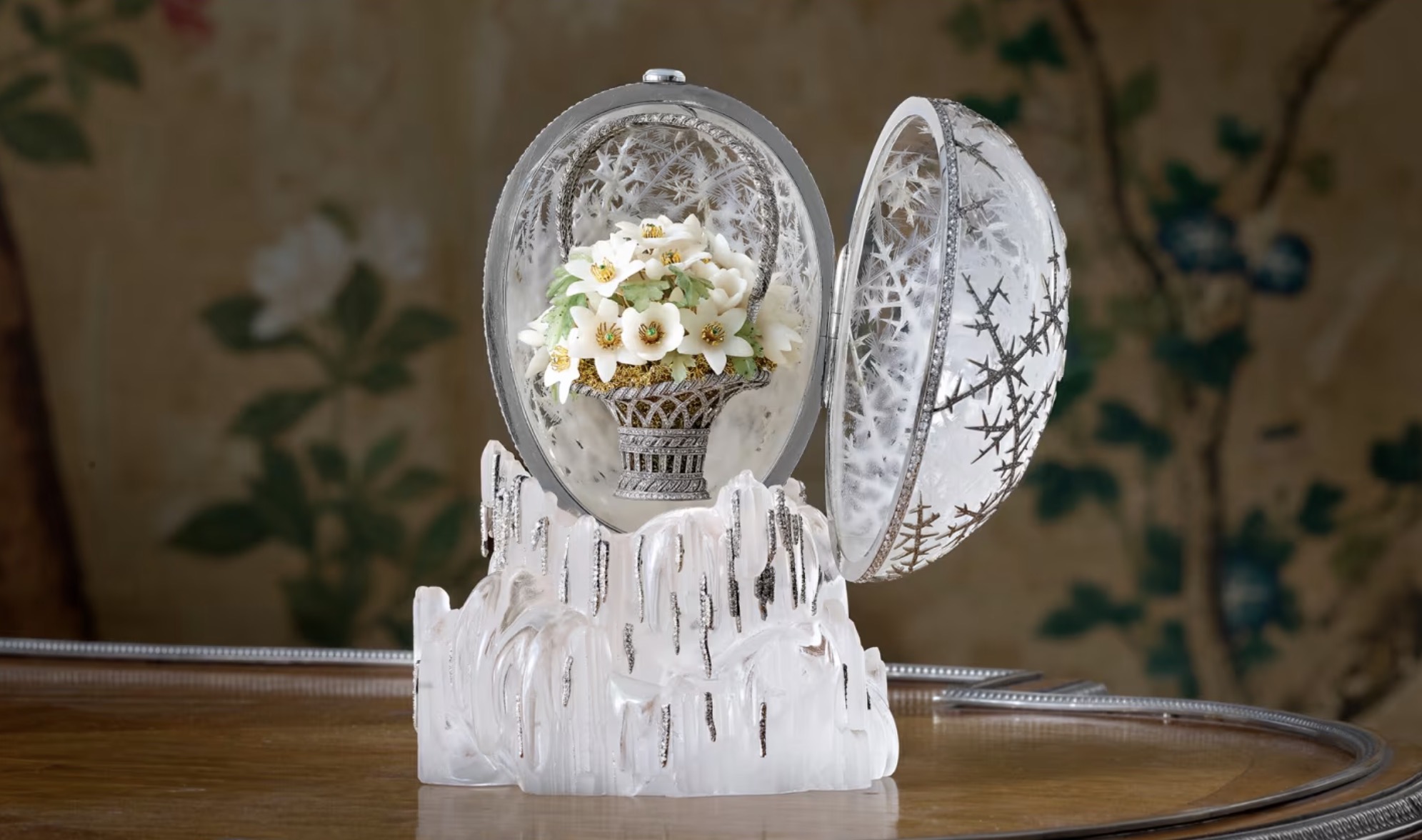
London loves a spectacle, especially when it comes packaged in rock crystal and 4,500 diamonds. On Tuesday evening, Christie’s delivered exactly that — the kind of auction theatre that makes the room hum — when the storied Winter Egg, one of the last Fabergé imperial eggs still adrift in private hands, sold for a staggering £22.9 million. Still, it comfortably smashed the previous Fabergé record (the £8.9m Rothschild egg back in 2007) and reaffirmed the egg’s long habit of breaking records every time it surfaces.
It’s a curious thing, watching a century-old imperial bauble move through modern financial airspace. Commissioned in 1913 by Tsar Nicholas II as an Easter gift for his mother, Dowager Empress Maria Feodorovna, the Winter Egg occupies that seductive nexus where art, craftsmanship, power, and loss all clatter together. Fabergé’s workshop made 50 imperial eggs; only seven are thought to remain in private hands. Of those, almost none appear at auction. Twenty-three years have passed since an imperial egg crossed the block. Rarity alone could have carried this one, but the Winter Egg has a touch of theatre baked into it — ice rendered in hard stone, frost captured in platinum, a kind of frozen gasp from the twilight hours of the Romanov dynasty.
Christie’s Head of Fabergé and Russian Works of Art, Margo Oganesian, looked understandably triumphant. “An exceptional and historic opportunity,” she said, emphasising the work’s “enduring significance” and “brilliance.” And she’s right — even in a room full of people conditioned to keep their cool, the egg radiates a strange presence. It’s both a jewel and an apparition.
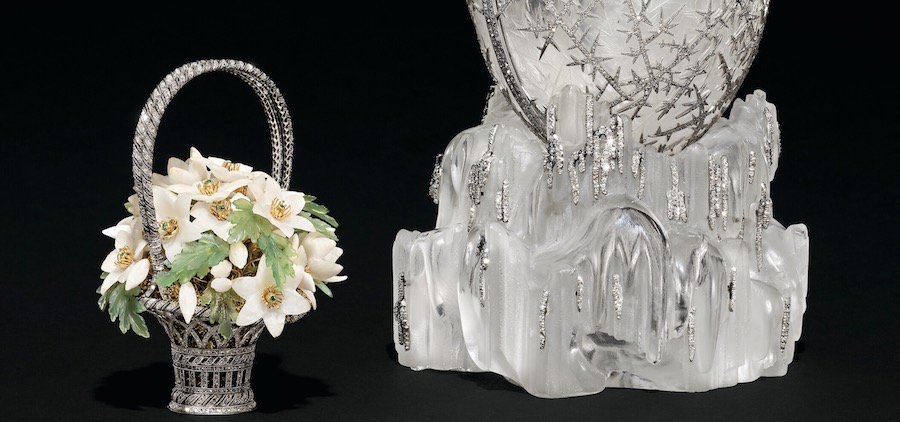
What still startles, though, is how modern it looks. Alma Pihl, the young designer behind it (a rarity herself — women weren’t generally leading Fabergé commissions), supposedly drew inspiration from ice crystals forming on her workshop window. The story has been repeated so many times that it’s become folklore, yet the object feels like a moment of nature captured mid-breath. Rock crystal cut like frozen water; snowflake patterns in platinum; diamonds so small they offer sparkle but no real “value,” at least in the traditional gemstone sense. As Kieran McCarthy of Wartski put it, the artistic alchemy lies in transforming “precious materials into a moment of nature.” Hold it, he said, and it’s “like holding a lump of ice.” Hard to argue.
But the Winter Egg’s path to Christie’s rostrum is far messier than its frost-smooth exterior suggests. When the Russian Revolution slammed shut the imperial world in 1917, the egg — along with countless Romanov treasures — was hauled off to the Kremlin Armoury. Within a few years, the cash-strapped Soviet government began selling off masterpieces for sums so low they now feel absurd. The Winter Egg surfaced in London at Wartski in the 1920s or early ’30s for £450 — the price of a modest car. A British collector bought it in 1934 for £1,500. Then it vanished.
For nearly two decades (1975 to 1994), the egg disappeared entirely. A lost Fabergé doesn’t drift quietly; it haunts. When the Winter Egg went under the hammer at Christie’s Geneva in 1994, it fetched 7.2 million Swiss francs, a record it promptly broke again eight years later in New York when it sold for $9.6 million. Then silence. Fabergé eggs tend to disappear into vaults, private museums, and undisclosed shipping crates. The Winter Egg’s return this week felt like an object surfacing through centuries, not decades.
The egg wasn’t alone at Christie’s, though it certainly overshadowed the broader sale — nearly 50 Fabergé pieces from what the house coyly called a “princely collection.” Jewelled pendants, gold boxes, miniature carvings — a royal’s desk drawer emptied with decorum. A hardstone figurine of a street painter fetched £1.5 million, which on any other night might have been headline material—a rare illustrated book documenting more than 1,000 Fabergé works, valued at over £500,000. Beautiful things, all. But the Winter Egg is different; it carries a gravitational pull, the sense of an era that died twice — once with the Romanovs, and again when their treasures were scattered.
What’s striking is how the Winter Egg still feels contemporary. Not just in design — that crisp, almost proto-modernist clarity — but in the way it echoes the long sweep of displacement and restitution debates still rattling through museum halls today. Here’s an object that moved from palace to armoury, from Soviet storerooms to Western dealers, from one private trove to the next. It’s not stolen, not repatriated, not entirely “lost” — just endlessly uprooted—a relic in permanent migration.
In the catalogue notes, Christie’s reproduces Nicholas II’s original invoice: 24,600 rubles. The third-highest sum Fabergé ever charged the imperial family. Imagine paying that for a gift to your mother, knowing the world around you was already tilting toward catastrophe. The egg is exquisite, yes, but it is also a timestamp.
As for Tuesday’s winning bidder, anonymity reigns. Christie’s kept their promise of discretion; no one in the room would have been surprised. High-profile Fabergé collectors prefer silence to spectacle. Perhaps the egg will vanish again, tucked into a vault somewhere in Zürich or Singapore, or maybe it will resurface sooner than expected — these things develop their own eccentric timelines.
For now, what lingers is the sensation of watching a work of art with so much imperial baggage, so much lore, glide back into the shadows with another record at its heels. Fabergé’s Winter Egg endures because it refuses to stay still. It glitters, then slips away — like frost melting on a windowpane, or history remembering itself just long enough to be sold.
Top Photo: Courtesy Christie’s, The Winter Egg, one of the last Fabergé eggs left in private hands