
The Russian state has deemed Pussy Riot an extremist organisation and banned them, outlawing their activities inside Russia. The decision is no surprise, for years, the band has existed in open conflict with the Kremlin, testing the limits of dissent until those limits were sealed shut. The collective has been arrested several times and has moved outside of Russian jurisdiction.
The ruling follows a September judgment that sentenced all five members in absentia to lengthy prison terms, ranging from eight to 13 years. That earlier case, heard by Moscow’s Basmanny District Court, accused the group of spreading what authorities called false information about the Russian army. None of the women were present. None are likely to return.
By formally designating Pussy Riot as extremist, the state escalates its campaign from punishment to erasure. The ban criminalises association, circulation, and support, recasting a loose, performative art collective as a threat to national security. It is a familiar tactic, sharpened for the current climate: dissent reframed as danger, critique flattened into criminality.
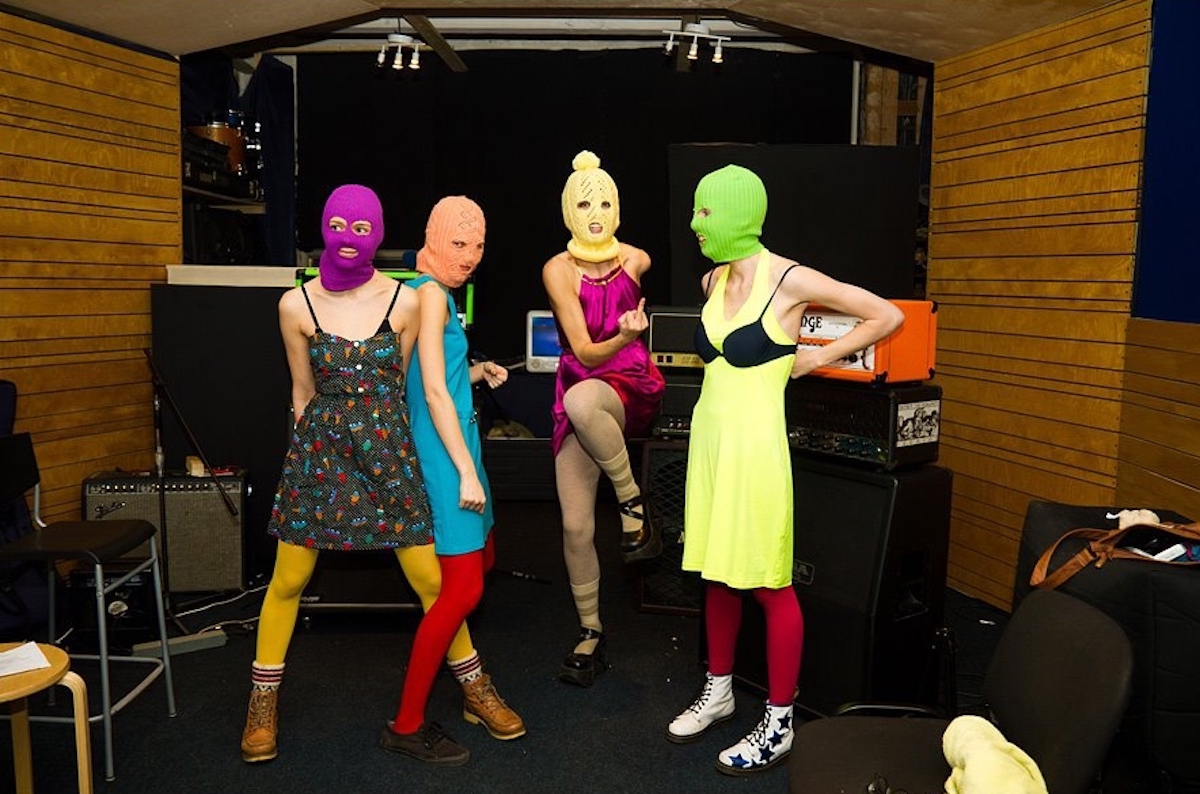
Pussy Riot emerged in Moscow in 2011. The band was confrontational from the outset, using an anonymous, masked, and deliberately chaotic delivery. The collective fused punk music, performance art, and feminist protest into a format designed for maximum friction. Songs were short. Lyrics were blunt. Venues were unauthorised. The point was never polished. The point was presence.
The group grew out of Russia’s underground art scene, shaped by collectives like Voina and informed as much by conceptual art and Situationist tactics as by Punk music. Early performances took place in public spaces — Red Square, subway platforms, rooftops — where brightly coloured balaclavas and shouted slogans disrupted the routines of everyday life. These were not concerts. They were interventions.
International attention arrived in 2012, after members of Pussy Riot staged a performance inside Moscow’s Cathedral of Christ the Saviour. The action, later dubbed a “Punk Prayer,” criticised the close alliance between the Russian Orthodox Church and Vladimir Putin. Three members — Nadezhda Tolokonnikova, Maria Alyokhina, and Yekaterina Samutsevich — were arrested and charged with hooliganism motivated by religious hatred. Their subsequent trial, televised and heavily choreographed by the state, became a global symbol of Russia’s tightening grip on artistic and political expression.
Tolokonnikova and Alyokhina served nearly two years in penal colonies. Samutsevich received a suspended sentence. The punishment did not quiet the group. If anything, it clarified Pussy Riot’s role. After their release, the collective expanded its reach beyond Russia, reframing itself as a mobile platform for activism rather than a fixed lineup. Members changed. Masks remained.
Over the following decade, Pussy Riot operated across borders, collaborating with artists, musicians, and human rights organisations. Their work addressed state violence, gender oppression, prison conditions, and authoritarianism, often through performances that blurred protest and spectacle. Exhibitions, talks, music releases, and street actions became part of the same continuum. Art was not separated from politics; it was the delivery system.
The Russian state, meanwhile, continued to respond with surveillance, arrests, and charges. Members were detained repeatedly. Homes were raided. New laws made dissent easier to prosecute and harder to defend. After Russia’s full-scale invasion of Ukraine in 2022, the consequences escalated sharply. Pussy Riot’s outspoken opposition placed its members firmly beyond the boundaries of tolerable criticism.
Sentenced in absentia in 2024 and now officially banned as an extremist organisation, Pussy Riot occupies a strange space: erased at home, amplified abroad. What began as a flash of colour and noise has hardened into a long-term record of resistance. Whether understood as musicians, artists, or activists, Pussy Riot’s significance lies less in any single action than in their refusal to separate creativity from consequence.
Photo: Denis Bochkarev, Courtesy Wikimedia