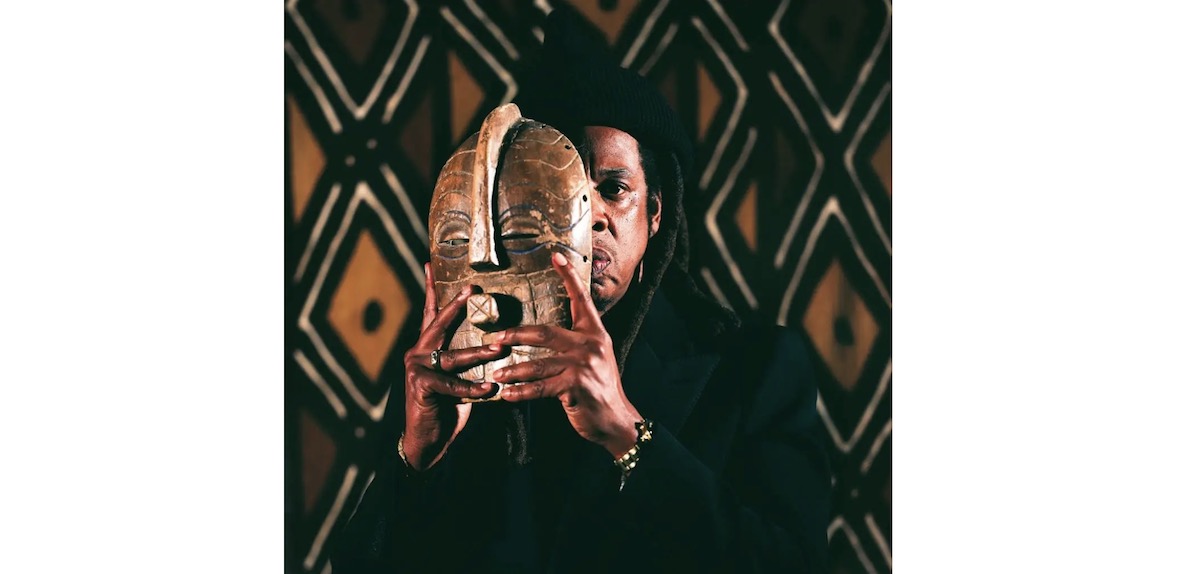
GQ, under new editor Adam Baidawi, has announced its first major global special issue, featuring Jay-Z, who is now styling his name JAŸ-Z in honour of the 30th anniversary of his 1996 debut album, Reasonable Doubt. For the cover, they hired the brilliant artist Rashid Johnson.
Johnson is one of the most significant American artists working today, a Chicago-born, multidisciplinary practitioner whose paintings, sculptures, installations and photographs have spent the better part of two decades interrogating Black identity, cultural history, collective anxiety, and the complex textures of what it means to be a Black man in America. His work resists the kind of monolithic readings that the culture industry tends to reach when it wants something legible and comfortable. In that sense, the pairing with Jay-Z is not just visually interesting. It’s conceptually coherent.
Jay-Z has never been a straightforward figure either. Thirty years on from Reasonable Doubt, a debut album so assured it sounded like the work of someone who had already been doing this for a decade, he remains genuinely hard to pin down. The music, the business, the art collecting, the public persona, and the deliberate opacity around certain aspects of his life. He has spent his career making it difficult for anyone to reduce him to a single thing, which is exactly what Johnson’s work does too.
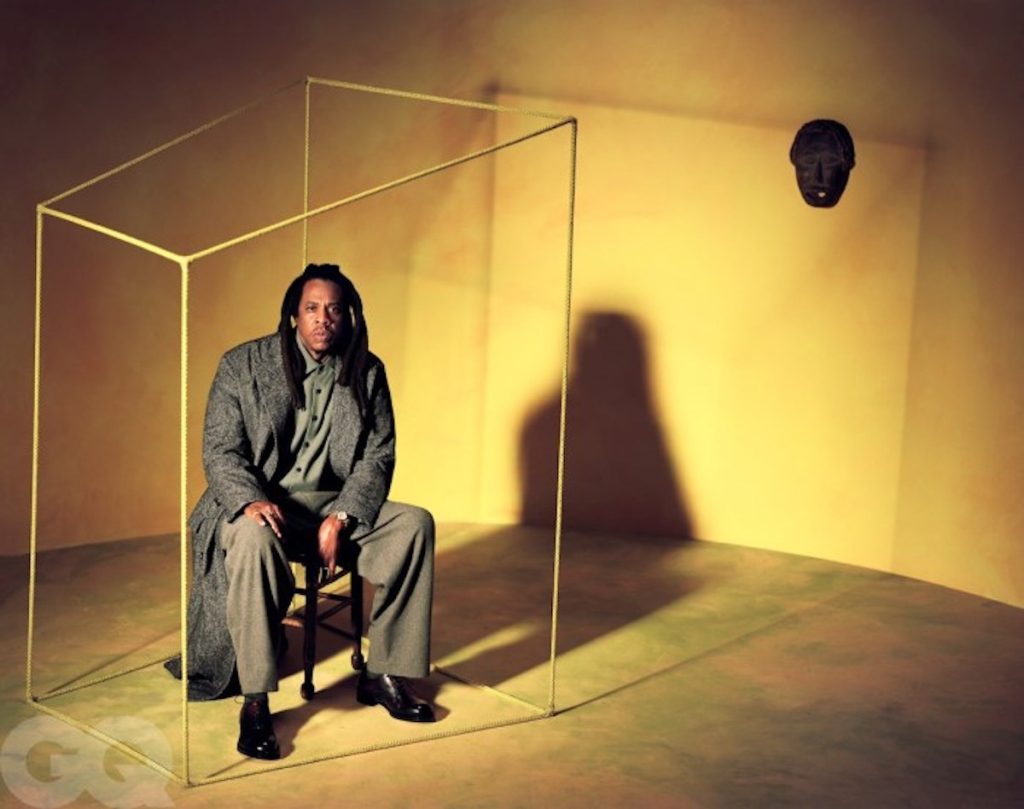
Jay-Z, photographed by RASHID JOHNSON/GQ © RASHID JOHNSON/GQ
For the shoot, Johnson told GQ he drew on two reference points that are, on the surface, unlikely companions: James Van Der Zee, the great Harlem Renaissance photographer who documented Black life, aspiration and dignity in portraits of extraordinary formal beauty, and Francis Bacon, whose raw, destabilising paintings of the human figure are about as far from Van Der Zee’s aesthetic as it’s possible to get. That Johnson held both in mind simultaneously is entirely characteristic of how he works the collision of references, the refusal of a single register. “Jay’s music, lyricism, and sophistication are very much in line with a lot of interesting and historically important Black thinkers,” he told the magazine, citing Harold Cruse, W. E. B. Du Bois and Michael Eric Dyson. Which is a serious claim, delivered without apology.
The art-world connection isn’t new to Jay-Z. He has been seriously engaged with contemporary art for over a decade, and his engagements have been anything but superficial. The 2013 music video for Picasso Baby, performed live at Pace Gallery and deliberately echoing Marina Abramović’s The Artist Is Present, was one of those cultural moments that confused people in interesting ways. Was it art? Was it marketing? Was it a sincere engagement with the questions performance art asks about presence, endurance and the relationship between artist and audience? Possibly all three, and the ambiguity was the point.
The 2018 Apeshit video, shot at the Louvre with Beyoncé, placed the pair against works from the museum’s permanent collection, the Winged Victory, the Mona Lisa, and David’s The Coronation of Napoleon, in a sequence that was simultaneously a celebration of that collection, a provocation about who those spaces are for, and a genuinely spectacular piece of image-making. Whatever you made of it, it was doing more than one thing at once.
In 2023, Roc Nation partnered with the Brooklyn Public Library on The Book of Hov. This career-spanning exhibition included a sculpture by Daniel Arsham, Hov’s Hands, a cast of Jay-Z’s arms making his signature diamond hand sign. It was curated with assistance from Jeanne Greenberg Rohatyn, his art dealer. He appears on the ARTnews Top 200 Collectors list. He owns several works by Johnson.
Johnson, meanwhile, has been having the kind of sustained institutional moment that confirms rather than creates a reputation. His survey, A Poem for Deep Thinkers, opened at the Guggenheim in New York last April, a significant show in a significant space and has since travelled to the Modern Art Museum of Fort Worth. Before that, shows at the Moderna Museet in Stockholm, the Metropolitan Opera, Storm King, the National Gallery of Canada, and the ICA in Richmond. The range reflects both the ambition of the work and the breadth of its appeal across institutional contexts. Johnson is one of those artists whose practice generates enough conceptual density to sustain serious critical engagement while also communicating something immediate and felt to a wider audience.
He received his BA in Photography from Columbia College Chicago and his MFA from the School of the Art Institute of Chicago. The photography training shows in the precision with which his images are constructed, even as the work has expanded across sculpture, painting, drawing, film, and installation. The materials he uses — shea butter, black soap, mirrors, plants, books, bronze — are chosen for their biographical and cultural resonance. They carry history. The work is both personal and collective.
The GQ cover is, in one sense, a magazine commission. In another, it’s two people who have spent their careers not easily categorised, finding a formal reason to be in the same room. Van Der Zee and Francis Bacon as joint reference points for a portrait of one of the most scrutinised men in American cultural life, made by one of the most thoughtful artists currently working.