Last week, the spoiler-prone Reuters news agency claimed to have identified Banksy — But Does It Matter? One of the art world’s most enduring mysteries has been the subject of endless speculation for years, the latest claims to have identified the man behind the Banksy persona. The news agency has named him directly, but in this summary Artlyst has not… and, for reasons that will become clear, neither will we. What the investigation has done is assemble a body of circumstantial evidence that, taken together, is more compelling than anything that has come before.
The starting point was Ukraine. In late 2022, an ambulance pulled up to a bombed-out apartment building in Horenka, a village outside Kyiv, less than eight kilometres from Bucha, where Russian forces had left at least 300 civilians dead seven months earlier. Three people got out. Two were masked. The third Giles Duley, a documentary photographer who lost an arm and both legs to a landmine in Afghanistan in 2011, was not.
Cardboard stencils came out of the ambulance. Spray cans followed. Within minutes, a bearded man in a bathtub appeared on what had been an interior wall before the Russians destroyed the building. Banksy confirmed the Ukraine murals on Instagram shortly after. The footage he posted showed a painter in a grey hoodie, filmed from behind, face hidden.
Reuters reporters went to Horenka. They brought a photo lineup of artists long rumoured to be Banksy and showed them to locals. One resident, Tetiana Reznychenko, had made coffee for the two men who painted the bathtub mural and had seen them without their masks. She shook her head at most of the lineup. Then her eyes widened at a photo of Robert Del Naja, frontman of Massive Attack and a Bristol graffiti pioneer known as 3D. She denied recognising him, but the reaction was noted.
Del Naja has been one of the more persistent Banksy rumours for years. A Scottish writer identified in 2016 that several Banksy street pieces had appeared in cities around the same time Massive Attack performed there. Del Naja’s connection to Duley runs deeper still. Duley’s photography has served as backdrop visuals at Massive Attack concerts. And Reuters, citing sources familiar with Ukrainian immigration records, confirmed that Del Naja and Duley entered Ukraine together on 28 October 2022, crossing the border from Poland shortly before the Banksy murals began appearing.
But here is where the investigation takes a turn. On the same day, at the same border crossing, another individual entered Ukraine. The passport listed a common English name, one of the most common in Britain, shared with a certain rock star whose alter ego inspired a Banksy portrait of the Queen. The date of birth on that passport matched that of the man Reuters believes to be Banksy. He left Ukraine in November 2022. Del Naja and Duley’s presence may have been cover or company. Del Naja is, according to Reuters, not Banksy, but he is a graffiti artist and friend of the man who is, and has been, his secret painting partner on at least one occasion.
Other evidence accumulated over the years points in the same direction. A graffiti arrest in New York in September 2000, in which a man was caught defacing a billboard on the roof of 675 Hudson Street, with damage serious enough for police to seek felony charges, produced a confession and a name. It appears in court and police documents. It is the same name Reuters connects to Banksy. A 2004 encounter with Jamaican photographer Peter Dean Rickards yielded 21 photographs of Banksy at work, 14 of which showed his face. Those images, cross-referenced with the New York arrest records and with a 2008 Mail on Sunday investigation that had come close but hedged its conclusions, form the core of Reuters’ case.
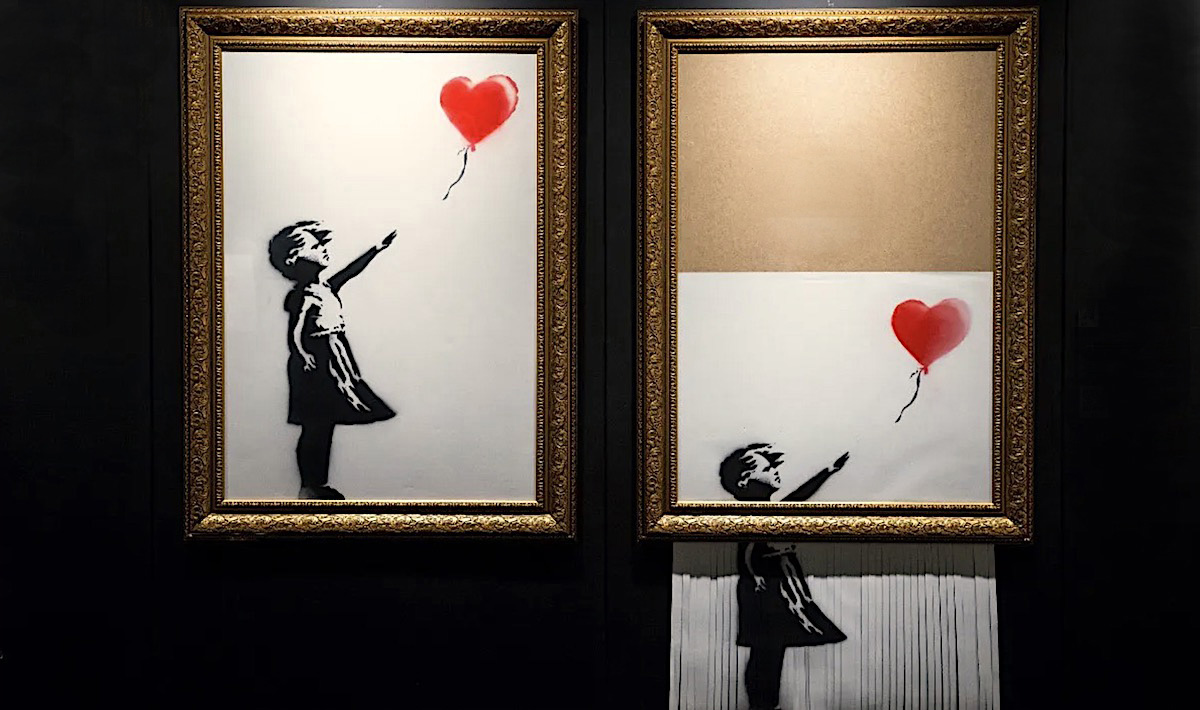
And then there is the Sotheby’s moment. The 2018 auction of Girl with Balloon, at which a shredder hidden inside the frame activated the instant the hammer fell, reducing a $1.4 million painting to a half-destroyed artwork that would later sell for $25 million under the name Love is in the Bin. An art dealer present that day noticed an eccentric figure nearby, wearing a broad-necked scarf and thick glasses that appeared to have a small camera built into the bridge. The man wasn’t watching the painting being shredded. He was watching the crowd. Having since seen the photographs Reuters located, the dealer is “pretty sure” it was the same person. “I don’t want to be the guy who exposes Banksy,” he said.
That sentiment is widely shared. Banksy’s inner circle holds. NDAs have been signed. Others stay quiet out of loyalty, or something closer to fear of the artist, of his fans, of Pest Control, the company that authenticates his work and controls access to it.
The mystique, for now, remains intact. Just slightly less so than yesterday.
Banksy has built anonymity into his work. The whole project, the unauthorised placement, the self-disappearing act, the refusal of the gallery system’s demand for a named, marketable, interviewable personality, depends on the absence of a fixed identity. Revealing the name doesn’t add anything to Girl with Balloon or the Walled Off Hotel, or the shredded canvas moment at Sotheby’s. If anything, it punctures something. The mystique is load-bearing.
Authorship matters legally. Banksy’s anonymity creates genuine problems around copyright, authentication, and estate planning that will eventually need to be resolved. Works have been challenged, fakes have circulated, and the question of who legally owns the rights to this body of work is not academic; it’s worth hundreds of millions of pounds.
Anonymity is also, at this point, a performance. Banksy is one of the most commercially successful artists alive. The work sells through Pest Control, his authentication body. There are books, films, and major institutional exhibitions. The “outsider” status is carefully managed from the inside. Knowing who is doing that, managing who benefits, and who controls the narrative is a reasonable journalistic and cultural question.
There’s also an accountability dimension. The work makes pointed political and ethical arguments. When an anonymous figure of enormous cultural influence makes those arguments, the question of who is speaking, from what position, with what resources and relationships, isn’t irrelevant. We ask it of everyone else.
The identity, when it finally becomes public and no longer a guarded secret, will likely be deflating, as these things tend to be. But the reveal itself will be an art piece in its own right. It will tell us something about what we needed the myth to be, and why. By the way, this is nothing new; it was all revealed by Claudia Joseph in the Mail on Sunday (not that we read this publication) in 2008.